Adobe Commerce B2B Features: What Magento Gives You Natively, and Where Custom Work Starts

Category
eCommerce Niches

Did the idea of starting an online store without inventory ever get stuck in your mind? Many aspiring entrepreneurs and business owners like you have this question, and at the same time, they think owning stocks and handling logistics are the primary methods to grow online. Why? Because they have seen various eCommerce businesses around them succeed using this method only.
However, what if we say you can even start an online store and grow well without inventory?
In fact, you don’t need an inventory, a warehouse, or logistics to deliver your products to the users. You can sell them online without inventory, giving you abundant time to focus on other things like promoting, marketing, and growing sales. In short, you require two most essential skills: building your store and selling your products quickly.
Now, if you are curious to get an answer to the question of how to start an online store without inventory, you are at the right place. Here, we will share the best ways to start an online store without inventory.
So, let’s get the ball rolling.
1. Dropshipping

Source: WithinTheFlow
Dropshipping is a low-risk business model that enables you to sell products to your target audience without holding your own inventory. Typically, you partner with dropshipping suppliers or manufacturers who store, package, and ship products directly to your customers.
For instance, if you have an online office decor store, you can partner with suppliers offering items like files, folders, printer paper, and staplers. When a customer places an order, the supplier ships the product directly to them. If you negotiate private labeling, the products may feature your branding, but this often requires additional agreements and costs. To explore what kinds of products are commonly suitable for private labeling, you can refer to this list of private label products.
Dropshipping offers numerous benefits for small businesses and entrepreneurs, so let’s look at them briefly.
- Low startup costs as you don’t need to purchase inventory upfront or manage warehousing. However, startup expenses like setting up your online store, marketing, and sourcing reliable suppliers still apply.
- Flexibility to test and sell various products on your online store without any commitment to bulk purchases. This allows you to explore profitable niches and expand market reach.
- As you don’t have to invest time in the physical inventory, scaling your business becomes easy.
- Logistics, including packaging, shipping, and delivery, are handled by the supplier, allowing you to focus on marketing and growing your business.
Along with its benefits, dropshipping comes with challenges. These include limited control over packaging and branding unless you opt for private labeling, dependency on suppliers for inventory availability, and potential delays in shipping times. These operational hurdles are part of the broader issues many online sellers face, which makes it important to be aware of common eCommerce challenges and how to handle them as your business grows.
Additionally, competition is high, and profit margins are often slim, making it crucial to choose the right products and suppliers carefully. One effective way to address the profitability concern is by focusing on high-ticket dropshipping products, which typically offer better margins.
Despite these drawbacks, the dropshipping market is growing at a never-before rate. According to the research, the global dropshipping market is anticipated to grow at a CAGR of 22% from 2025 to 2030 and projected to reach 1253.79 billion by 2030. Despite its challenges, dropshipping remains a popular way for entrepreneurs to start an online business due to its scalability and low entry barriers.
If you are using Shopify, understanding the right setup process can make a significant difference in your success. This step-by-step guide to dropshipping on Shopify covers everything from choosing products to integrating apps and managing orders efficiently.
Launch Your Dropshipping Store Hassle-Free!
Simplify your dropshipping journey with expert eCommerce solutions. We provide everything you need to succeed, from store setup to seamless integrations.
Contact Us2. Print On Demand Products
Print-on-demand is an eCommerce business model in which you can set up a store and sell items to the customers only after the order is placed without making any upfront investment and inventory storage.
As soon as someone places an order from your print-on-demand store, you forward the order to the printing business, which looks after the printing and shipping of the product.
There are a vast number of products that you can sell using this approach, such as t-shirts, mugs, phone cases, and more.
The print-on-demand method brings with it some significant advantages as follows:
- Option to sell customized products that align well with your audience and represent your brand.
- Like dropshipping, Print-on-Demand doesn’t ask you for inventory or any investment initially, thus saving you time and money.
- Streamlined production process because the supplier looks after manufacturing, printing, packaging, and shipping, thus allowing you to focus on creating unique designs and marketing.
- Ability to test new designs without the need to make a massive investment.
- Low financial risk because you need to pay for the designs or products after a customer places an order.
However, just like any other business, this also has its own set of drawbacks. These include low profit margins, limited customer data, high production costs, and slow delivery.
Even though it has challenges, print-on-demand is a great option for expert graphic designers or creative entrepreneurs to sell products online without an inventory.
Create a Print-On-Demand Store Effortlessly!
Turn your designs into profit with a professional print-on-demand store. Let us handle the technical details while you focus on creativity.
Get a Free Consultation3. Digital Products and Services
Digital goods and services are a new movement in eCommerce that helps small business owners develop successful businesses in the digital environment rather than the burden of physical inventory.
From eBooks to online courses to digital downloads and subscriptions, the list of the digital marketplace is limitless. For example, online educational courses allow learners to acquire new skills and knowledge in a way that is accessible and flexible. The subjects covered may be business, technology, and arts and crafts.
Other digital products that can be sold online include:
- Digital artwork and graphic design assets
- Music and audio files
- Video tutorials and online workshops
- Software and apps
- Templates and presentations
The advantages of selling digital products online include:
- No storage or inventory is needed because products/ services are provided online.
- High scalability because there is no limit on the number of times you can sell the same product/service.
- Because there are no costs involved in manufacturing and shipping, digital products have a high-profit margin compared to physical ones.
- Digital products/services can be offered to users worldwide without any geographical constraints.
- This approach allows you to create unique products and work whenever you want.
If you are trying to be successful in a challenging environment, it is crucial to pick a niche that is in line with your interests, expertise, and audience. For instance, if you have hands-on experience in fitness and wellness, consider producing and marketing custom-made workout guides and diet plans for particular target groups or purposes.
By defining a niche market, you can stand out as an authority in the market and count loyal customers eager to keep investing in your valuable digital offerings.
4. Fulfillment by Amazon
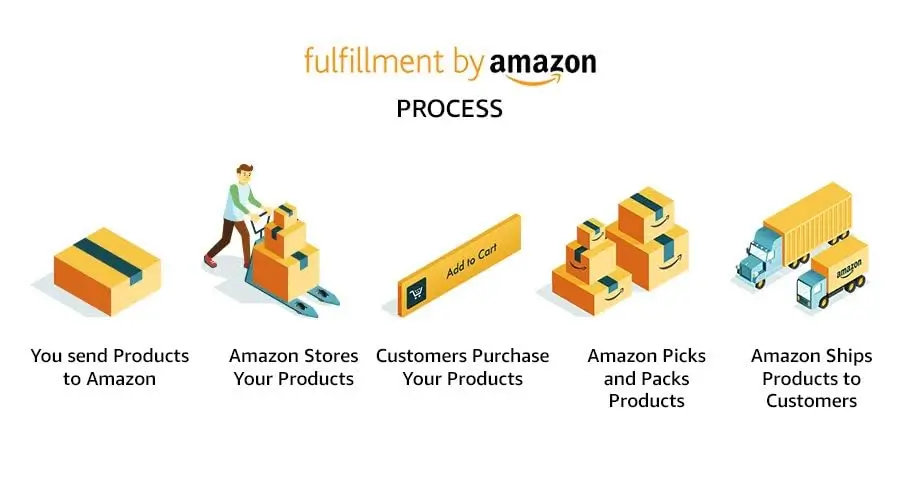
Source: Amazon
If you are wondering how to sell on Amazon without buying products, welcome to Fulfillment by Amazon (FBA). FBA gives entrepreneurs the power to sell items on Amazon without storing their product inventory. It will enable sellers to take advantage of Amazon’s huge network of fulfillment centers, where orders are shipped, packed, and stored straight to consumers.
This eliminates the logistic concerns of managing inventory. Through FBA, sellers could divert their attention to business growth and increase their product offerings, while Amazon will do complex things like order fulfillment and customer service.
Fulfillment by Amazon brings significant advantages for entrepreneurs and business owners. Let’s look at them in brief:
- Sellers don’t have to invest considerable amounts in storing and shipping.
- Based on the total amount of items, FBA expands with your business.
- Amazon takes your stress of storage, managing, and shipping products, thus simplifying your logistics.
- Prime shipping eligibility makes your products more appealing to Amazon Prime users. Hence, you can provide quick delivery of your products.
- FBA products usually rank higher in the popular search engines, thus ultimately improving your visibility.
These benefits make FBA an excellent option for entrepreneurs who want to streamline operations and invest more time in expanding their business.
Along with the advantages, FBA has several drawbacks, such as an upfront fee and platform commission, which might not be suitable for many businesses. Secondly, limited control as you need to abide by the rules of the third-party fulfillment provider – Amazon.
Say, for example, if you are a craft candle maker aiming to sell your candles on Amazon. Entering the Amazon platform through Fulfillment by Amazon (FBA) lets you list your candles without dealing with inventory or shipping logistics.
Becoming one of the FBA entrepreneurs will require you to establish an Amazon seller’s account and enroll in the FBA program. From there, you can easily navigate to the seller’s dashboard, where you will upload your inventory and product listings. So when someone orders, Amazon picks, packs, and ships it on your behalf. You will also benefit from access to knowledge and analytics that will allow you to check your sales report and develop your eCommerce business strategies accordingly.
5. Using Third-Party Logistics Company
Utilizing a 3rd party logistics (3PL) company is a good option for enterprising people seeking to simplify shipping and fulfillment processes without handling inventory.
Using a 3PL provider to manage logistics operations might benefit enterprises by providing experienced personnel to manage warehousing, inventory, and order fulfillment processes. Therefore, sellers do not have to deal with order processing, warehousing, or logistics but can rather focus on marketing and product development as the tasks are taken care of by the 3PL provider.
Some of the key advantages of using a 3PL company include
- Streamline your various operations, such as inventory, warehousing, and order fulfillment.
- Ability to scale the business without worrying about logistical constraints.
- Utilize the expertise and modern infrastructure of the 3PL to simplify your daily operations.
- Their bulk handling ability saves a massive amount of money on warehousing, staff, and shipping.
However, the 3PL has its drawbacks, such as limited control over management and shipping, high reliance on third-party providers for operations, and high costs on packing, shipping, and storage, which affect profits.
For instance, an example of a 3PL service provider is ShipBob. ShipBob provides a comprehensive fulfillment solution, including warehousing, picking and packing, and shipping logistics. With the help of ShipBob, companies can now use the network of fulfillment centers all over the U.S. that ShipBob has to offer to optimize the shipping time and cost as long as they benefit from some advanced inventory management tools and real-time order tracking features.
6. Affiliate Store
Entrepreneurs can earn income through an affiliate store, whereby they market and sell products from other sellers and receive commissions. For an affiliate storefront, sellers can offer a curated range of goods from diverse brands and stores. The seller gets an affirmation payment for every transaction set through the commission induced on each sale.
This business model eliminates the need to keep inventory lists, fill customer orders, and provide customer care services, allowing entrepreneurs to concentrate on their website’s traffic and conversion only.
These are ample benefits to running an affiliate store:
- Earn commission for every sale made from your store via referral links, thus helping you establish a passive income source and generate revenue with minimal effort.
- It doesn’t require any high investment in inventory, storage, or product development, thus making it ideal for new-age entrepreneurs.
- With no need to worry about inventory and fulfillment, this approach lets you focus on product promotion and marketing.
- Gives the flexibility to include products from multiple vendors and even scale operations anytime without making many changes in the store.
Apart from the advantages, affiliate stores have some drawbacks, such as high competition, difficulty generating consistent income, and heavy reliance on external merchants.
By collaborating with credible and successful affiliate marketing platforms and being able to market the products to their targeted audience, they can earn good profits with reduced initial costs.
Final Words
In summary, there are several creative ways to start online stores without inventory management, which was traditionally used. Entrepreneurs can look into many different channels using dropshipping and print-on-demand services incorporating affiliate marketing, third-party logistics, and a lot more.
These strategies provide flexibility, scalability, and a way to earn passive income relatively, so they appeal to new business owners who want to enter the active eCommerce interface.
If you are just starting to create an online presence and develop your business, keep in mind that you do not have to do it all by yourself, and there will be no need to reinvent the wheel. At WebDesk Solution, we’re committed to offering comprehensive eCommerce development services, providing a complete solution for establishing and managing your online store. Trust us to deliver a seamless online experience that drives sales and boosts your online presence.
Frequently Asked Questions
You can sell products on Amazon without inventory by using fulfillment services, such as Fulfillment by Amazon (FBA). With FBA, Amazon does all the work of storing, packing, and shipping your products to customers, freeing you from dealing with warehouse logistics and allowing you to focus instead on sales.
Using dropshipping, a retail fulfillment technique, the seller does not own inventory for the products they sell. Rather, when a store sells anything, it buys it directly from a third party and ships it straight to the buyer.
Yes, various models, such as dropshipping and print-on-demand, require some upfront costs. You only need to pay for the product after the customer orders from the store. Besides this, you might need to invest in domain name, hosting, and store marketing.
Absolutely, you can scale the store without inventory. Indeed, dropshipping is a business model that doesn’t need any inventory. You can look after marketing, expanding your store, and optimizing on the go.