


Overview
WebDesk Solution designed and developed Intelcom’s Shopify public app to connect the carrier’s logistics systems with Shopify merchants across Canada. The app included merchant onboarding, real-time shipment eligibility checks, bulk booking and label generation, order splitting, and tracking visibility within Shopify. This gave Intelcom a scalable way to onboard merchants, automate shipping workflows, and improve shipment monitoring for high-volume eCommerce operations.
With over 35 years of deep operational experience, Intelcom stands tall as one of Canada’s most trusted parcel delivery networks. Handling over 400,000 parcels daily, they are not just a logistics service provider but an integral part of Canada’s last-mile delivery infrastructure-especially as a delivery partner to eCommerce titans like Amazon. Through its fleet of 425+ independent delivery partners, Intelcom offers nationwide delivery capabilities, even to the most remote destinations.
However, with eCommerce merchants increasingly demanding seamless carrier integrations within their storefronts, Intelcom saw a gap: a lack of real-time, scalable tools to connect directly with Shopify merchants. They aimed to develop a Shopify Public App to extend their reach to thousands of businesses while simplifying onboarding, order processing, and shipment tracking. But such a platform would need to be both technically sound and operationally robust. That’s when they brought in WebDesk Solution.
WebDesk Solution was engaged to architect and develop Intelcom’s Shopify public app, including API integration, merchant onboarding flows, order-processing logic, and shipment tracking within Shopify.

Approach
When Intelcom’s senior team, Mathieu and David, initiated discussions with Shopify, they were immediately directed to WebDesk Solution-Shopify’s Certified App Development Partner. Their requirement was crystal clear: a public-facing Shopify app that would connect Intelcom’s logistics engine with Shopify’s merchant base across Canada. But the complexity lay in the details-managing eligibility checks, handling bulk orders, implementing tracking systems, and automating merchant onboarding within Shopify’s technical ecosystem.
Led by Daniel from WebDesk Solution, we initiated a comprehensive discovery phase. We dissected Intelcom’s internal Express API, compared it against Shopify’s app architecture, and explored scalable infrastructure options like AWS and Azure. After thorough deliberation, Intelcom chose Amazon Web Services (AWS) with a Serverless Lambda architecture, optimizing for elasticity and fault tolerance. The engagement covered discovery, proof-of-concept validation, Shopify app architecture, and custom development across React, Node.js, and AWS.
Over several weeks, we executed a working Proof of Concept (POC) to validate feasibility. With successful tests in merchant order sync, booking flows, and label generation, the POC was approved. We then transitioned into full-cycle agile development, integrating high-performance logic and creating a secure, merchant-friendly experience.
What technical and operational challenges did Intelcom need to solve in its Shopify public app?
API-Driven Order Eligibility Filtering With Real-Time Logic
One of the key issues Intelcom faced was how to ensure that only eligible orders, based on geographical serviceability, could be processed for shipping. Not every postal code in North America is serviceable by Intelcom. The system had to be intelligent enough to automatically extract postal codes from orders, call Intelcom’s Label Print API in real time, and determine eligibility without human input. Any failure in this logic would result in shipping delays, customer complaints, and ultimately, merchant dissatisfaction. Achieving real-time, high-volume filtering while syncing directly with Shopify’s backend posed both performance and architectural challenges.
Merchant Onboarding That Required Negotiation and Secure Credential Mapping
Unlike plug-and-play carrier apps, Intelcom required every merchant to secure personalized API credentials after one-on-one negotiations. This included the issuance of a unique API key and client code per merchant. The problem was twofold: how to scale this onboarding process to accommodate thousands of merchants and how to securely store and integrate each merchant’s credentials into the app backend-ensuring that authentication, key storage, and API calls were all done in a secure and scalable manner. Any manual misstep could compromise security or create onboarding delays.
Bulk Order Processing, Tracking, and Label Generation
Shopify merchants often fulfill dozens or even hundreds of orders per day. Intelcom’s system needed to support bulk processing logic, allowing users to select multiple orders, retrieve booking and tracking data, and automatically generate shipping labels-then compile them into one downloadable PDF. This required designing a queue-based architecture, ensuring proper asynchronous calls to Intelcom’s APIs, and generating multi-label PDFs without performance lag. Moreover, seamless visibility into all tracking data within Shopify’s admin panel was essential to retain usability for merchants.
Accurate Order Splitting Based on Product Origin and Pickup Locations
A major complexity was Intelcom’s need to split orders at the line-item level. A single order might include items from multiple fulfillment centers, each requiring different pickup arrangements. The system had to intelligently analyze product-level data, match it to pickup zones, and create multiple bookings-all while maintaining a unified Shopify Master Order ID for support and analytics. Any misalignment between booking data and the original order could result in tracking breakdowns and customer service issues.
Lack of Visual Tracking in Shopify Required a Real-Time Infographic System
Shopify’s default order tracking is basic-it doesn’t reflect detailed logistics events such as warehouse scanning, sorting facility departure, or delivery attempts. Intelcom needed a visual timeline system to depict each stage of delivery, giving merchants a comprehensive snapshot of their shipment journey. This system had to consume data from Intelcom’s tracking APIs and display it in a user-friendly, real-time interface embedded within Shopify’s admin UI. Developing such a tracking layer without slowing down performance required frontend and API optimization.
Key Metrics




How did WebDesk Solution solve onboarding, shipping logic, and tracking in Intelcom’s Shopify app?
Smart Postal Code Validation and Real-Time Order Sync Logic
We developed a backend module that synced Shopify orders using webhooks and API polling. For each new order, the module extracted the shipping address and sent a Label Print API request to Intelcom. The API responded with an eligibility status, which we used to categorize the order. Eligible orders were displayed in one tab, while non-eligible orders were listed separately. This real-time verification engine ensured that only serviceable orders were processed. Additionally, it enabled merchants to focus on fulfillment-ready shipments, reducing manual filtering and operational inefficiencies.

Seamless Merchant Onboarding With One-Click Credential Integration
To overcome the manual onboarding hurdle, we designed a merchant registration wizard inside the app. When a merchant initiated registration, the app automatically triggered Intelcom’s onboarding workflow, requesting and receiving their API key and client code. These credentials were securely encrypted and stored in the app’s backend, using tokenized access management. This eliminated the need for merchants to handle any raw API keys, while providing them with instant access to Intelcom’s services once approved. This solution dramatically reduced onboarding friction and ensured secure, scalable access management. This work combined custom Shopify app development with secure credential integration and onboarding workflow automation.

Automated Bulk Order Processing and Consolidated PDF Label Generation
Merchants could now select any number of eligible orders in their dashboard and trigger a bulk booking request through Intelcom’s API. Each successful booking returned tracking data and label files, which were compiled into a single PDF document for download. The logic was optimized to support thousands of bookings per batch with fail-safe retry mechanisms. This functionality not only enhanced productivity but also reduced human errors in manual label generation and enabled daily batch shipments to go out with confidence and speed.
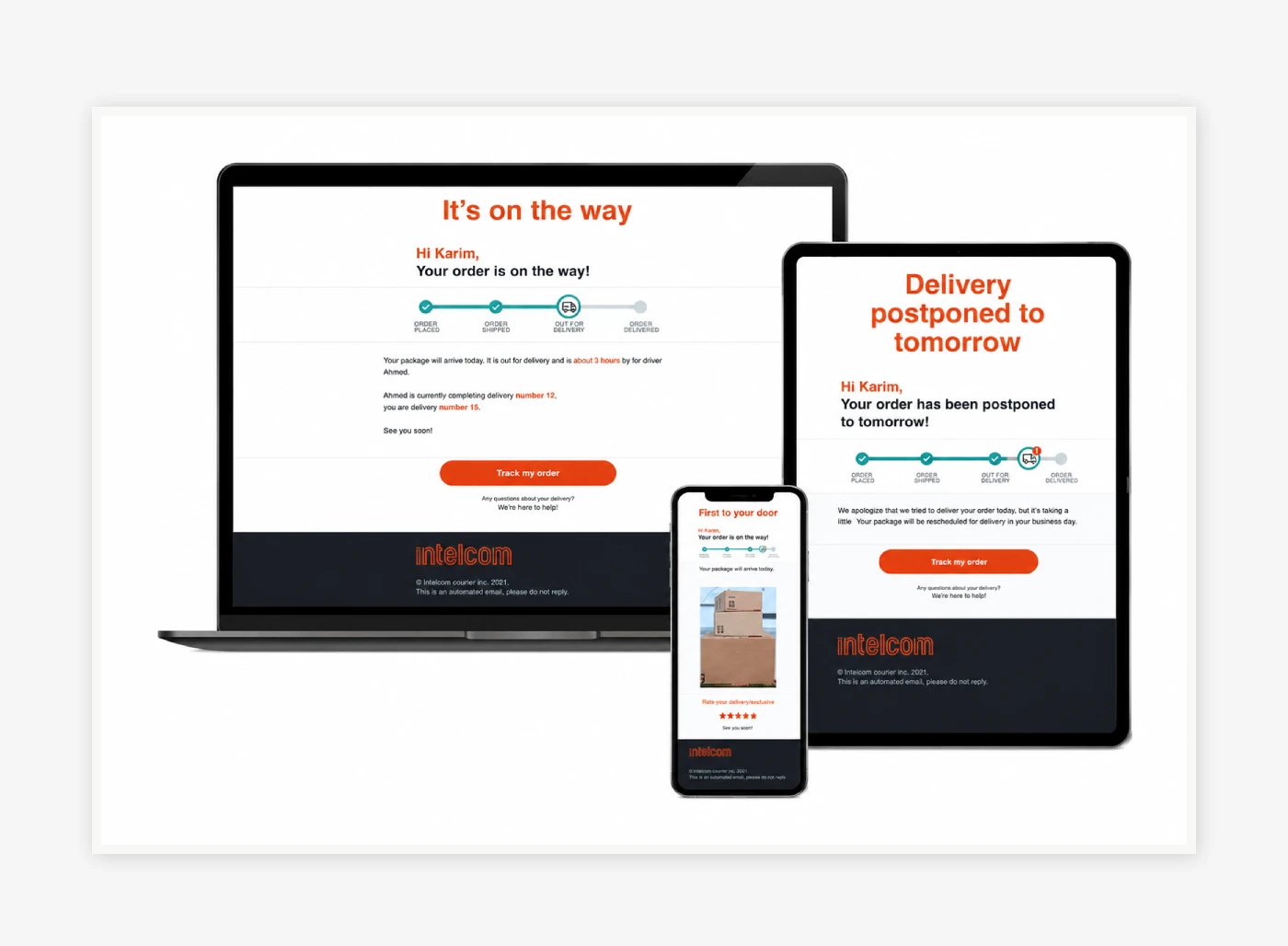
Origin-Aware Order Splitting With Unified Master ID Tracking
To handle line-item-based routing, our app automatically evaluated the origin warehouse for each SKU in an order. If an order included products from different locations, it was split into virtual sub-orders for pickup and booking. However, each sub-order retained a reference to the Shopify Master Order ID, allowing merchants to track the entire fulfillment process from a single source of truth. This logic empowered merchants with accurate routing and tracking, even when dealing with complex multi-warehouse inventory models.
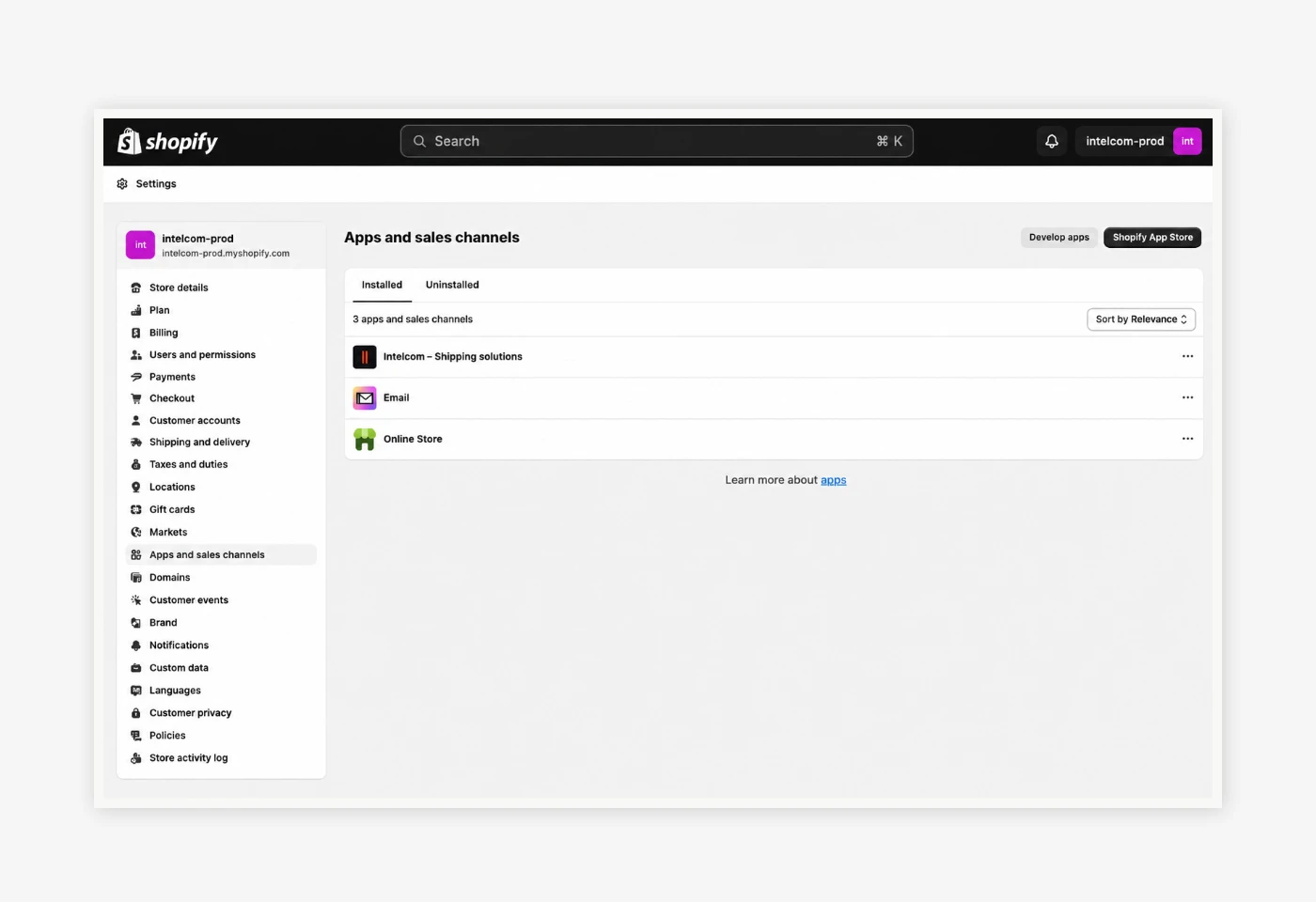
Real-Time Infographic Delivery Timeline Interface
We designed a custom React-based timeline tracker integrated directly into the merchant dashboard. Using Intelcom’s tracking API, the system pulled timestamped updates-warehouse check-in, in-transit scans, delivery attempts-and rendered them in a visually intuitive format. Merchants could click “View Tracking” and instantly see a color-coded progress bar with status updates by date and location. This infographic-style delivery timeline boosted customer satisfaction by enhancing shipment visibility and eliminating guesswork.
Scalable Serverless Lambda Architecture for Enterprise-Grade Shopify Public App
To ensure Intelcom’s Shopify Public App could handle unpredictable workloads, spikes in merchant traffic, and large-scale order processing, WebDesk Solution architected a robust, fully serverless AWS Lambda architecture. This design not only removed the limitations of traditional server hosting but introduced high scalability, cost efficiency, and rock-solid performance under variable demand.
Our infrastructure utilized the following components in synergy:
- Amazon Route 53 handled DNS routing, ensuring global availability.
- AWS WAF (Web Application Firewall) protected the application from malicious attacks like SQL injection, bot traffic, and DDoS vulnerabilities.
- Amazon CloudFront CDN optimized content delivery for speed and low latency.
- AWS S3 was used for hosting the ReactJS frontend and storing PDF shipping labels.
- AWS ECR (Elastic Container Registry) housed our Node.js container images and source code.
- AWS Lambda executed backend logic on-demand, interfacing with Intelcom APIs, Shopify endpoints, and our database layer.
- Amazon API Gateway acted as the secure middleware for routing frontend requests to Lambda functions.
- AWS Aurora served as our cloud-native relational database, providing high availability and compatibility with MySQL/PostgreSQL.
- Amazon DynamoDB managed serverless NoSQL storage for credentials, metadata, and key-value transactions.
- Amazon CloudWatch enabled real-time monitoring, logging, and alerting across all system layers.
- AWS IAM ensured fine-grained access control and enforced least-privilege security policies.
- AWS KMS (Key Management Service) handled encryption for data at rest and in transit.
In terms of DevOps and security, we implemented:
- Centralized flow logs and CloudTrail auditing for full traceability.
- Service Control Policies to restrict unnecessary privileges.
- Backup strategies, including S3 replication to a secondary region and Aurora snapshots.
- Auto-remediation rules to tighten security groups and protect against exposure.
From an application lifecycle perspective:
- Backend: Node.js with Express.js – for efficient asynchronous request handling and modular business logic execution.
- Frontend: React.js – for live form inputs, real-time previews, and responsive popup rendering on the storefrontReact.js – for live form inputs, real-time previews, and responsive popup rendering on the storefront, was served from S3, routed via CloudFront and protected by WAF.
- Database: MongoDB
- Incoming requests first passed through Route 53, then WAF, CDN, and eventually hit our API Gateway before being handled by the Lambda-Node-Aurora pipeline.
- Server: AWS
This architecture ensured:
- 99.99% uptime, even during traffic surges
- Sub-300ms API response times, thanks to optimized Lambda cold start mitigation
- Scalability with zero server management, lowering infrastructure overhead
- Faster deployments with containerized backend and CI/CD hooks
Ultimately, this serverless setup allowed Intelcom’s Shopify Public App to perform like an enterprise-grade SaaS platform-fast, reliable, and always ready to scale with the needs of modern eCommerce merchants.
This project became complex because the app had to translate Intelcom’s logistics rules into Shopify workflows while handling postal-code eligibility, negotiated merchant credentials, bulk label generation, split orders, and real-time tracking inside one system.
What results did Intelcom achieve after launching the Intelcom Shopify app?
Reduced merchant onboarding time by over 80% with automated API key integration
Improved order fulfillment accuracy and reduced shipping errors by over 60%
Decreased bulk processing time by 40%, enabling daily batch fulfillment
Maintained 100% order ID consistency even after order splitting
Delivered real-time tracking clarity, leading to a marked increase in merchant trust and retention
Achieved 99.99% uptime with serverless architecture and sub-300ms response latency
App successfully listed in the Shopify App Marketplace, driving adoption among high-volume Canadian merchants
Conclusion
This project shows WebDesk Solution’s experience delivering Shopify apps that combine carrier API integration, merchant workflow automation, and real-time tracking in a single operational system.


