eCommerce ERP Integration: What Connects, What Breaks, and How to Scope It

Category
Apps and Integrations
Online businesses rely on a variety of tools to manage orders, customer information, payments, inventory, and marketing. However, when these systems do not communicate effectively, even simple tasks can become confusing, slow, and prone to errors. Many eCommerce brands face daily challenges, including delayed order processing, inconsistent data, and limited visibility across operations, all of which affect efficiency and customer experience.
eCommerce integrations address this problem by connecting key business systems into a unified setup where information flows automatically without manual effort. When systems work together, businesses gain better control over operations, reduce costly errors, and provide a smoother experience for customers at every touchpoint.
Most eCommerce operations rely on several tools, including CRM software, ERP platforms, inventory management systems, payment processors, shipping solutions, and marketing platforms. Without proper integration, these systems operate in isolation, causing communication gaps and operational inefficiencies. With the right integrations, data flows consistently, orders move faster, and performance insights become more accurate and actionable.
Research indicates that businesses with well-integrated eCommerce systems see measurable improvements in revenue, repeat purchases, and checkout performance. These improvements also help reduce cart abandonment and transaction errors, supporting long-term growth and improved customer satisfaction.
This blog explains the different types of eCommerce integrations, how they work in real-world scenarios, and the practical benefits they offer, helping you build a more efficient, scalable, and customer-focused online business.
What Are eCommerce Integrations?
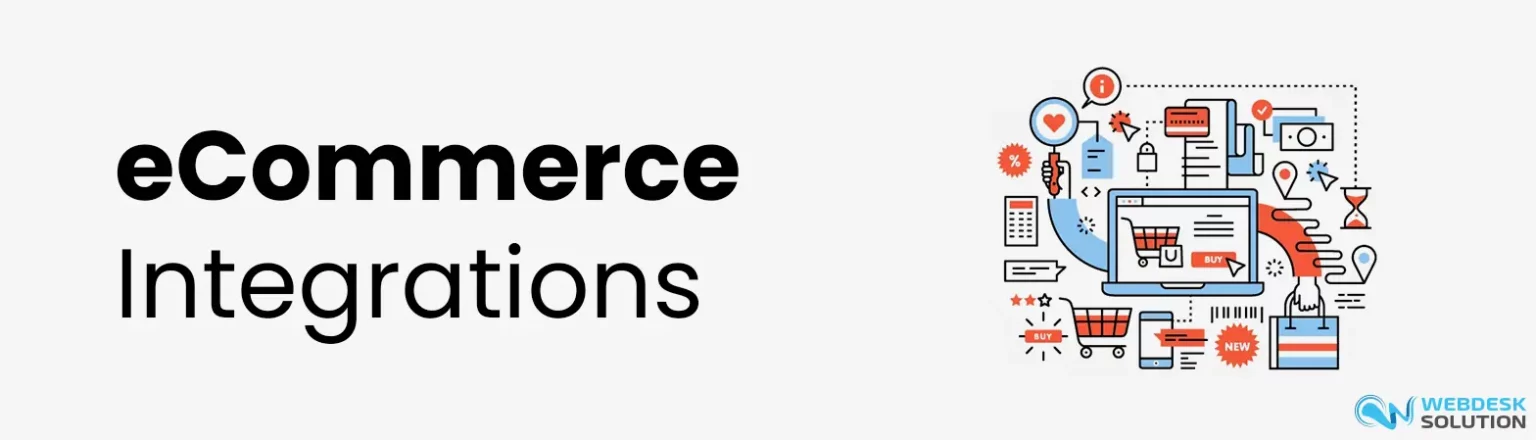
eCommerce integrations involve the process of connecting an online store with back-office systems, including ERP, CRM, inventory, accounting, and marketing platforms. These integrations enable systems to share information automatically, keeping product details, inventory levels, and sales data accurate and up to date. eCommerce integrations ensure operational efficiency by eliminating manual data entry and synchronizing multiple applications. This gives businesses clear, real-time insights across all connected systems, helping them make faster and more informed decisions.
Types of eCommerce Integrations
There are many eCommerce integrations available. Some of the major types are as follows.
ERP Systems

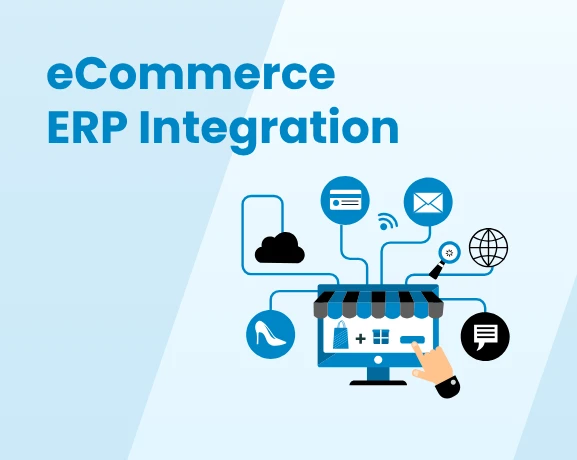
ERP (Enterprise Resource Planning) integrations connect eCommerce platforms to enterprise resource planning software, enabling two-way syncing of inventory, orders, and financial data. The integration automates workflows, reduces errors, and makes it easier to track workflows across departments.
Large-volume merchants become more efficient in handling back-office operations and can make better decisions. Some of the leading ERP solutions are SAP Business One, Microsoft Dynamics 365, NetSuite, Oracle ERP Cloud, and Epicor, which provide scalable alternatives for businesses that are expanding.
CRM Systems

CRM integrations unify customer data on one dashboard, including lead tracking, interactions, and buying behavior. They enable automated marketing campaigns, customer segmentation, and sales pipeline management to improve retention and revenue.
HubSpot and Salesforce are widely recognized for their advanced automation capabilities. Zoho CRM, Pipedrive, and ActiveCampaign offer flexible solutions for small to mid-sized eCommerce businesses seeking to personalize customer engagement.
Inventory Management Systems

Inventory integrations automate stock tracking, alert the company about low inventory, and synchronize stock levels across multiple locations. This prevents both overstocking and stockouts and enables automated reorder workflows.
TradeGecko and DEAR Inventory are great choices for multi-location businesses, whereas companies that require integrated supplier management and real-time inventory insights will benefit most from Cin7, Skubana, and Brightpearl.
Shipping & Logistics

Shipping integrations automate the entire order fulfillment process with minimal human intervention, including fetching shipping rates, printing labels, and updating tracking information automatically. Most integrations support multiple carriers, batch processing, and international shipping.
Companies like ShipStation and Easyship are geared towards small and medium-sized businesses, whereas ShipBob and Printful facilitate businesses with a large volume of shipments that require automated logistics on a global scale.
Payment Gateways

Payment gateways allow customers to make online transactions securely, supporting credit cards, digital wallets, and regional payment methods. They manage transaction processing, refunds, and PCI compliance.
Stripe and PayPal are global leaders in eCommerce payments. Square and Authorize.Net serve small businesses, while Amazon Pay integrates directly into marketplaces for frictionless checkouts.
Marketing Automation Tools

Marketing automation integrations automate routine marketing tasks such as email campaigns, social media posts, and customer segmentation. They use behavior-based triggers to send personalized messages that drive higher conversion rates.
HubSpot and Marketo are feature-rich enterprise solutions. ActiveCampaign provides all the functionality required for a growing online store, while tools like Omnisend and Klaviyo specialize in eCommerce-focused workflows for targeted automated campaigns.
Customer Service Integrations

Customer service integrations connect eCommerce platforms to support systems such as live chat, help desks, or AI chatbots. They organize customer queries and order histories for quicker resolution, improving overall customer satisfaction.
Freshdesk and Zendesk are used by many for scalable support, while Intercom and Tidio focus on live chat and conversational support for small to medium eCommerce businesses.
Reporting and Analytics

Analytics integrations provide businesses with insights into traffic, customer behavior, and sales trends. They offer dashboards, conversion tracking, and customizable reports for informed decision-making.
Google Analytics and Adobe Analytics provide enterprise-level analytics. Mixpanel offers product-focused tracking. Piwik helps companies that prioritize privacy, while Kissmetrics focuses on behavioral analytics to optimize marketing and operational strategies.
Benefits of eCommerce Integrations
eCommerce integrations offer several measurable benefits, enhancing operations, customer experience, and business scalability.
Operational Efficiency

Integrations improve fulfillment by automating shipments, synchronizing inventory across channels, and enabling real-time order tracking. Such automation reduces manual work, speeds up delivery, prevents out-of-stock situations, and enhances workflow coordination with 3PL providers.
Consistent operations, faster order processing, and higher service reliability ensure day-to-day activities run smoothly and resources are used efficiently.
Data Accuracy

eCommerce integrations ensure that data in inventory, pricing, and order management systems is accurate. Automation eliminates errors that can occur through manual entry, keeping stock levels and product information reliable at all times.
Businesses can rely on accurate data for reporting, forecasting, and decision-making, improving inventory planning and reducing discrepancies that help to increase sales or customer satisfaction.
Enhanced Customer Experience

Integrations connect all eCommerce tools, creating seamless shopping experiences. Accurate product availability, smooth checkout, live tracking, and consistent payment and shipping options are just a few benefits customers enjoy.
Streamlining these processes reduces pain points and increases customer satisfaction and loyalty. A frictionless user experience strengthens engagement, encourages repeat purchases, and builds trust, positioning the business as reliable and customer-focused.
Scalability

Integrations make scaling easier by allowing new sales channels, markets, and product lines with minimal disruption. This ensures consistent service, synchronized inventory, and smooth workflows across all platforms.
By ensuring a high-quality customer experience, businesses can scale to new markets or expand product lines without compromising system reliability or data accuracy.
Cost Savings

Automation minimizes errors in operations, returns, and rework costs. Integrations reduce overhead by cutting down on manual updates, correcting orders, and preventing other types of mistakes. Companies can reduce labor, shipping, and administrative costs while improving overall process efficiency.
Optimizing workflows helps companies minimize operational waste, increase profitability, and free up resources for business growth initiatives.
Challenges in eCommerce Integrations
Stability can be affected by many technical barriers that may affect data flow and long-term performance.
Compatibility Issues

Systems may have different designs and API standards, making the integration process challenging. Incompatible communication protocols can cause data inconsistencies, system malfunctions, and interrupt daily operational workflows.
When integrations involve tools from different vendors, troubleshooting can take significantly longer. Stable eCommerce integration requires careful evaluation of the systems to avoid performance gaps and unexpected failures.
Data Migration

Migrating historical records to a new integrated environment is a complex process when datasets vary in structure, format, or logic. Incorrect mapping can result in missing entries, corrupted values, or duplicated records, affecting overall accuracy.
Large product catalogs, extensive sales histories, and complex datasets make the migration process even more challenging. Clear migration rules, validation checks, and controlled transfer batches ensure integrity in the process.
Security Concerns

Connecting multiple platforms increases the risk of security threats such as intercepted data, unauthorized access, or insecure transfer points. Without strict encryption and authentication, sensitive information such as payments and personal details can be highly attractive to hackers.
Implementing strong security measures and compliance with standards like GDPR helps to support users’ confidence and lower the risk of breaches. Effective monitoring also enhances security across all integrated systems.
Cost of Implementation

Most integrations will include licensing fees, customized development, technical configuration, and ongoing support. Additional costs may come from employee training or troubleshooting, which can impact the overall project budgets.
Unexpected changes can occur when integrations are scaled or when new modules are added. A detailed financial plan helps streamline implementation and prevents operational resources from being overburdened during long-term maintenance.
Wrapping Up
A strong integration setup brings every part of an online store together, giving owners cleaner workflows, dependable data, and smoother customer experiences. Each connected system boosts visibility while reducing the manual workload that usually slows growth. When all systems work in sync, eCommerce brands gain the clarity, stability, and scalability needed to make daily operations more predictable and efficient.
WebDesk Solution helps businesses reach this level of efficiency through structured integration planning, advanced implementation, and ongoing support. If you’re also exploring ways to strengthen your store’s foundation, our eCommerce development expertise can support your long-term growth. Reach out to us to build an ecosystem that enhances performance, improves decision-making, and lays a foundation for sustainable eCommerce success.
Frequently Asked Questions
Start by analyzing where delays, errors, or repetitive tasks happen in your operations. Focus on integrations that automate these areas, improve data accuracy, and streamline workflows. Consulting with an eCommerce expert can help identify the most impactful integrations for your store.
Some platforms provide ready-made connectors for common tools, but custom development may be needed for unique systems or advanced functionality. Custom integrations ensure data syncs correctly, workflows remain uninterrupted, and your store operates securely.
The timeline depends on the number of systems, data complexity, and required customization. Simple integrations can be completed in a few days, while complex setups involving ERP, CRM, and logistics tools may take several weeks. Proper planning and testing help minimize disruptions.
Yes. Connecting payment gateways, inventory, and shipping tools ensures accurate stock, seamless checkout, and timely order updates. These improvements create a smoother experience for customers, which reduces errors and encourages completed purchases.

Related Posts