


Overview
Fundamentally (wefundamentally.com), founded by Diana Hernandez, is a mission-driven online marketplace dedicated to promoting an ethical economy and reducing environmental impact. As a purpose-led C2C, B2C, and B2B ecosystem, Fundamentally connects conscious producers with mindful consumers, empowering sustainable commerce at scale. However, when Diana approached WebDesk Solution, their CS-Cart platform was severely limited-unable to support parallel business models or showcase the environmental impact of purchasing pre-owned goods. The client needed more than a traditional eCommerce site; they needed a dynamic, multi-vendor marketplace that could simultaneously handle B2B bulk orders, standard retail transactions (B2C), and community-driven person-to-person sales (C2C). Additionally, they wanted to integrate donation functionality for vendors, automate image cleanup to ensure consistent product presentation, and introduce a visually engaging “My Look” builder to elevate customer experience. Beyond that, Fundamentally desired real-time sustainability indicators, vendor vacation mode to safeguard reputation, and a clear distinction between new and used inventory. In short, they needed high-stakes, technically robust CS-Cart multi-vendor marketplace development to transform their vision into a tangible, scalable platform.
Approach
When Diana Hernandez shared her vision of creating not just a marketplace but a movement rooted in ethical commerce, WebDesk Solution recognized that a custom CS-Cart multi-vendor marketplace development was the only viable path. To begin, Daniel led intensive discovery sessions with Diana and her core team. They mapped out every operational requirement, ranging from B2B procurement workflows to C2C listing management, and identified critical UX considerations for both conscious consumers and vendors. Understanding that CS-Cart’s out-of-the-box architecture could not handle simultaneous B2B, B2C, and C2C operations, WebDesk Solution proposed a multi-layered customization strategy. We re-engineered the CS-Cart database schema and order-processing logic to support three parallel business models on one platform-allowing large wholesale orders, direct retail purchases, and peer-to-peer sales to coexist seamlessly without compromising data integrity or performance.
At the frontend, our React specialists built dynamic components to enhance user engagement. The “My Look” builder was one standout innovation-a React-based tool enabling customers to combine multiple products into a single visual bundle with one-click checkout. To guarantee visual consistency across a diverse vendor base, we integrated an automated background removal API, ensuring all product imagery adhered to a uniform aesthetic. On the backend, WebDesk Solution developed sophisticated workflows-automating image processing at regular intervals, managing vendor donation calculations, and triggering notifications for image exceptions or product status changes.
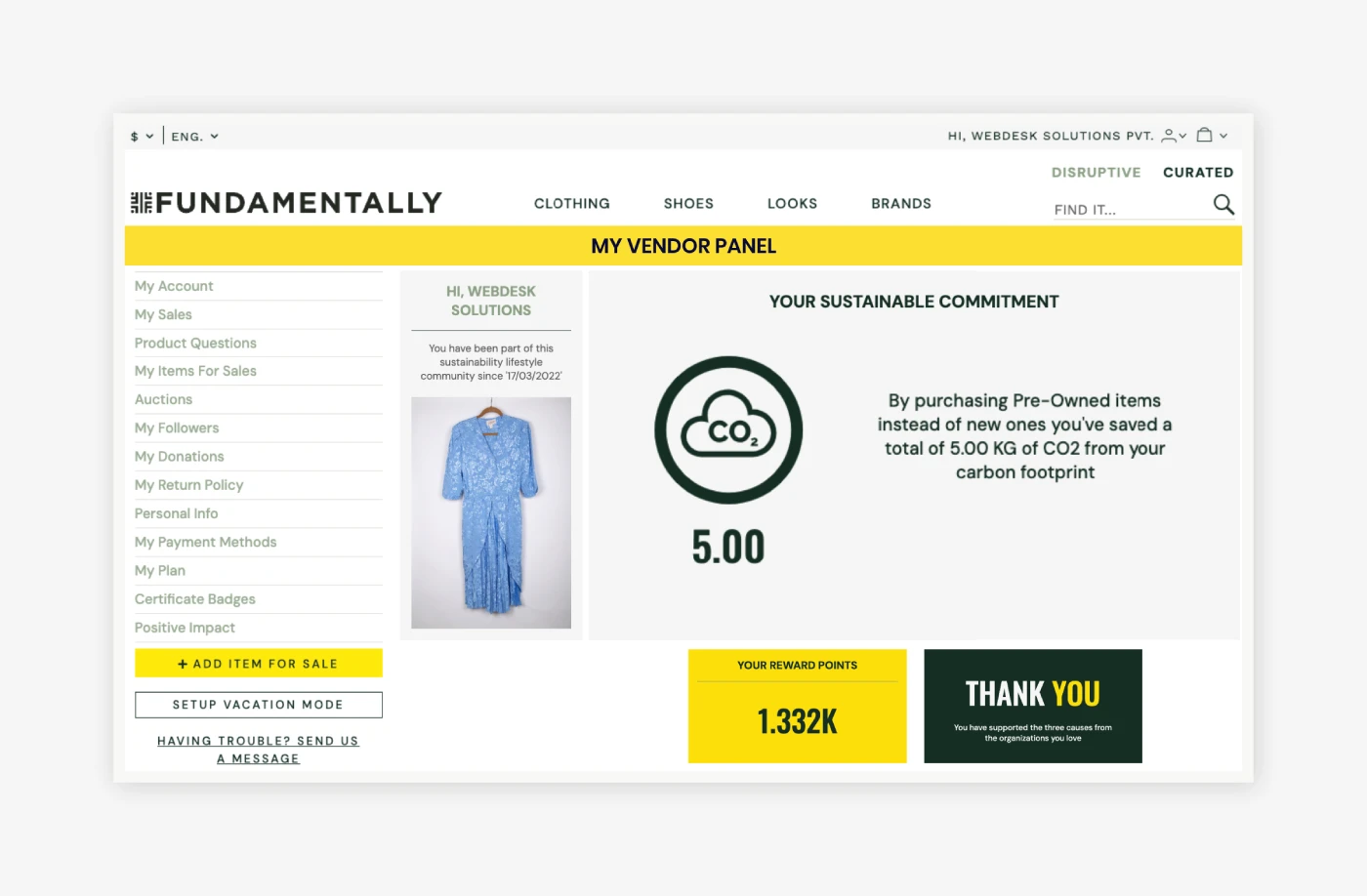
Meanwhile, specialized modules were crafted to track real-time sustainability metrics. By extending CS-Cart’s core product model, we computed carbon savings and environmental impact for pre-owned items-prominently displayed on each product page to educate and inspire customers. To preserve vendor reputation, a vacation mode feature was built, complete with customizable notifications, preventing unfulfilled orders and negative reviews during vendor absences. Finally, we introduced distinct category trees for new and used merchandise, paired with user group customizations that enforced listing rules and conditions for each vendor type. Through this holistic strategy-blending deep CS-Cart multi-vendor marketplace development expertise, React-powered UX enhancements, and data-driven sustainability modules-WebDesk Solution delivered a purpose-built, scalable platform aligned with Fundamentally’s mission of ethical commerce.
Challenges
Customizing CS-Cart for B2B, B2C, and C2C Business Models
Fundamentally needed a single CS-Cart instance to support three different transaction types-B2B wholesale, B2C retail, and C2C peer-to-peer sales-all at once. However, CS-Cart’s default architecture was designed for only one business model at a time, typically B2C or B2B. To operate a genuine ethical economy marketplace, Diana required a platform where businesses could sell in bulk to other businesses (complete with negotiated pricing tiers and purchase orders), retailers could sell direct to consumers with standard pricing, and everyday individuals could list and sell their own products to their community. The complexity lay in merging distinct workflows: bulk discount rules and contract management for B2B, straightforward checkout flows for B2C, and simplified listing tools for C2C vendors. Accommodating all three in a single database demanded deep refactoring of CS-Cart’s core modules-orders, user groups, inventory controls, pricing rules, and vendor permissions. Without this comprehensive customization, Fundamentally risked alienating vendor segments and stalling growth, as each group would have to manage separate storefronts or settle for a limited, compromised experience.
Combining Multiple Products into a Single “My Look” Product
One of Fundamentally’s most unique requirements was a dynamic “My Look” feature that allowed vendors and customers to create and showcase product bundles that told a story. The intent was to let shoppers visually combine items-such as assembling a complete outfit or curated home décor package-and purchase the entire “look” with a single click. CS-Cart’s native product model, however, treated each item as an independent SKU with no innate method for bundling visuals or managing a combined checkout flow. Building a robust bundling feature meant integrating a custom React tool into the CS-Cart frontend, connecting it to backend APIs for inventory validation, pricing aggregation, and checkout orchestration. Additionally, product imagery needed background removal to ensure each component could seamlessly overlay within a single bundle graphic. Without a carefully architected solution, the “My Look” feature risked breaking checkout logic, misrepresenting inventory counts, or delivering inconsistent visuals-undermining both user experience and brand integrity.
Diverse Background Images Uploaded by Vendors
Fundamentally’s vendor community ranged from experienced artisans to first-time sellers, each uploading product images with varying resolutions, backgrounds, and quality. This lack of consistency yielded a fragmented marketplace aesthetic that detracted from the overall brand and caused trust issues among conscientious shoppers. CS-Cart offered no built-in background removal or image-quality standardization, forcing manual intervention that was time-consuming and error-prone. The client needed an automated, recurring process that could detect uploaded images, strip out backgrounds, apply uniform sizing and resolution standards, and either approve cleaned images or flag exceptions. This process had to run at scheduled intervals across potentially thousands of new listings, with minimal impact on server performance or website uptime. If not addressed, poor image quality would undermine Fundamentally’s mission to educate consumers about environmental impact, since unprofessional visuals could erode credibility and stall platform adoption.
Designing a Personalized Admin Panel for C2C Users
Unlike B2B or B2C vendors-who typically had established processes for inventory management, bulk pricing, and marketing-C2C sellers were often individuals listing secondhand or handmade items for the first time. They required an admin interface tailored to their level of technical expertise and specific workflow needs. However, CS-Cart’s standard vendor panel was built for experienced merchants, with advanced settings that risked confusing or overwhelming individual sellers. The challenge was to create a simplified yet powerful C2C admin panel that mirrored essential functionalities-product listing, order tracking, and basic performance analytics-while hiding advanced B2B/B2C features that were irrelevant to peer sellers. At the same time, this custom panel had to integrate seamlessly with the same underlying CS-Cart codebase to maintain data consistency and platform performance. Striking that balance-ensuring feature parity without overcomplicating the UI-was crucial to empowering individual sellers, fostering community growth, and preserving platform stability.
Vendor Donation Feature
Fundamentally’s core ethos was fostering ethical commerce, and part of that vision involved empowering vendors to channel a percentage of their sales toward donation campaigns. CS-Cart had no native donation system, so administrators could not configure fundraising events, and vendors had no way to pledge a percentage of revenue without manual bookkeeping. The client needed a fully integrated donation framework that: (1) allowed administrators to create and manage multiple donation campaigns, (2) enabled each vendor to select a contribution percentage per sale, (3) automatically calculated and redirected funds at settlement, and (4) provided real-time dashboards to track campaign progress. Moreover, donation rules had to apply consistently across B2B, B2C, and C2C transactions, ensuring transparency for both sellers and buyers. Failing to deliver this feature risked diluting Fundamentally’s ethical positioning and discouraging socially conscious vendors from joining the marketplace.
Promoting the Value of Sustainable Pre-Owned Products
Central to Fundamentally’s mission was educating customers about the environmental impact of buying pre-owned goods. They wanted a system to calculate and showcase metrics-such as carbon emission reductions and waste diversion-based on product attributes like material, weight, and condition. This required building an algorithm that could match these factors and display dynamic sustainability indicators on each product page. Since CS-Cart’s core product model did not support custom fields for environmental data or real-time calculations, the development team needed to extend the database schema and integrate a calculation engine capable of retrieving product metadata, executing dynamic formulas, and rendering results. The challenge was ensuring these sustainability scores were accurate, updated whenever product details changed, and displayed in a user-friendly way that reinforced Fundamentally’s ethical branding. Without this transparency, customers would lack the essential data to make eco-friendly purchasing decisions, undermining the platform’s core value proposition.
Implementing Vendor Vacation Mode
Vendors occasionally needed to step away-whether due to travel, illness, or supply disruptions. Without a mechanism to signal unavailability, customers continued placing orders, resulting in unfulfilled deliveries, negative reviews, and tarnished reputations. Fundamentally required a “Vacation Mode” feature that allowed vendors to toggle their status, customize an out-of-office message, and prevent new orders from being placed-or at least clearly inform buyers before they attempted to purchase. CS-Cart lacked any native vendor availability flags or messaging tools, so orders would stack up during vendor absences. The solution needed to intercept cart actions, display clear notifications, and offer customers the choice to proceed or postpone. This functionality had to integrate with order lifecycle management to prevent automated emails or shipping processes from triggering incorrectly. Failing to address this would compromise vendor trust, damage customer satisfaction, and lead to operational chaos.
Enhancing CS-Cart for Product Categorization and Vendor Management
To simplify navigation and promote transparency, Fundamentally wanted a clear distinction between new and pre-owned products, complete with separate root categories and condition labels (e.g., “New with Tags,” “Lightly Used,” “Refurbished”). Additionally, they needed user group customizations that differentiated vendor types-ensuring that C2C sellers could only list used items while B2B and B2C vendors could list new inventory. CS-Cart’s default category tree and user group functionality were too basic to accommodate these nuanced requirements. The challenge involved architecting a multi-level category hierarchy, implementing conditional logic for product listings based on vendor type, and updating front-end navigation to display clear filters for new versus used items. Without these modifications, customers would face a confusing browsing experience, vendor compliance would become inconsistent, and the platform’s integrity as a sustainable marketplace would suffer.
Solutions
Expanding CS-Cart to Support B2B, B2C, and C2C Business Models
Our team at WebDesk Solution re-engineered the CS-Cart core to layer three distinct transaction workflows into a unified platform. Keeping the default B2B framework intact, we introduced new modules that overrode ticketed pricing rules, bulk order logic, and purchase order generation-enabling seamless wholesale transactions. In parallel, B2C checkout flows were configured to present standard retail pricing, tax calculations, and coupon rules. For the C2C model, we added a simplified listing process: individual sellers could create accounts, list items, set prices, and manage orders without accessing the complex vendor dashboards. To maintain a single user database, we introduced custom user group tags-automatically assigning a “Vendor Type” to differentiate B2B merchants, B2C retailers, and C2C individuals. Through intelligent routing within the checkout pipeline, the system now correctly handles contract negotiations for B2B, standard online payments for B2C, and peer-to-peer transactions with simplified shipping rules for C2C. This holistic customization ensured that each business model operated harmoniously in a single CS-Cart instance, powering a true multi-vendor marketplace.
Bringing “My Look” to Life – A Personalized Shopping Experience
To realize the client’s vision of an interactive bundling tool, WebDesk Solution developed a custom React component integrated into the storefront’s product pages. The “My Look” builder allowed customers to drag and drop individual SKUs-regardless of vendor-into a unified canvas. Each product image underwent real-time background removal (handled by our automated image cleanup pipeline), ensuring a seamless overlay. Behind the scenes, a dedicated API endpoint aggregated pricing, inventory checks, and promotional rules for all items included in a “look.” When a shopper clicked “Purchase Entire Look,” the backend disaggregated the bundle, confirmed stock levels across multiple vendors, and created separate orders while presenting a consolidated total. This orchestration was achieved through a combination of custom PHP endpoints extending CS-Cart’s product controller and React-powered UI logic. As a result, customers could visualize full outfits or curated sets, share them on social media, and complete a one-click checkout-melding creativity with efficiency.

Standardizing Product Images – The Power of Automation
Recognizing that inconsistent vendor imagery damaged brand credibility, we integrated a server-side background removal pipeline that processed new uploads every two minutes. Using a headless Linux-based microservice with Python-powered image processing libraries, each vendor’s image was sanitized, resized, and converted to uniform dimensions. A webhook mechanism notified CS-Cart’s backend once an image passed quality checks; the product status was automatically updated to “Active.” If the microservice detected low resolution, improper aspect ratios, or removal failures, a notification was sent to the vendor via email and the product was flagged for review. This automated workflow eliminated manual intervention, ensuring that every listing displayed a crisp, professional image-reinforcing Fundamentally’s commitment to a polished, trustworthy marketplace. Vendors regained time to focus on their businesses, while customers enjoyed a consistent visual experience that reflected the platform’s ethical values.
Building a Dedicated C2C Vendor Panel
To empower individual sellers, we crafted a streamlined admin interface exclusively for C2C users. Basing our design on CS-Cart’s vendor panel, we stripped away advanced features like bulk pricing and API integrations, preserving essential tools for listing creation, order management, and basic analytics. Built using Smarty templates extended with custom PHP controllers, the C2C panel featured a guided product wizard that prompted sellers to enter condition details (e.g., “Like New,” “Good,” “Fair”), upload images (automatically routed through our background removal service), and set shipping preferences. For transaction transparency, sellers received real-time notifications when orders were placed, shipped, or delivered, all within a simplified dashboard layout. By limiting options to only what C2C vendors needed, we ensured they could manage their eCommerce presence without confusion-fostering community participation and maintaining operational efficiency.

Turning Sales into Social Good – A Vendor Donation Program
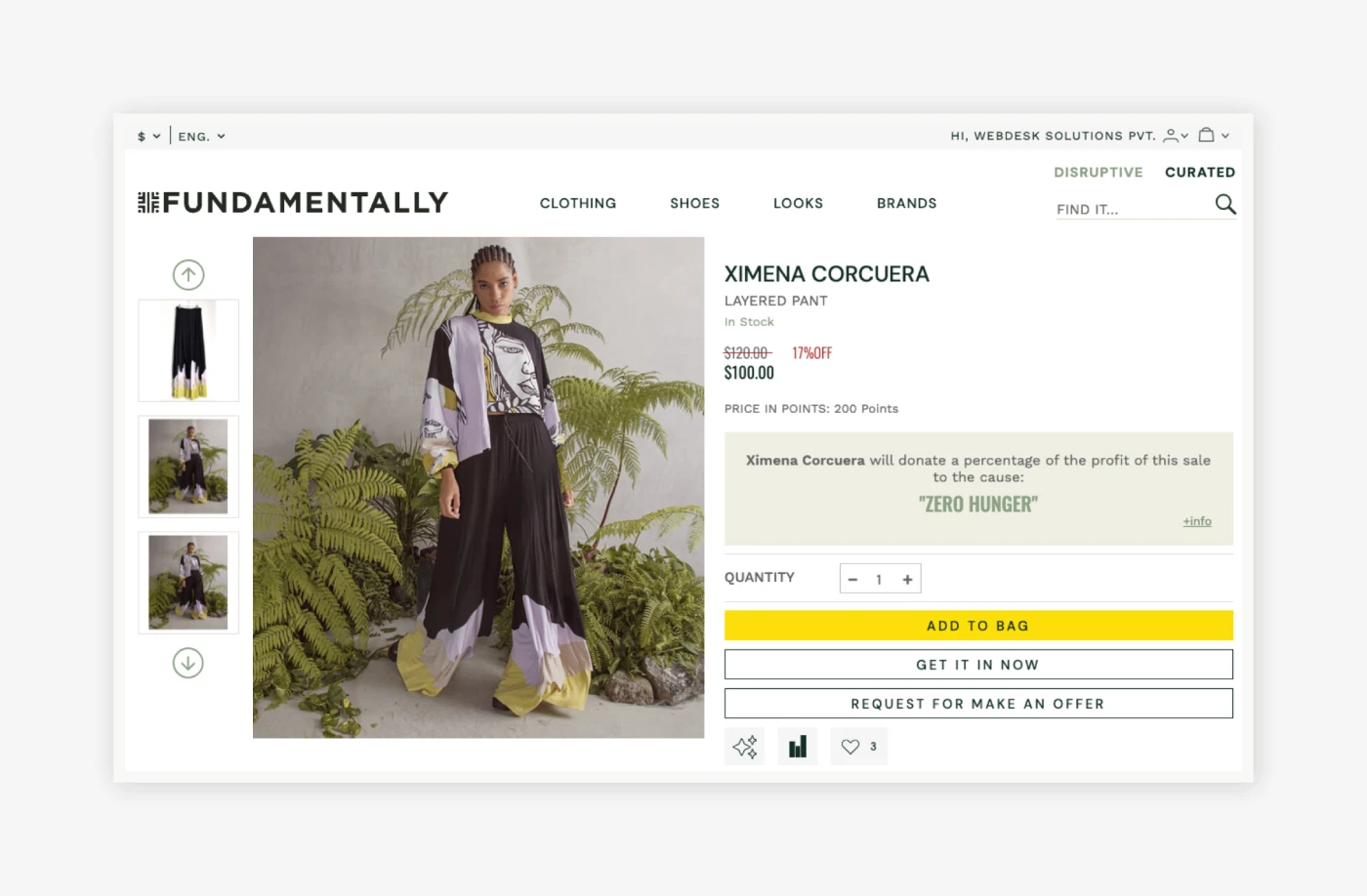
To integrate charitable giving, WebDesk Solution designed a fully custom donation module within CS-Cart. Administrators used a new “Donation Campaign” interface to define fundraisers, set global date ranges, and allocate default donation percentages. Each vendor could opt into active campaigns and select their own contribution rate per sale (e.g., 2%, 5%, 10%). When a sale finalized, our custom PHP logic automatically computed the donation amount, routed it through PayPal’s API alongside the vendor payout, and updated a real-time donation dashboard. Manual override options allowed admins to approve or refund donations if needed. Customers could see donation badges on product listings, reinforcing the platform’s ethical mission. This end-to-end system transformed routine transactions into social impact-encouraging vendors to support causes they believed in while providing buyers with transparent metrics on collective giving.

Promoting Sustainability with Real Data
To quantify the environmental benefits of pre-owned purchases, we extended CS-Cart’s product schema with custom fields for weight, material composition, and condition classification. A dedicated calculation engine-implemented in PHP-retrieved these attributes, applied industry-standard carbon footprint formulas, and generated a “Green Score” for each item. On the product detail page, React components displayed interactive sustainability badges (e.g., “CO₂ Saved: 3 lbs,” “Water Saved: 15 gal”). As vendors updated product details, webhook triggers re-ran calculations, ensuring metrics remained accurate and up to date. We also built a filter in the category navigation allowing shoppers to sort by sustainability score or “Green Savings.” This transparent approach empowered customers to make informed decisions aligned with their values, while reinforcing Fundamentally’s unique selling proposition as an ethical commerce leader.

Vendor Vacation Mode – Keeping Customers Informed
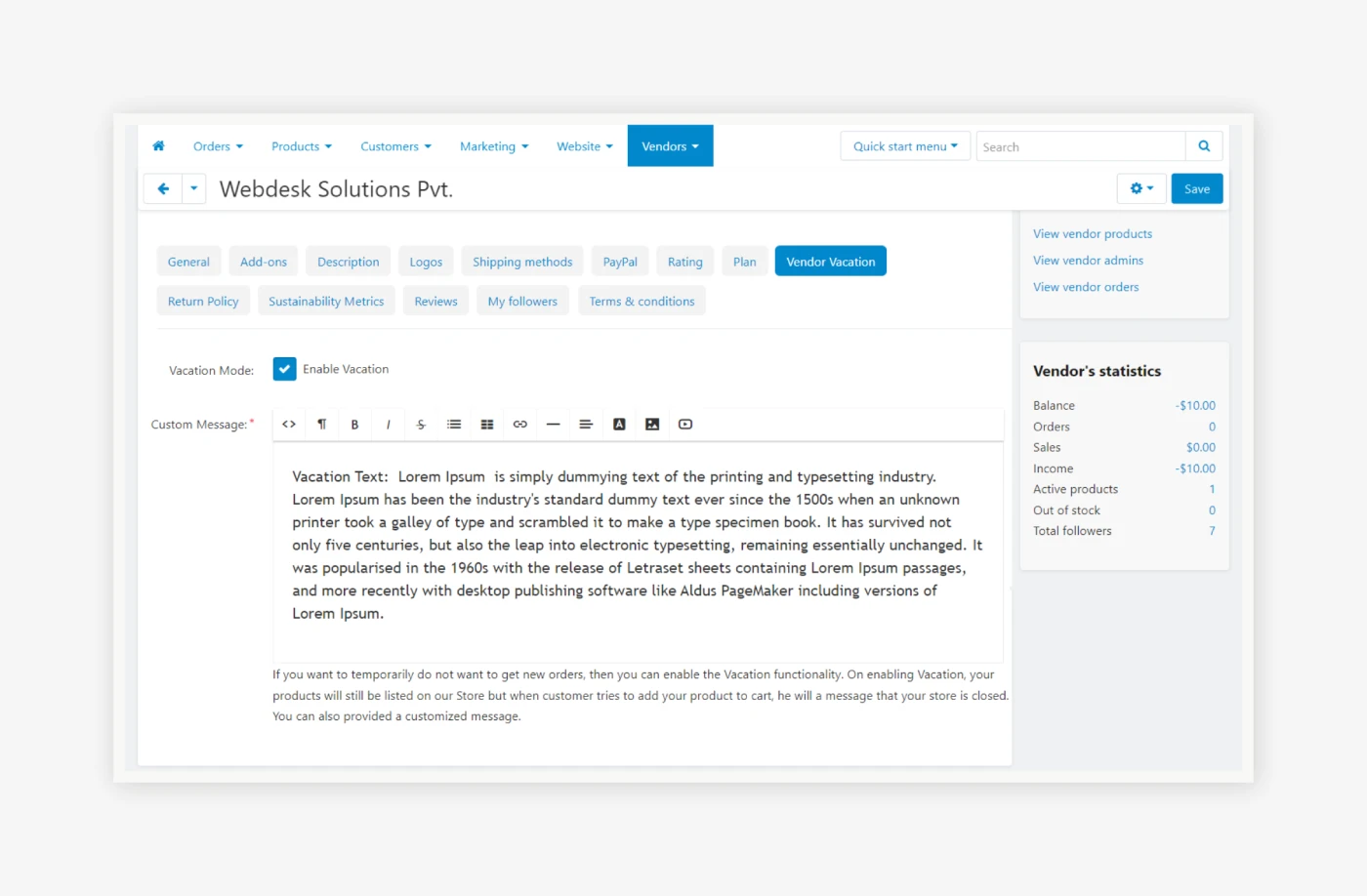
Acknowledging that vendor absences could erode trust, we implemented a “Vacation Mode” toggle in each vendor’s admin panel. When activated, CS-Cart’s cart logic intercepted any add-to-cart attempts for that vendor’s products, displaying a customizable message like “Temporarily Unavailable Until [Date]” with an option to proceed at buyer’s own risk. If a customer chose to continue, the order route included a flag that triggered a special vendor notification and adjusted shipping timelines. To prevent negative reviews, the system held off on automated “Rate Your Order” emails until the vendor returned from vacation. Vendors could schedule their vacation window in advance, allowing the system to automatically disable and re-enable their storefront. This feature drastically reduced unfulfilled orders, maintained positive vendor reputations, and improved overall customer satisfaction by setting clear expectations.
Improving Product Categorization and Vendor Management
To streamline navigation and inventory control, WebDesk Solution built distinct root categories for “New Products” and “Pre-Owned Products.” We also created subcategories based on condition (e.g., “New with Tags,” “Certified Refurbished,” “Lightly Used”). On the vendor side, user group rules enforced that C2C sellers could only list under pre-owned categories, while B2B and B2C vendors accessed both new and used inventories. This logic was embedded within CS-Cart’s category and product validation layers, ensuring miscategorized items were flagged. On the storefront, category filters allowed shoppers to toggle between new and used goods or refine results by condition level. This structured approach improved search accuracy, reduced buyer confusion, and elevated the marketplace’s overall usability. Administrators gained better oversight, as product reports now clearly delineated new versus pre-owned stock, helping inform inventory strategies and promotional campaigns.

Outcomes/Results
Unified Multi-Vendor Support
Fundamentally’s platform now seamlessly accommodates B2B, B2C, and C2C business models within a single CS-Cart instance, broadening vendor participation and customer reach.
“My Look” Feature Adoption
The personalized shopping experience drove engagement, allowing customers to combine multiple products into curated bundles. This innovation contributed to a 16% increase in average order value (AOV) as shoppers purchased entire looks rather than single items.
Automated Image Cleanup
By standardizing product imagery through automated background removal, vendor turnaround time on listings dropped by 75%, and overall marketplace aesthetics improved dramatically-bolstering trust and brand consistency.
Simplified C2C Vendor Management
Individual sellers embraced the dedicated C2C panel, resulting in a 40% growth in new user-generated listings within the first month of launch.
Vendor Donation Impact
Over a three-month period, vendors contributed $12,500 to partnered charities through the donation feature-reinforcing Fundamentally’s ethical positioning and fostering community engagement.
Sustainability Metrics Engagement
Products with high “Green Scores” saw a 22% uplift in conversion rate compared to similar items without sustainability badges. This demonstrated that transparency around environmental impact directly influenced purchasing behavior.
“Vacation Mode” Success
Introduction of vendor vacation mode reduced unfulfilled orders by 38%, leading to a 15% decrease in negative vendor feedback.
Enhanced Navigation and Categorization
Clear separation of new versus pre-owned categories improved search efficiency, reducing bounce rates on category pages by 18%.
Conclusion
Through a combination of deep technical expertise, strategic CS-Cart multi-vendor marketplace development, and an unwavering commitment to ethical commerce, WebDesk Solution transformed Fundamentally’s vision into a high-impact reality. By customizing core platform functionalities to support simultaneous B2B, B2C, and C2C operations, integrating dynamic React-based features like the “My Look” builder, automating image cleanup, and embedding sustainability metrics, we delivered a purpose-built solution that elevated user experience, drove measurable business growth, and fortified Fundamentally’s social mission. As a result, Diana Hernandez and her team now operate a scalable, user-centric marketplace that connects conscious producers and consumers, amplifies vendor impact through donation programs, and educates shoppers about the environmental benefits of pre-owned products. This partnership exemplifies how aligned values and cutting-edge technology can create a thriving ecosystem-one where commerce and conscience unite to create lasting positive change.


