


Why did PartsConnexion need to migrate from Shopify Plus to BigCommerce?
PartsConnexion (pcX) is not your average electronics retailer. Born from the legacy of Sonic Frontiers and The Parts Connection, this Burlington-based company was created to serve a very specific, passionate customer: the DIY audio enthusiast. For over two decades, founders Chris Johnson and Victoria Switzer meticulously curated a product catalog that included rare capacitors, matched tubes, and audio kits-turning pcX into a global authority in high-end audio components.
With thousands of SKUs, a loyal international customer base, and growing ambitions in the guitar amp and loudspeaker markets, pcX needed an online experience that matched its high-performance ethos. Unfortunately, their eCommerce platform was falling behind. Built initially on ShopSite and then temporarily transitioned to Shopify Plus, their setup was held together by workaround scripts and patched integrations-none of which could support their complex multi-currency, multi-storefront needs.
When Shopify deprecated the very feature (checkout.liquid) that enabled their unified checkout vision across PartsConnexion and their sibling brand AudioConnexion, the cracks in their infrastructure widened into full-blown fault lines. That’s when they turned to WebDesk Solution.
WebDesk Solution was engaged to plan the migration from Shopify Plus to BigCommerce, redesign the storefront architecture, and build the custom integrations needed for the client’s multi-store, multi-currency operation.

Approach: Platform Agility Meets Strategic eCommerce Architecture
The project kicked off during a tense moment. Tania from Parts Connexion, was frustrated, uncertain, and stuck in limbo between two storefronts, two currencies, and two countries. Our initial engagement started with a detailed discovery call led by Daniel from WebDesk, who walked through every nuance of the brand’s operations-from pricing models and custom checkout requirements to dual warehouse fulfillment and user experience inconsistencies.
Initially, Shopify Plus seemed like a viable path, but as its roadmap shifted, it became clear that the platform could no longer support the depth of customization pcX required. We didn’t just suggest BigCommerce-we guided Tania through it. She was unfamiliar with the platform, and rightfully nervous about rebuilding from scratch.
To ease the transition, we proposed a parallel development model. While the client continued to run business on Shopify, we architected a custom-built, scalable solution on BigCommerce that ticked every box:
- Dual storefronts managed from a centralized backend
- Custom checkout logic tied to currency and shipping origin
- Flexible product modifiers and MSRP-based discounting
- Seamless frontend integration for branded newsletter promotions
- Intelligent shipping configuration via ShipperHQ
- Unified customer login across both brands
The engagement also included private Node.js app development to manage unified login, MSRP-based discount logic, newsletter deal handling, and data synchronization outside BigCommerce’s theme layer.
To further address areas Shopify Plus could not accommodate, we developed a private custom application hosted on an external Node.js server. This app acted as a control hub for unified login, discount logic, newsletter deal handling, and data synchronization, independent of BigCommerce’s theme layer, enhancing the performance and flexibility of key features.
In six months, WebDesk had laid the foundation for a resilient, agile, and future-ready eCommerce experience for PartsConnexion-one that aligned perfectly with their operational and branding needs.
What technical and operational challenges had to be solved in this BigCommerce migration?
Platform Instability Due to Shopify Plus Limitations
During development on Shopify Plus, the client relied heavily on checkout.liquid to create a unified checkout experience across two storefronts. However, Shopify’s sudden deprecation of this feature in favor of Checkout Extensibility drastically limited our ability to customize the checkout flow. This created operational uncertainty and derailed months of work. The client was deeply concerned about the stability and future of their revenue-driving storefronts, leading them to question the sustainability of their Shopify Plus investment.
Currency-Specific Dual Payment Gateways for Cross-Border Commerce
Handling payments in both CAD and USD wasn’t just a convenience-it was essential for customer trust and financial transparency. Without the right setup, customers were being charged conversion fees, which led to drop-offs during checkout. The client needed a system where CAD transactions went to a Canadian PayPal account and USD to a U.S. account, all while maintaining a single checkout experience that didn’t confuse customers or create extra steps.
Managing Complex Pricing Adjustments With Fixed Rates And Dynamic Conversions Across Multiple Currencies
The client required pricing flexibility that allowed them to control some prices with fixed values in CAD or USD, while allowing others to be dynamically converted based on real-time currency exchange rates. Managing this hybrid structure introduced complexity on multiple fronts: tagging products correctly, applying accurate conversion ratios, and preventing misalignment between listed and actual prices. The need to switch between fixed and dynamic pricing required a deeply customized logic layer to ensure consistent product presentation and accurate pricing across storefronts.
Apply Discounts Based On The Manufacturer’s Suggested Retail Price (MSRP)
PartsConnexion wanted to move away from standard discount logic. Instead of applying percentage discounts on the current sale price, they required promotions to be based exclusively on the original MSRP. This meant even if an item was already marked down, the promotional discount should calculate from the higher MSRP value. Further complexity was added by the need to avoid discount stacking, ensuring that deeper discounts wouldn’t be unintentionally overwritten by active promotions. A custom logic structure was essential to manage this non-standard pricing requirement.
Managing Two Front Ends From A Single Store
The client needed to present two branded experiences-PartsConnexion and AudioConnexion-while maintaining a shared backend. Since both storefronts had to be visible worldwide, geo-targeted domain redirection was not an option. Instead, content and product visibility had to be managed using domain-level custom scripts and tag-based logic. The challenge was maintaining consistent branding and merchandising without creating operational chaos in the backend. Proper segregation of frontend elements, while operating from a shared database, demanded a high level of structural precision and quality control.
Product Customization With Additional Fees
The product catalog included configurable items such as matched vacuum tubes, which required optional add-ons selected by the user at the time of purchase. These add-ons affected pricing and inventory, and needed to be tracked accordingly. Unlike standard variant configurations, the add-ons were often conditional and required real-time validation and pricing logic. Implementing an accurate, scalable product customization framework that could accommodate this granularity, while remaining easy for the client to manage, was a high-priority requirement.
Unified Login Across Separate Storefronts
Maintaining two distinct storefronts often meant customers had to register twice, leading to friction, duplicate accounts, and a frustrating user experience. The client wanted a seamless solution where a single login granted access to both PartsConnexion and AudioConnexion. This would eliminate confusion and improve retention. However, executing this on a multistore architecture with different frontends required a secure, centralized authentication system that synchronized credentials and session data across both stores.
Customizing Newsletter Deals For Seamless Website Integration
Newsletter campaigns were a significant driver of engagement and revenue, but there was no existing mechanism to translate email-exclusive deals to the website without manual duplication. The challenge was twofold: enable the marketing team to dynamically control which deals appeared on-site, and ensure those deals visually matched the styling and messaging of the emails. The client needed a branded, customizable frontend module that could fetch and render newsletter promotions as part of the core site experience.
Complex Shipping Rate Configuration with ShipperHQ
With warehouses in both Canada and the U.S., the client required a shipping engine that could account for packaging dimensions, product weights, and destination zones across carriers like Canada Post and USPS. They also needed the ability to show rates by parcel size and apply custom surcharges. The solution had to account for international handoffs between carriers, label adjustments, and flexible pricing zones. Misconfiguration could result in lost revenue or order cancellations, making this a mission-critical implementation.
Custom Products Export for Bulk Edit
BigCommerce’s native export/import functions did not support several custom fields critical to the client’s operations. These included newsletter tags, filtered metadata, pricing tiers in CAD, and fields tied to unit of measure and visibility restrictions. Furthermore, Price List functionality offered no built-in bulk editing tools. The client required custom export modules that allowed precise control over what fields were extracted, bulk-edited, and imported-without compromising data integrity or operational efficiency.
Key Metrics




How did WebDesk Solution implement the BigCommerce migration and custom integrations for PartsConnexion?
Strategic Migration from Shopify Plus to BigCommerce Enterprise
To overcome Shopify’s architectural constraints, we performed a strategic migration from Shopify Plus to BigCommerce Enterprise. BigCommerce offered significantly more flexibility, particularly in API access and headless capabilities. The platform empowered us to implement custom checkout logic, real-time inventory sync, and storefront differentiation without limitation. We built a complete new site structure from scratch, retaining the existing customer and order data through a structured data migration. This move protected the business from future disruptions and laid the groundwork for scalability.

Streamlined Payment Gateway Configuration For Currency-Specific Transactions
We used BigCommerce’s native features to configure multiple gateways based on checkout currency. CAD payments were routed through a Canadian PayPal gateway, while USD payments flowed to a U.S.-based gateway. This eliminated cross-border transaction fees and ensured a smooth experience for users. The currency logic was embedded directly into the checkout flow, giving customers clarity and enhancing trust. The resulting uplift in completed transactions validated the effectiveness of this dual-routing strategy.

Flexible Pricing Strategy Using Dynamic Conversion and Fixed Price Lists
To support both dynamic and fixed pricing across multiple currencies, we combined BigCommerce’s automatic currency conversion with its price list functionality. Products tagged for dynamic pricing reflected live exchange rates, ensuring accurate global pricing. For fixed prices, we configured price lists that overrode conversion logic. This allowed, for instance, a $100 USD product to appear as $120 CAD even if the market rate differed. This hybrid approach provided transparency to international customers and operational clarity for the client’s pricing strategy.
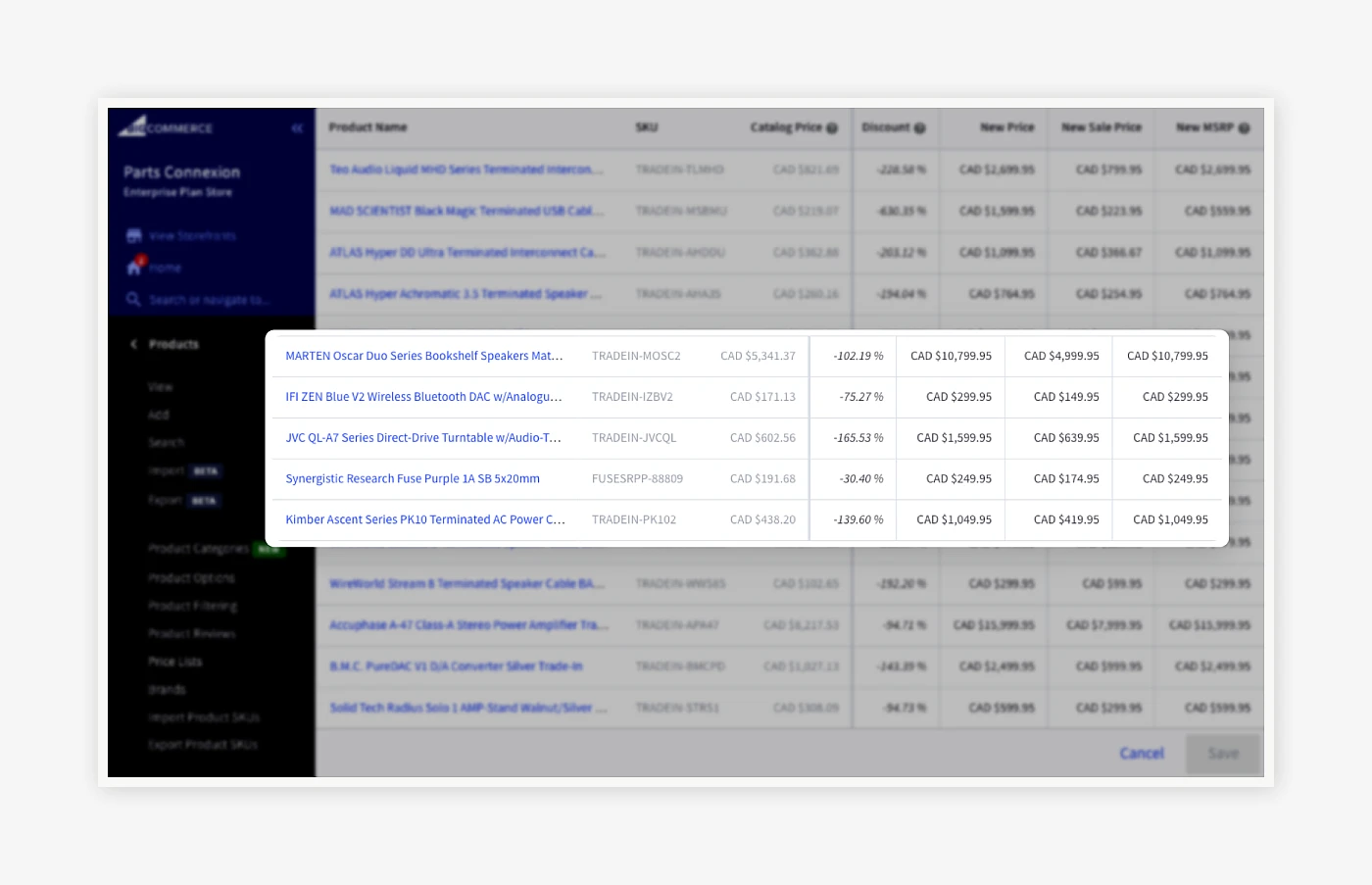
Custom MSRP-Based Discount Module With Overlap Prevention for Optimized Pricing
To fulfill the requirement of discounts based on MSRP, not the current price, we developed a custom discount engine. It consistently applied promotional discounts to MSRP regardless of existing markdowns. A $100 MSRP product on sale for $85, with a 25% discount, would become $75 instead of $63.75. Our logic also checked for discount conflicts, ensuring no overlap or unintended stacking. This system empowered the marketing team with precision while protecting profit margins and enhancing buyer trust.

Implementing Dual Frontend Solutions With a Unified Backend
We leveraged BigCommerce’s Channel Manager to deploy two distinct frontends-PartsConnexion and AudioConnexion-from a shared backend. We utilized tag-based product controls, assigning visibility to either or both storefronts. Shared SKUs maintained unified inventory while the user experience remained unique across both brands. The backend structure simplified merchandising workflows and enabled seamless backend operations. This architecture achieved the perfect balance of brand differentiation and operational efficiency, allowing each storefront to thrive without redundant data entry or inventory conflicts.

Custom Add-Ons and Automated Pricing With BigCommerce Modifiers for Tailored Product Options
We implemented BigCommerce’s product modifiers to handle nuanced customizations like matched vacuum tube outputs. Modifiers were automatically applied during product imports using structured tags. These modifiers enabled customers to select enhancements that adjusted final pricing in real time. The system supported complex rule sets, like optional pairing fees or performance grading, while ensuring backend consistency. This enabled customers to personalize products without confusion and allowed the team to maintain accurate inventory and pricing for customizable items.

Seamless Cross-Storefront Login With BigCommerce’s Multi-Pass Feature
To simplify access across the two storefronts, we enabled BigCommerce’s Multi-Pass login. This created a unified identity layer, allowing customers to register once and access both sites seamlessly. We wrote a custom script to assign new accounts to a universal store ID, syncing user data across storefronts. This eliminated duplicate accounts, improved customer retention, and streamlined user management. With one login, customers could explore the entire PartsConnexion and AudioConnexion catalog, creating a fluid shopping experience.

Enhancing User Engagement With eConnexion Sales Flyers
To elevate the newsletter-to-website connection, we created a homepage module called eConnexion Sales Flyers. This pulled live promotional data and rendered it in a visually branded block, consistent with email campaigns. The admin team could control layout, product visibility, pricing display, and branding elements directly from the BigCommerce backend. We introduced features like percent-savings highlights, quick-add to cart, and inquiry buttons. The result: increased user engagement, faster purchase decisions, and marketing promotions that felt consistent across every channel.

Seamless Shipping Integration With ShipperHQ for Advanced Logic
We configured ShipperHQ to accommodate dimensional packing, weight-based calculations, and custom pricing zones. Fixed shipping rates were enabled for standard box sizes, while live rate shopping handled complex shipments. We also relabeled Canada Post rates as USPS for U.S. customers to reduce brand confusion. In-store pickup options were enabled with geofencing radius control. This solution reduced cart abandonment due to unclear or inflated shipping costs and provided granular control over shipping rules for both Canada and U.S.-based logistics.

Custom Import/Export Modules for Selective Bulk Editing and Price List Management
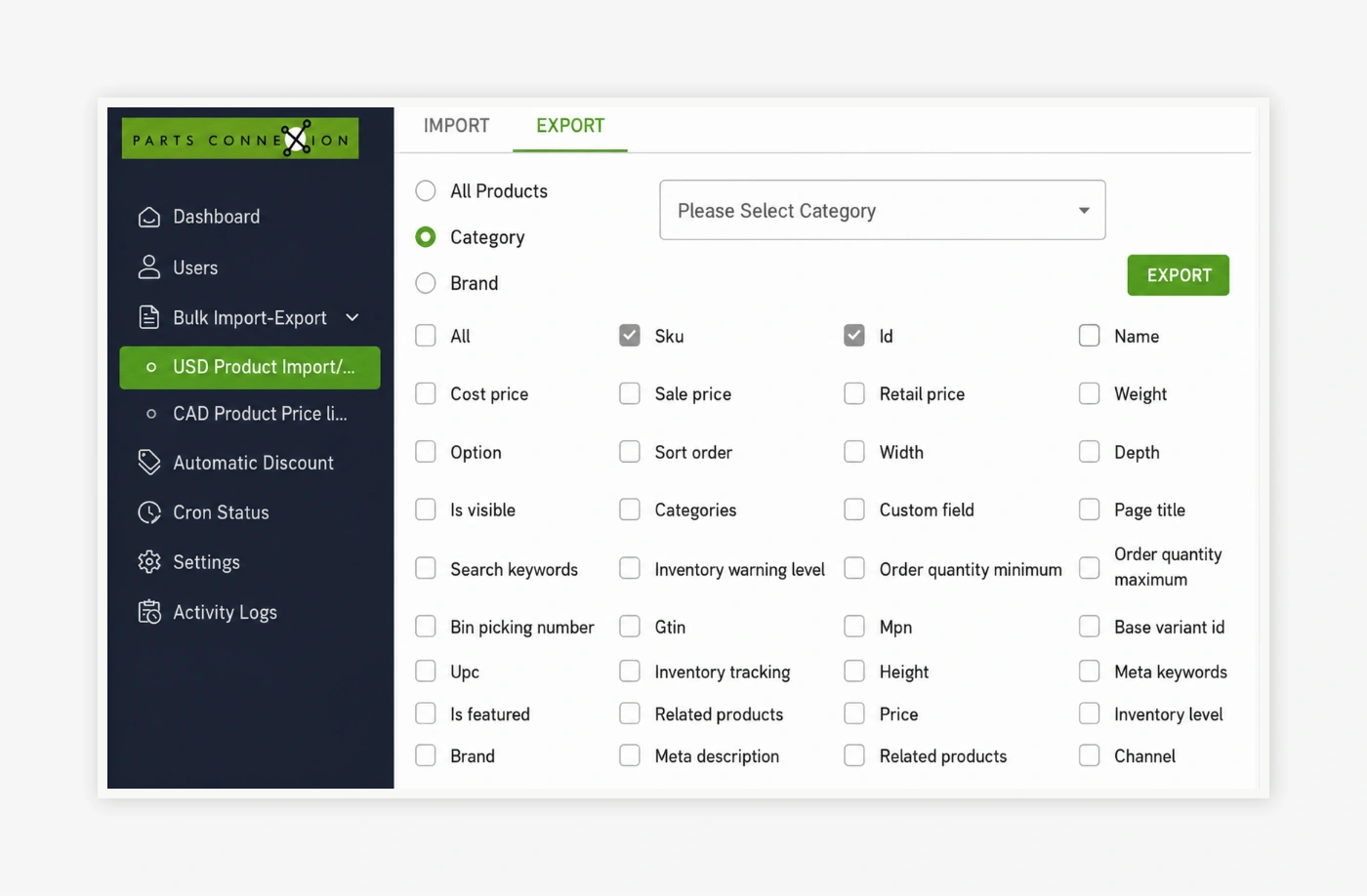
To overcome BigCommerce’s export limitations, we built two custom modules. One allowed selective field export, including custom fields like unit of measure, CAD-only pricing, and newsletter tags. Users could export by brand, category, or field group. The second module supported price list export/import, enabling fixed price management in CAD across product segments. These tools dramatically reduced manual work, increased data accuracy, and empowered the team to make bulk changes to their catalog without relying on third-party apps or error-prone spreadsheets. WebDesk Solution also built custom import and export tooling so the client could bulk edit pricing, metadata, newsletter tags, and other catalog fields that BigCommerce did not support natively.

Private Custom App Architecture Built for Flexibility, Speed, and Scalability
To meet PartsConnexion’s advanced functionality needs-such as unified login across storefronts, MSRP-based discount logic, newsletter deal synchronization, and bulk data manipulation-we developed a private custom app hosted on a secure, high-performance Node.js server. This app operates independently of BigCommerce’s front-end theme layer, allowing us to bypass the platform’s limitations while still leveraging its backend via robust API integration.
We built this app from the ground up using a modern tech stack:
- Backend: Node.js with Express.js for high-speed request handling
- Frontend: React.js for a responsive, SPA-like (Single Page Application) user experience
- Database: PostgreSQL to manage session data, discount rules, and data synchronization logic
- API Integration: OAuth-authenticated BigCommerce Storefront & Catalog APIs for real-time data sync
- Hosting: Deployed on a Heroku server with auto-scaling and load balancing enabled
This architecture allowed us to:
- Sync logins across PartsConnexion and AudioConnexion without user friction
- Maintain sub-300ms response times during complex logic execution
- Manage product-level export/import customization outside BigCommerce limits
- Execute logic like MSRP-based discounts that require middleware flexibility
- Isolate infrastructure for 99.99% uptime with token-based API security
By decoupling key workflows from BigCommerce’s native limitations, we enabled full customization, better performance, and future-proof scalability. Every advanced feature highlighted throughout this case study-from bulk product editing to cross-domain user sessions-is powered by this private custom app ecosystem.
This project became complex because the team had to replace a Shopify Plus setup that depended on deprecated checkout customization while preserving two storefronts, dual-currency payments, shared login, and cross-border shipping logic from one backend.
WebDesk Solution delivered the migration, custom app development, and integration work required to run two branded storefronts, dual-currency checkout, and shared customer access from one BigCommerce backend.
Outcomes/Results
Measurable Business Impact After Migration
- +92% conversion rate increase
- +5.39% revenue growth
- +30% increase in site traffic
- +15.52% increase in order volume
- Zero currency confusion at checkout
- Unified backend across brands with dual frontends
- Custom tools for pricing, discounting, and exporting saved countless admin hours
Conclusion: From Platform Uncertainty to a Future-Proof Commerce System
What started as a project beset by platform limitations and uncertainty became a blueprint for scalable eCommerce success. WebDesk Solution’s migration strategy and tailored custom app development empowered PartsConnexion to reclaim control, preserve brand integrity, and future-proof their operations. From dual storefronts and complex shipping logic to a private custom middleware app, every challenge was met with technical ingenuity and human-first strategy-unlocking an entirely new level of performance, customer satisfaction, and revenue growth.


