


Bio & Chic isn’t just another eCommerce business—it’s a movement. Based in New York City, this forward-thinking brand supplies biodegradable, compostable, and eco-conscious catering and baking supplies to event planners, party hosts, and businesses across the United States. Their warehouse operations out of New Jersey offer same-day shipping, and their product catalog—from bamboo plates to sugarcane-based utensils—is designed to minimize environmental impact while maximizing elegance.
But like many rapidly scaling brands juggling sustainability and logistics, their backend was starting to fray. Behind the scenes, Bio & Chic’s operations relied on Fishbowl ERP and a network of 3PLs. Unfortunately, their existing middleware couldn’t bridge the gap between their ERP and BigCommerce storefront. Stock levels were often out of sync. Orders were managed manually. And fulfillment across multiple warehouses was growing increasingly chaotic.
What they needed wasn’t just a connector—it was a full-on transformation. That’s when they reached out to WebDesk Solution.
WebDesk Solution was engaged to plan, build, and deploy a custom Fishbowl ERP and BigCommerce connector for Bio & Chic’s inventory and order workflows.
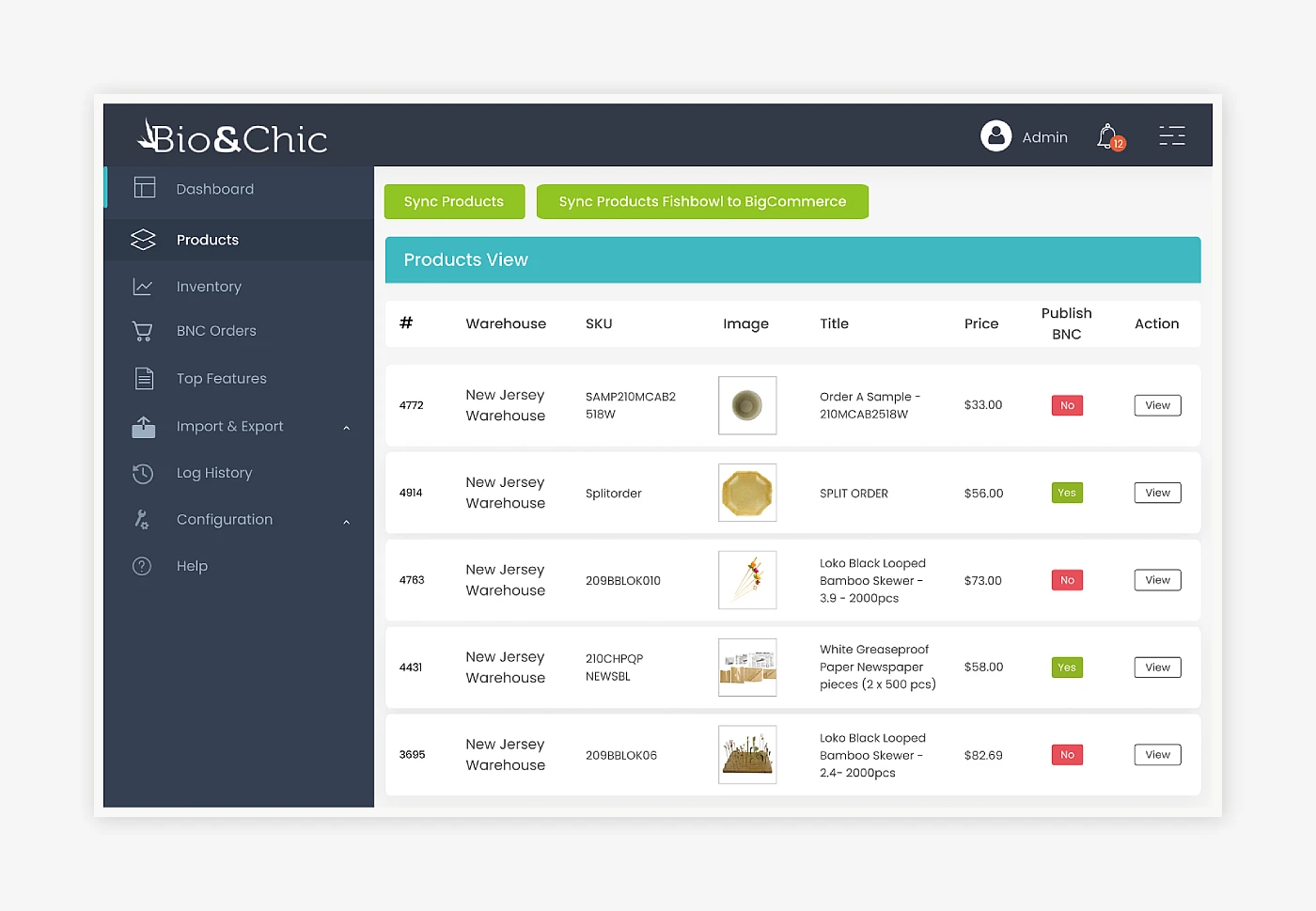
Approach
Having worked with Adam Merran, the founder of Bio & Chic, on previous projects, we knew the stakes. His team was burning hours daily reconciling product data, pushing updates manually from Fishbowl to BigCommerce, and navigating fulfillment headaches due to real-time stock discrepancies.
We kicked off with discovery calls led by Daniel and Sam from WebDesk Solution, diving deep into the operational architecture. We dissected how Fishbowl ERP interfaced with their warehouses, how orders flowed (or rather didn’t), and why their existing dashboard was failing. Our team also evaluated existing third-party Fishbowl web connectors, but none could handle the level of complexity required—especially around warehouse-based order splitting, dynamic stock syncing, and backorder management.
Adam wasn’t a technical founder, so our job was twofold: solve the problem and make the solution feel secure and understandable. We proposed building a custom web connector—hosted externally, API-integrated with both Fishbowl and BigCommerce, and tailored to Bio & Chic’s operations. We broke down the architecture, reassured Adam about uptime and continuity, and ensured the store could run uninterrupted while we developed the app.
The result? A bespoke ERP integration app that seamlessly connected Fishbowl to BigCommerce—engineered by WebDesk to turn logistical chaos into operational flow.
WebDesk Solution led the discovery and integration architecture work needed to support warehouse-based order splitting, inventory syncing, and backorder handling.
Why was a custom Fishbowl ERP and BigCommerce connector necessary for Bio & Chic’s multi-warehouse operation?
Bridging the System Divide – Building a Cloud-Hosted Custom Connector for ERP Integration
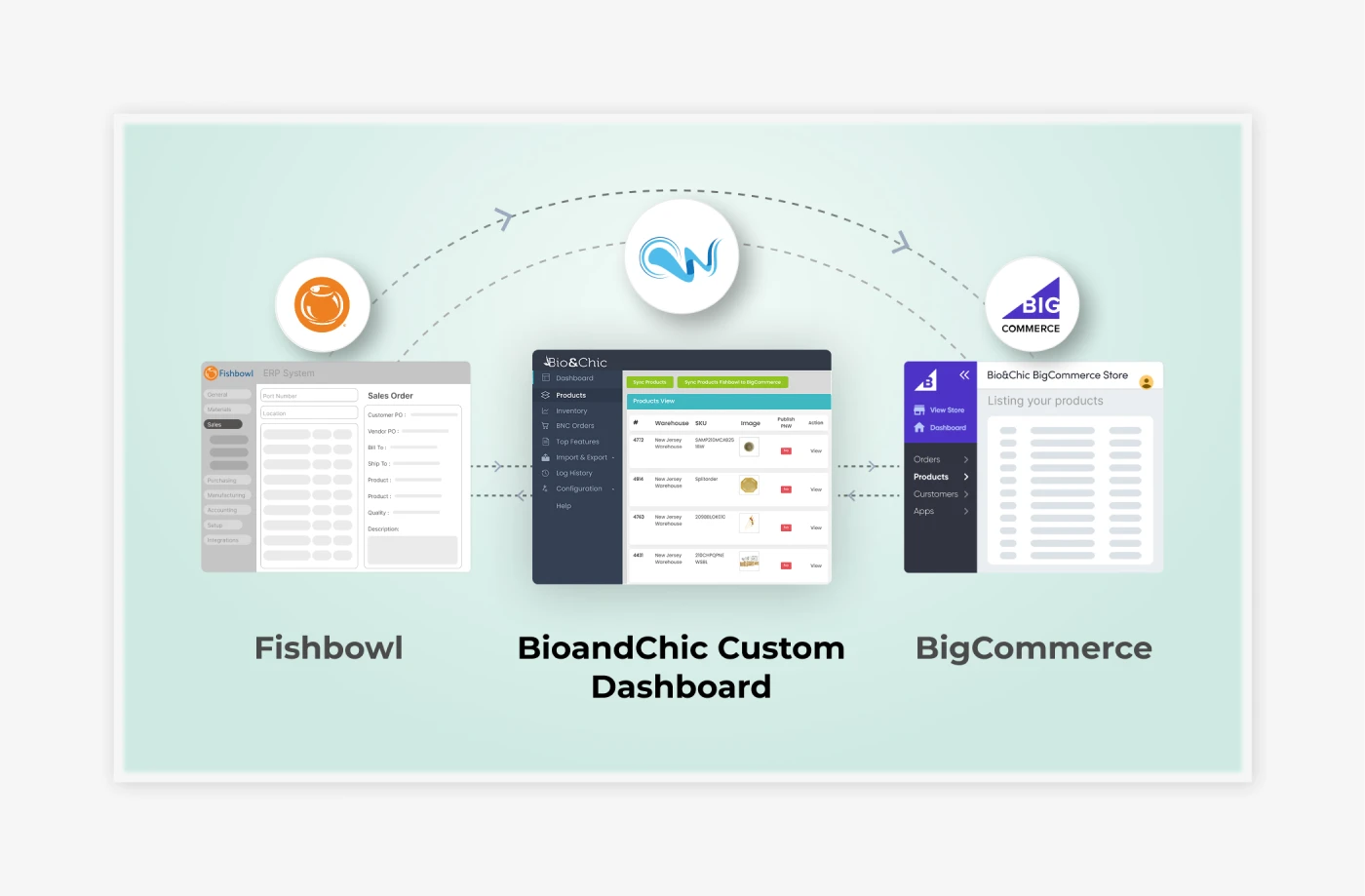
Bio & Chic’s middleware solution wasn’t built for the demands of a multi-warehouse, ERP-powered business. Their dashboard couldn’t accurately sync product or inventory data between Fishbowl and BigCommerce, leading to mismatched stock levels across locations. Fishbowl’s on-premise infrastructure and rigid data schema made native integration nearly impossible. To make matters more complex, their fulfillment operations spanned multiple warehouses via 3PLs. WebDesk needed to host Fishbowl in the cloud, build PHP scripts for real-time sync, and create a resilient architecture to handle data flow between two systems not designed to speak to each other.
Missing Backorder Logic – Fixing What BigCommerce Doesn’t Handle
Out-of-stock products meant lost sales. BigCommerce, by default, rejects purchases of unavailable items—leading to abandoned carts and frustrated customers.
Fishbowl, on the other hand, lacked an integrated system for backorders on the eCommerce front. Bio & Chic needed a reliable way to process and track backorders across multiple warehouses without adding complexity for customers. This wasn’t just a feature gap—it was a business continuity risk that could hurt customer retention and brand reputation.
Multi-Warehouse Inventory Sync – Complex Logic, Real-Time Accuracy
Inventory across multiple warehouse locations needed to be synchronized with precision. The challenge was twofold: Fishbowl’s data structure required interpretation before syncing, and BigCommerce lacked multi-location inventory intelligence out of the box. Bio & Chic’s admin team needed control over how and when to sync, without disrupting the live store. We had to deliver a flexible, admin-friendly solution that provided automated syncing, with safeguards against timing conflicts and data mismatches—all while optimizing for performance.
Automating “Top Features” – Making Marketing Simpler Through Smart Data
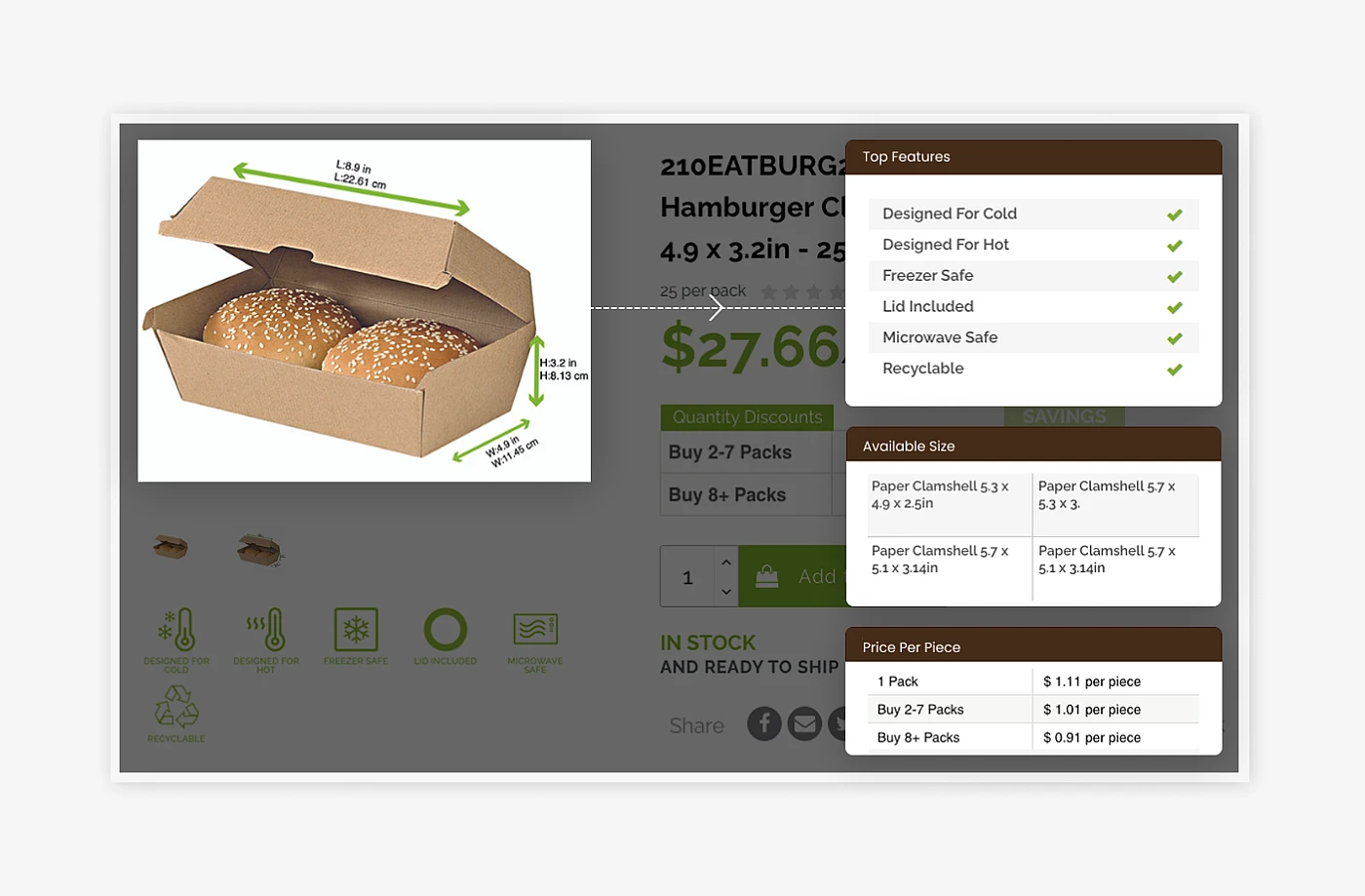
Bio & Chic wanted to highlight best-selling products on their BigCommerce store automatically, without relying on manual tagging or updates. However, this meant customizing Fishbowl’s internal functionality to support dynamic marketing-driven product listings. We needed to create a flow that allowed real-time syncing of “Top Feature” products between ERP and frontend—one that was easy to manage and immune to data lag or sync errors.
Key Performance Results


How did WebDesk Solution build the Fishbowl ERP and BigCommerce integration for inventory sync and backorders?
Custom PHP Connector Between Fishbowl ERP and BigCommerce
We developed a fully custom PHP-based integration layer, linking Fishbowl’s hosted environment with BigCommerce through secure RESTful APIs. Our architecture included bi-directional data mapping, JSON payload standardization, and error-handling routines to maintain data integrity across endpoints. We leveraged asynchronous job queues to manage high-frequency syncs without performance bottlenecks. By cloud-hosting Fishbowl and implementing secure token-based authentication, we unlocked greater speed, ensured 24/7 availability, and solved latency and handshake timeout issues. With this system, Bio & Chic gained complete visibility across all inventory and order workflows—fully automated, resilient, and scalable.
Backorder Automation with Order Splitting Intelligence
To tackle the backorder gap, we engineered a custom logic module within our connector, backed by event-driven architecture. When a customer placed an order for both in-stock and out-of-stock items, the system used real-time stock verification via API to split the order. An intelligent fulfillment engine generated distinct order objects with traceable UUIDs for each subset. Customers could track order segments through webhook-based notifications and were presented dynamic options through a rules-based logic interface. This minimized manual intervention while optimizing fulfillment latency and improving customer transparency.

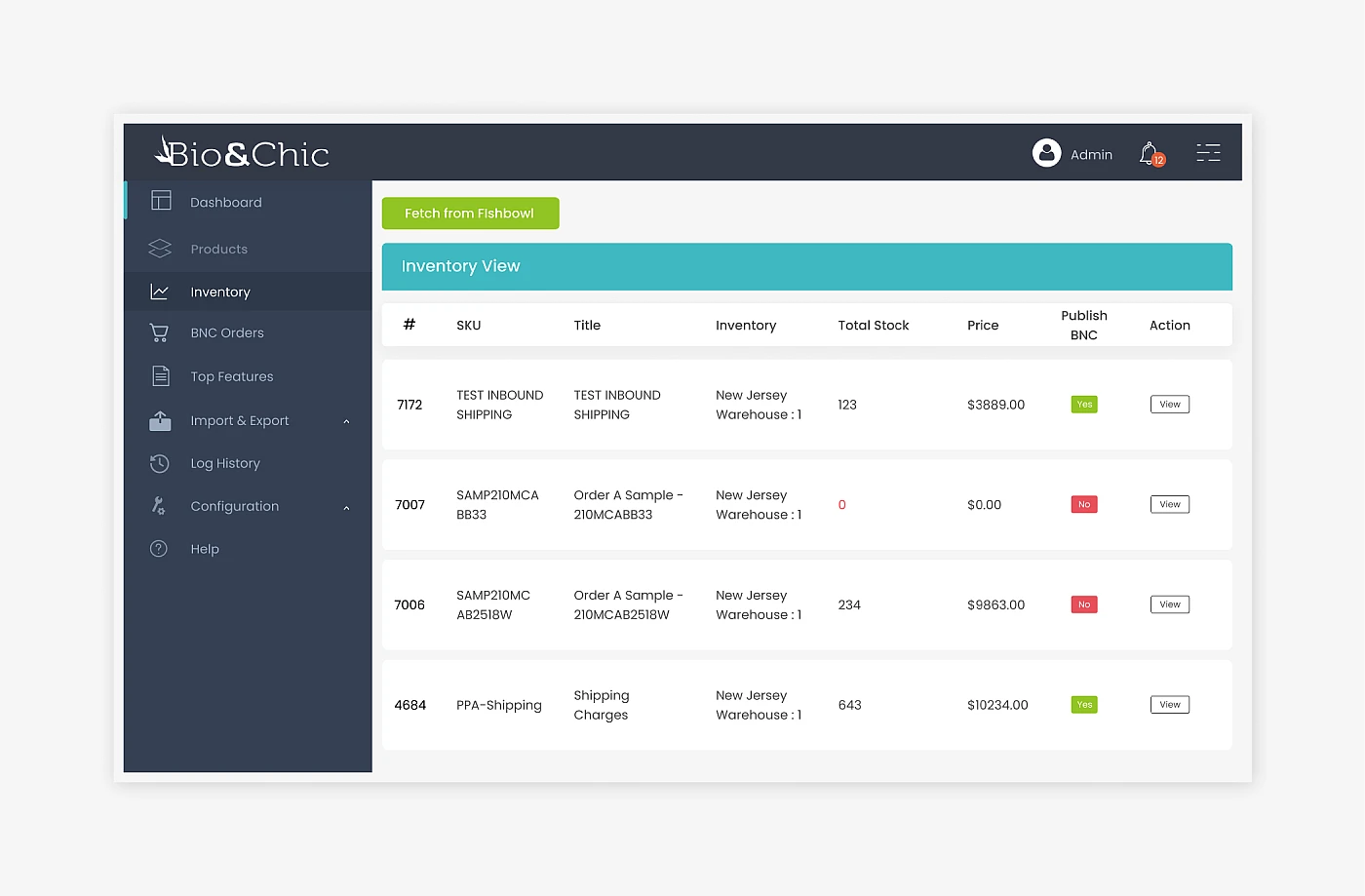
Multi-Warehouse Sync Module with Admin Controls
We built a robust inventory synchronization module featuring configurable cron-based scheduling and granular warehouse-level inventory throttling. The sync logic used delta comparisons to avoid unnecessary API calls, thereby reducing load while ensuring precision. Admins could define sync frequencies and priority queues per SKU, location, or stock threshold using a rule-based configuration panel. With full transactional logging and rollback capabilities, this system ensured data consistency across distributed inventory nodes—empowering operations to be both adaptive and audit-ready.
“Top Features” Automation Engine
We extended Fishbowl with a lightweight yet extensible module powered by a customizable algorithm that ranks products based on sales velocity and time-based performance metrics. This module writes directly to a data layer synchronized with BigCommerce using scheduled API pushes. By embedding business logic directly within the ERP’s SQL-based reporting system, we enabled dynamic flagging of high performers, automatically syncing them with the frontend. The Top Features engine operates autonomously, supported by exception tracking and fallback hierarchies for data gaps—ensuring stability in dynamic catalog environments.

What changed after Bio & Chic’s custom Fishbowl ERP and BigCommerce integration went live?
Inventory syncs now happen in real time across all Bio & Chic warehouses, eliminating errors and manual interventions.
The backorder experience was transformed: customers can now track partial orders, receive updates, and cancel items seamlessly.
Operational efficiency soared. Admins now manage inventory, fulfillment, and updates from a centralized interface with precise control.
Customer experience improved significantly, thanks to accurate stock visibility, fewer cart abandonments, and better communication around orders.
Product marketing became agile. Best-selling items are always up-to-date and prominently featured on the storefront.
Conclusion
This case study documents WebDesk Solution’s experience delivering custom Fishbowl ERP and BigCommerce integration work for multi-warehouse inventory and backorder requirements.
Bio & Chic’s eCommerce operations once ran on fragmented systems and manual effort. Now, they’re powered by a fully integrated ecosystem—intelligent, automated, and scalable. Through custom-built API connectors, cloud-hosted ERP architecture, and user-centric modules, WebDesk Solution gave Bio & Chic the tools to grow without chaos.
This wasn’t just an integration project—it was a digital transformation. Adam and his team now have confidence in their operations, the freedom to scale, and a technology partner ready for what’s next. As they continue to expand their eco-conscious brand, WebDesk Solution remains on standby—engineering the future of sustainable eCommerce, one connector at a time.


