


Overview
ProsetGolf, a rapidly expanding leader in the golf equipment rental industry, recognized that their legacy WordPress infrastructure was no longer capable of supporting the operational precision required for a modern rental marketplace. Their business model depended on real-time equipment availability across multiple vendors and locations, yet their system lacked the architectural sophistication to manage time-based inventory, vendor coordination, and transactional accuracy.
To remain competitive in the U.S. rental marketplace, ProsetGolf needed more than incremental improvement-they required a purpose-built digital ecosystem designed specifically for rental commerce. They partnered with WebDesk Solution to architect a fully custom multi-vendor rental system capable of managing complex booking logic, vendor operations, and dynamic inventory across distributed locations.
WebDesk engineered a comprehensive platform using React.js and Node.js, supported by a rental-optimized data architecture and real-time availability intelligence. This transformation was not merely a redesign-it was a full-scale reengineering of how rental transactions, inventory movement, and vendor coordination function within a high-growth environment.

Approach
WebDesk Solution initiated the engagement with a comprehensive technical and operational audit of ProsetGolf’s WordPress environment. The assessment revealed systemic architectural constraints: fragmented data models, plugin dependency conflicts, limited transactional control, and no deterministic mechanism for managing time-based inventory. Rather than retrofit a system fundamentally misaligned with rental operations, WebDesk proposed a ground-up rebuild tailored specifically for custom multi-vendor rental system development.
The platform architecture was designed around modular service domains-availability computation, booking orchestration, vendor management, commission reconciliation, and payment lifecycle control. Each module operates independently yet communicates through secure APIs, ensuring extensibility without systemic risk. PostgreSQL was selected for its relational integrity and performance in handling interdependent rental data structures.
From a customer experience perspective, WebDesk implemented an availability-first discovery framework. The booking journey begins with temporal and geographic filters, ensuring customers interact only with inventory that is verifiably available. This design dramatically reduces uncertainty and increases conversion confidence.
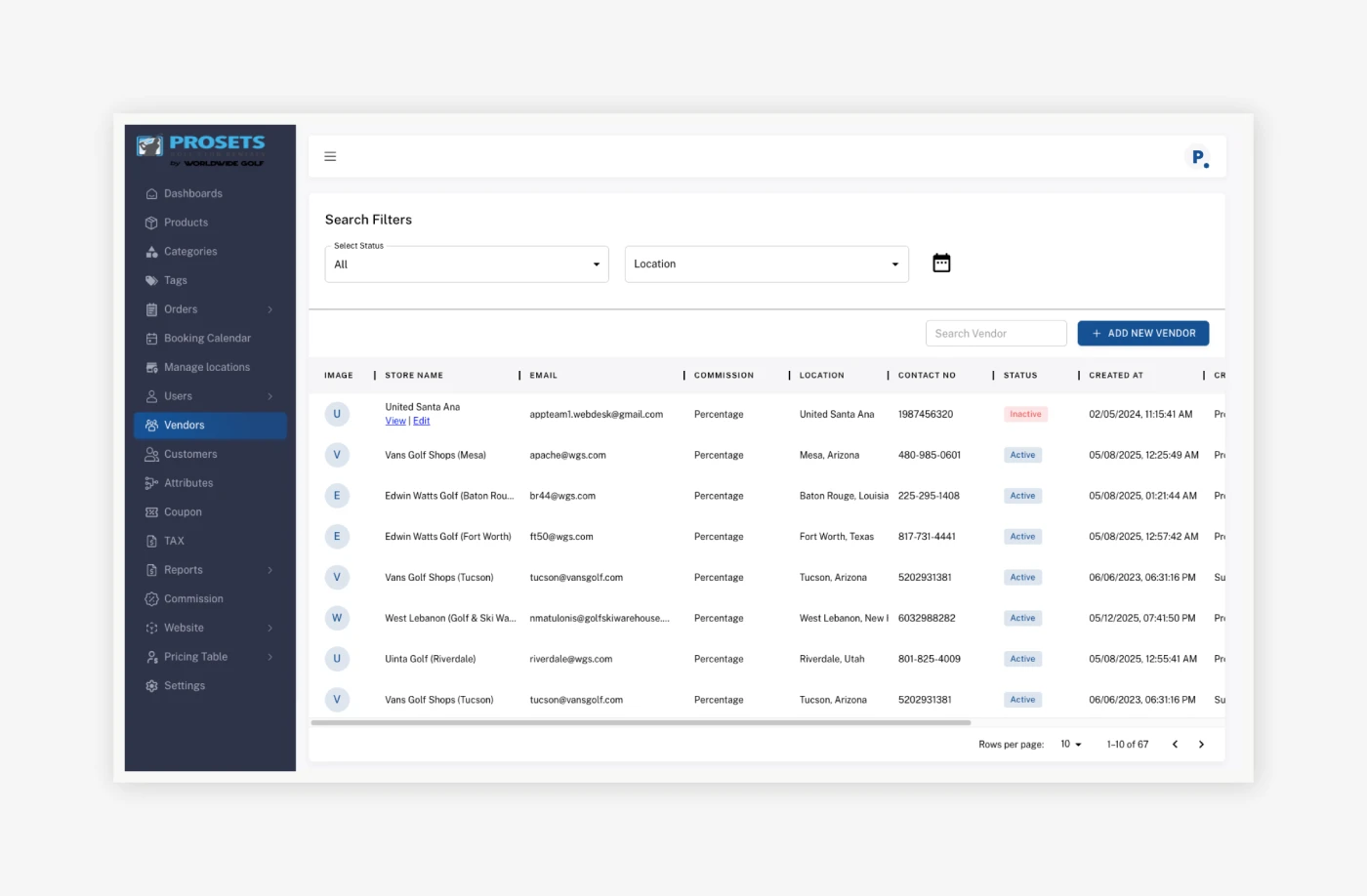
Operationally, role-based dashboards were engineered for customers, vendors, and master administrators. These interfaces replaced manual coordination with automated workflows, real-time reporting, and centralized control. The result is a production-grade rental marketplace engineered for accuracy, transparency, and sustained growth within the U.S. rental economy.
Challenges
Architectural Breakdown of a Non-Rental Native Platform
ProsetGolf’s WordPress environment lacked the computational model required for time-dependent inventory management. Rental availability, vendor ownership, and booking lifecycle events existed across disparate plugins with no authoritative system of record. This fragmentation created operational blind spots-vendors could not reliably verify reservations, administrators lacked real-time oversight, and inventory allocation required manual validation. As booking volume increased, the absence of deterministic logic led to systemic inefficiencies and elevated operational risk. The platform was structurally incapable of supporting a scalable multi-vendor rental marketplace.
High-Risk Data Migration Without Structured APIs
Legacy data was inconsistently structured and lacked relational integrity. Products, bookings, attributes, and vendor relationships existed in loosely coupled formats unsuitable for a modern rental architecture. Migrating this data into a new system required reconstructing relationships while preserving historical accuracy-critical for financial reconciliation and vendor trust. Without a reliable API framework, extraction and transformation posed significant risk of data corruption, mismatched bookings, and operational downtime.
Absence of Deterministic Availability Intelligence
Customers could browse equipment without confirmation of availability, only discovering conflicts during checkout. This product-first interaction model contradicted rental commerce fundamentals, where temporal availability is the primary purchase condition. The absence of real-time availability computation increased abandoned sessions, customer support workload, and reputational risk. ProsetGolf required a booking paradigm centered on verifiable inventory availability across time windows and locations.
Multi-Vendor Inventory Collision and Financial Ambiguity
Managing overlapping rental windows across multiple vendors introduced complex inventory concurrency challenges. The existing system lacked atomic controls to prevent double bookings or ensure inventory restoration after returns. Additionally, vendor commission calculation and settlement tracking were manual, error-prone, and opaque. This environment created financial reconciliation risk and strained vendor relationships-untenable for a marketplace scaling across U.S. locations.
Payment Lifecycle Complexity and Infrastructure Inefficiency
Rental commerce requires nuanced financial workflows, including authorization holds, staged capture, and automated refunds tied to operational events. The existing system could not support these workflows reliably. Simultaneously, Cloudinary bandwidth consumption generated unpredictable infrastructure costs, while timezone inconsistencies caused booking misalignment for geographically distributed users. Financial precision and global reliability were non-negotiable requirements.
Key Metrics




Solutions
Purpose-Built Multi-Vendor Rental Platform Architecture
WebDesk engineered a custom Node.js backend and React-based frontend designed explicitly for rental marketplace operations. The system centralizes inventory, bookings, vendor ownership, and transactional workflows within a unified operational core. Each domain-inventory lifecycle, vendor management, payment orchestration, and commission accounting-operates through structured services governed by a single source of truth. This architecture provides the deterministic control required for enterprise-grade rental marketplace software in the USA.


Rental-Optimized Data Model and Direct Database Migration Framework
WebDesk designed a relational data architecture treating bookings, vendors, inventory, and temporal availability as interdependent entities. A custom migration framework performed direct database extraction, normalization, validation, and relational reconstruction without API reliance. Historical bookings were preserved with full referential integrity, ensuring continuity for financial and operational reporting. The migration did not merely transfer data-it established a scalable foundation for long-term system intelligence.


Availability-First Booking Engine with Atomic Inventory Control
The customer journey was reengineered around temporal availability verification. Real-time availability computation evaluates inventory across overlapping booking windows and locations. A high-precision booking engine employs timestamp-based request sequencing and atomic inventory locking to prevent concurrency conflicts. This deterministic model eliminated double bookings and established transactional trust across the platform.

Unified Vendor Operations and Automated Commission Framework
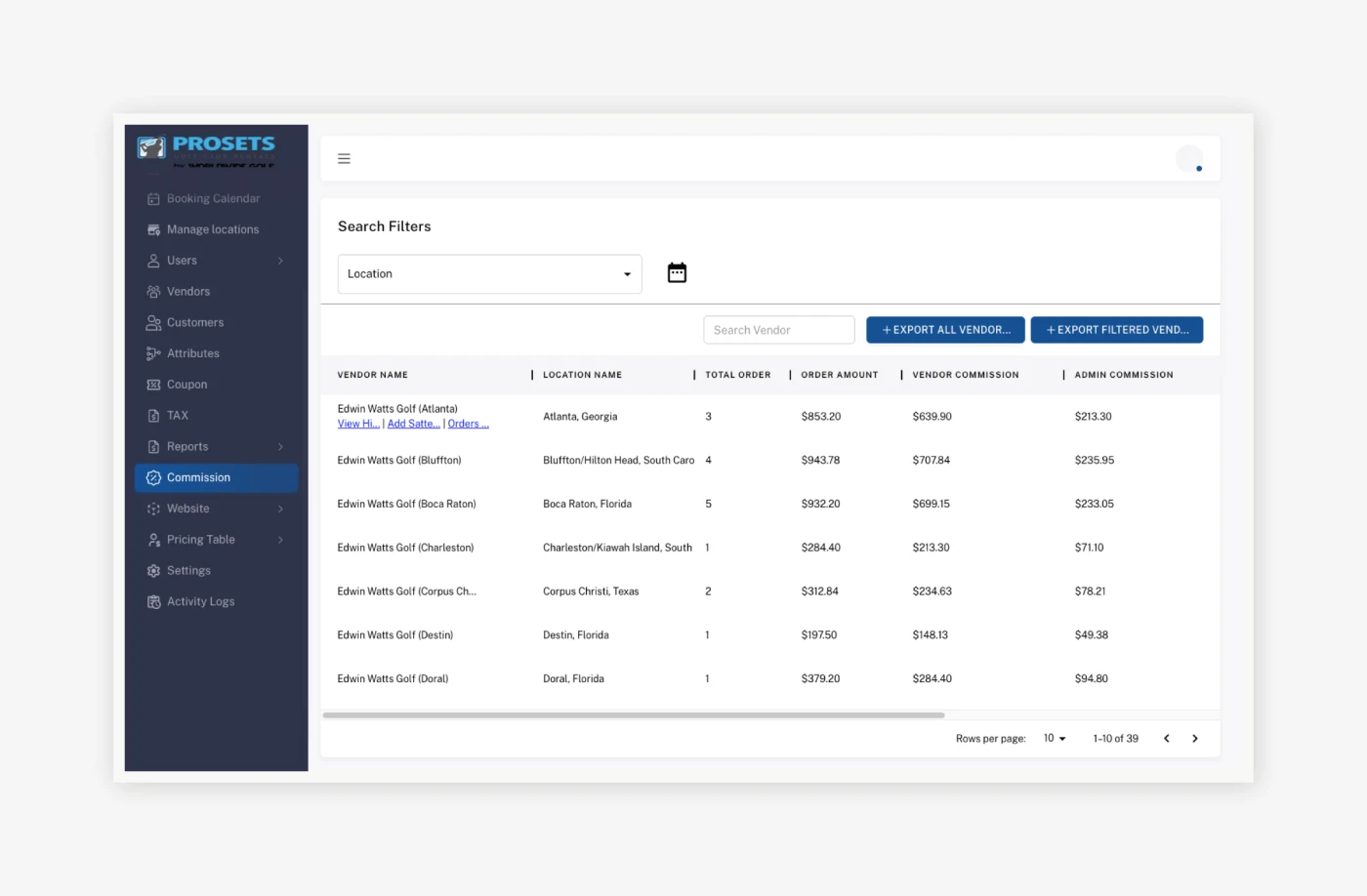
WebDesk implemented role-based dashboards enabling vendors to manage inventory, monitor bookings, and track financial performance in real time. Inventory automatically adjusts across booking, return, and maintenance buffer periods. Commission calculations are executed algorithmically per transaction, generating immutable settlement records and exportable reports. This system created operational transparency and scalable vendor governance.

Secure Payment Orchestration and Infrastructure Optimization
A multi-stage Stripe integration was deployed to manage booking charges, authorization holds, refunds, and vendor-aware settlement workflows. Payment states synchronize directly with booking lifecycle events to ensure financial accuracy. Media assets were migrated from Cloudinary to AWS S3 through a zero-downtime pipeline, reducing infrastructure expenditure by approximately 90%. Timezone normalization ensures bookings are stored in store-local time while rendered accurately for global users.


Outcomes/Results
The transformation delivered substantial operational and commercial impact across the platform.
Successful bookings increased by 150%, driven by an availability-first discovery model, while atomic inventory control eliminated booking conflicts entirely.
Conversion rates improved by 200% as confidence-driven UX streamlined the purchase journey.
Infrastructure costs were reduced by approximately 90% following migration to AWS S3, alongside significant vendor time savings achieved through automated workflows.
Product rendering performance accelerated by 45–60%.
The introduction of guest checkout contributed to a further 32% increase in bookings.
Customer satisfaction improved due to consistently reliable booking accuracy.
Conclusion
ProsetGolf’s platform transformation represents a definitive example of enterprise-grade custom multi-vendor rental system development in the USA. By replacing a fragmented CMS environment with a purpose-built rental architecture, WebDesk Solution delivered a scalable ecosystem capable of managing complex vendor networks, time-based inventory, and high-volume transactional workflows with precision.
This engagement demonstrates how deep technical engineering-availability computation, atomic booking orchestration, and relational data modeling-translates directly into commercial performance. The platform now operates as a conflict-free rental marketplace engineered for expansion across new locations, vendors, and product categories.
WebDesk Solution continues to support ProsetGolf’s roadmap evolution, including AI-driven inventory forecasting, automated damage assessment workflows, and advanced vendor analytics. The system is not merely modernized-it is architected for the future of digital rental commerce.


