

Overview
Greg William Steele and his wife, Nadine, weren’t just launching another Shopify store — they were stepping into a business model defined by automation, supplier dependency, and razor-thin margins. Together, they founded GWS Inc. with the ambition to curate a wide range of gifts, electronics, sporting goods, and lifestyle products through a modern dropshipping ecosystem. The vision was bold: a flexible online storefront that could evolve with market demand, operate without inventory overhead, and scale without operational chaos.
But ambition met reality fast. There was no existing infrastructure. No validated fulfillment model. No product niche to anchor branding decisions. And no technical foundation capable of supporting automated order routing, supplier integrations, or conversion-optimized UX. Greg brought experience in IT project management. Nadine brought creative intuition and brand sensibility. What they didn’t have was a system — the kind that quietly carries thousands of moving parts without breaking under pressure.
They weren’t asking WebDesk Solution to “build a website.” They needed a complete digital operating model — one that could handle supplier volatility, automate fulfillment logic, support future category expansion, and convert first-time visitors into paying customers.
What followed was a high-stakes transformation. One that required architectural clarity, strategic restraint, and technical discipline from day one. This was not about launching fast. It was about launching right.
Approach
Before WebDesk Solution entered the picture, Greg and Nadine were navigating the dropshipping landscape with more questions than answers. They were evaluating Fulfillment by Amazon alongside supplier-based dropshipping, unsure how these models would coexist inside Shopify. Supplier reliability was uncertain. Domain ownership was fragmented. Platform assumptions were based on surface-level research rather than execution realities. Every decision felt urgent — and potentially irreversible.
WebDesk Solution stepped in not as builders, but as strategic operators.
Our first move was discovery — deep, uncomfortable, and necessary. We challenged assumptions, mapped dependencies, and translated technical constraints into business consequences. We clarified what Shopify could and could not do out of the box. We evaluated automation risks, supplier behavior patterns, and long-term scalability implications. Only then did we define the build path.
From branding and domain control to dropshipping workflows and checkout logic, every layer was engineered with intent. Weekly working sessions became execution war rooms — obstacles removed, decisions documented, and progress aligned with the long game. When domain access delays surfaced, we navigated ownership resolution. When supplier instability threatened early momentum, we restructured workflows instead of forcing fragile integrations.
By the end, GWS Inc. didn’t just have a store. They had operational clarity, technical control, and confidence — the difference between guessing and building a real business.
Challenges
Fulfillment Architecture & Automation Misalignment at the Core
At the heart of GWS Inc.’s early strategy was a well-intentioned but structurally dangerous idea: combining Amazon FBA with third-party dropshipping suppliers inside a single Shopify environment. On paper, it promised flexibility. In reality, it introduced conflicting automation logic that threatened the platform’s long-term viability.
Amazon FBA operates on centralized inventory ownership, rigid fulfillment rules, and Amazon-controlled customer communication. Dropshipping relies on decentralized suppliers, asynchronous order confirmations, variable shipping timelines, and external inventory feeds. Trying to unify these systems would have fractured checkout logic, broken post-purchase automation, and introduced reconciliation nightmares across orders, refunds, and customer support.
This wasn’t a surface-level configuration issue. It was an architectural fork in the road. Choosing wrong would lock the business into technical debt that grows more expensive with every order processed. Rebuilding later would mean migrating data, re-engineering workflows, and retraining operations — all under revenue pressure.
The challenge required more than development expertise. It demanded strategic intervention, translating invisible system risks into tangible business consequences and helping the founders make a decision that protected future scalability.
Building Brand Credibility and UX Without a Defined Product Niche
Most eCommerce brands start with a niche, then design around it. GWS Inc. started with possibility.
Without a locked-in category, the brand faced a unique risk: appearing generic, unfocused, or untrustworthy to first-time visitors. At the same time, committing to a rigid visual identity too early would restrict future growth and force costly redesigns as the product mix evolved.
From a UX perspective, the site needed to guide discovery across multiple categories while maintaining coherence. Navigation logic, category hierarchy, product presentation, and homepage storytelling all had to work without anchoring to a single audience persona. From a technical standpoint, the Shopify theme needed to be modular, scalable, and performance-optimized across devices.
This wasn’t a design problem — it was a systems design problem disguised as branding. The challenge was to create credibility without confinement, flexibility without chaos, and personality without narrowing future opportunity.
Deployment Risk and Post-Launch Operational Volatility
As the platform approached launch readiness, execution risks surfaced fast. Domain credential access delays stalled DNS configuration, SSL provisioning, and live publishing — effectively freezing the go-live window. For first-time founders, every delay amplified uncertainty and pre-revenue exposure.
Then came post-launch volatility.
Supplier behavior through Spocket introduced order cancellations and fulfillment inconsistencies — not due to platform failure, but due to external dependency risk. Without clear diagnostics, it’s easy to blame the system when the real issue lies upstream. Left unmanaged, this volatility could erode customer trust before the brand had a chance to establish itself.
The challenge wasn’t just launching the store. It was launching with operational control, clarity, and resilience in an ecosystem where not everything is within your control.
Key Metrics




Solutions
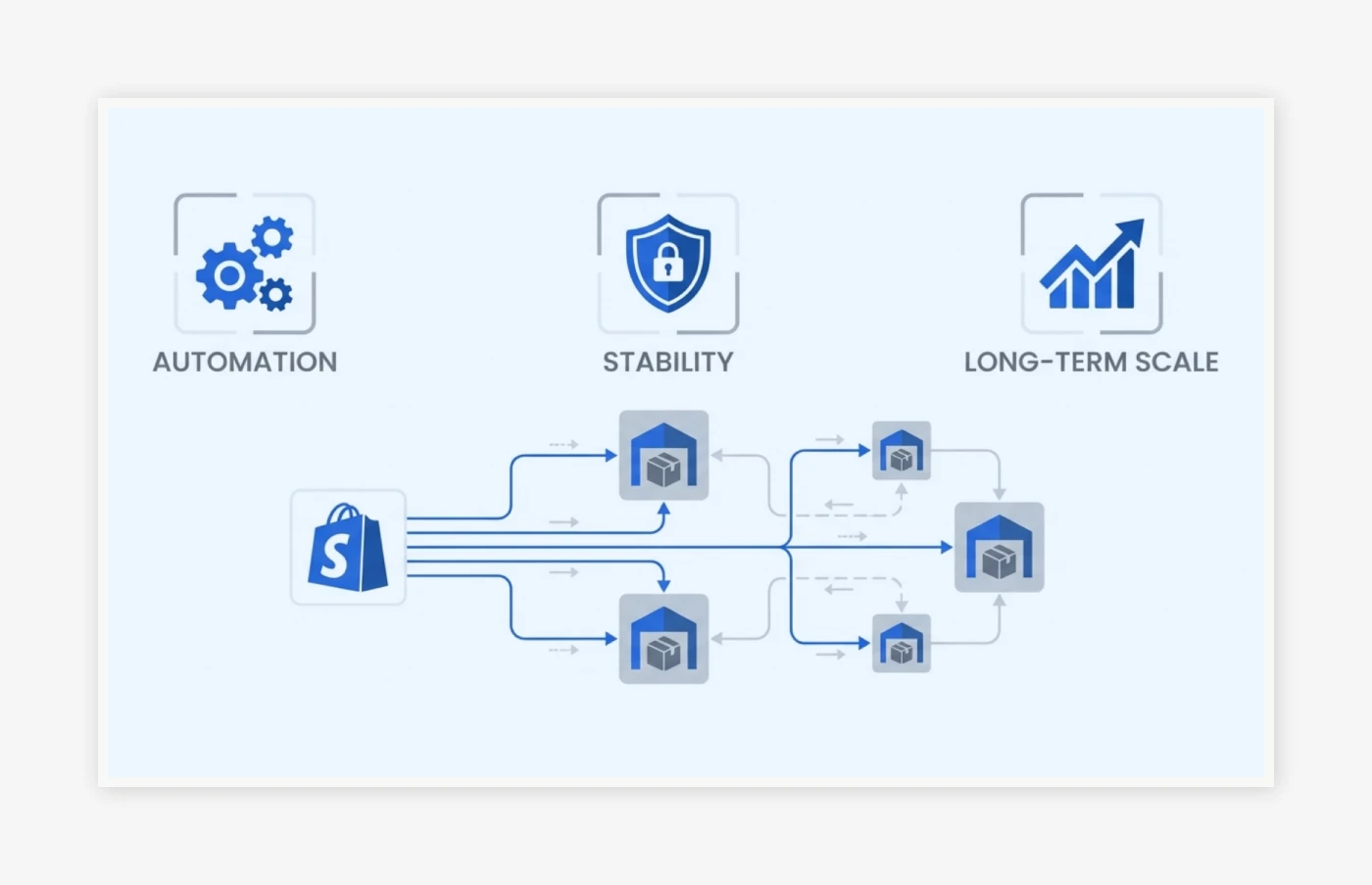
Unified Dropshipping Architecture Engineered for Automation, Stability, and Long-Term Scale
WebDesk Solution approached the fulfillment challenge as a systems architecture problem, not a plugin-selection exercise. Early in discovery, we mapped both Fulfillment by Amazon (FBA) and supplier-based dropshipping workflows at a transactional level — order creation, inventory synchronization, fulfillment confirmation, refund handling, and customer communication touchpoints. This revealed a critical reality: Shopify cannot natively reconcile Amazon-governed fulfillment logic with decentralized supplier-driven workflows without introducing brittle automation layers and manual exception handling.
Rather than allowing the client to proceed with a technically fragile hybrid model, we led a consultative realignment process. We translated architectural risk into operational consequences — delayed orders, inconsistent checkout behavior, broken automation chains, and escalating maintenance costs as order volume increased. This wasn’t about preference; it was about protecting the platform from structural failure six months down the line.
Once aligned on a unified dropshipping strategy, we engineered a Shopify architecture optimized for decentralized fulfillment. Backend order logic was structured to support asynchronous supplier processing while maintaining consistent customer-facing communication. Automation flows were intentionally designed to scale — allowing additional suppliers, product categories, and order volume without reengineering core logic.
By removing fulfillment conflict at the foundation, we eliminated future technical debt before it could form. The result was a clean, automation-ready ecosystem capable of supporting growth without introducing fragility — a critical distinction between a store that launches and a business that survives.
Modular Brand System and Adaptive UX Architecture Built for an Undefined Market
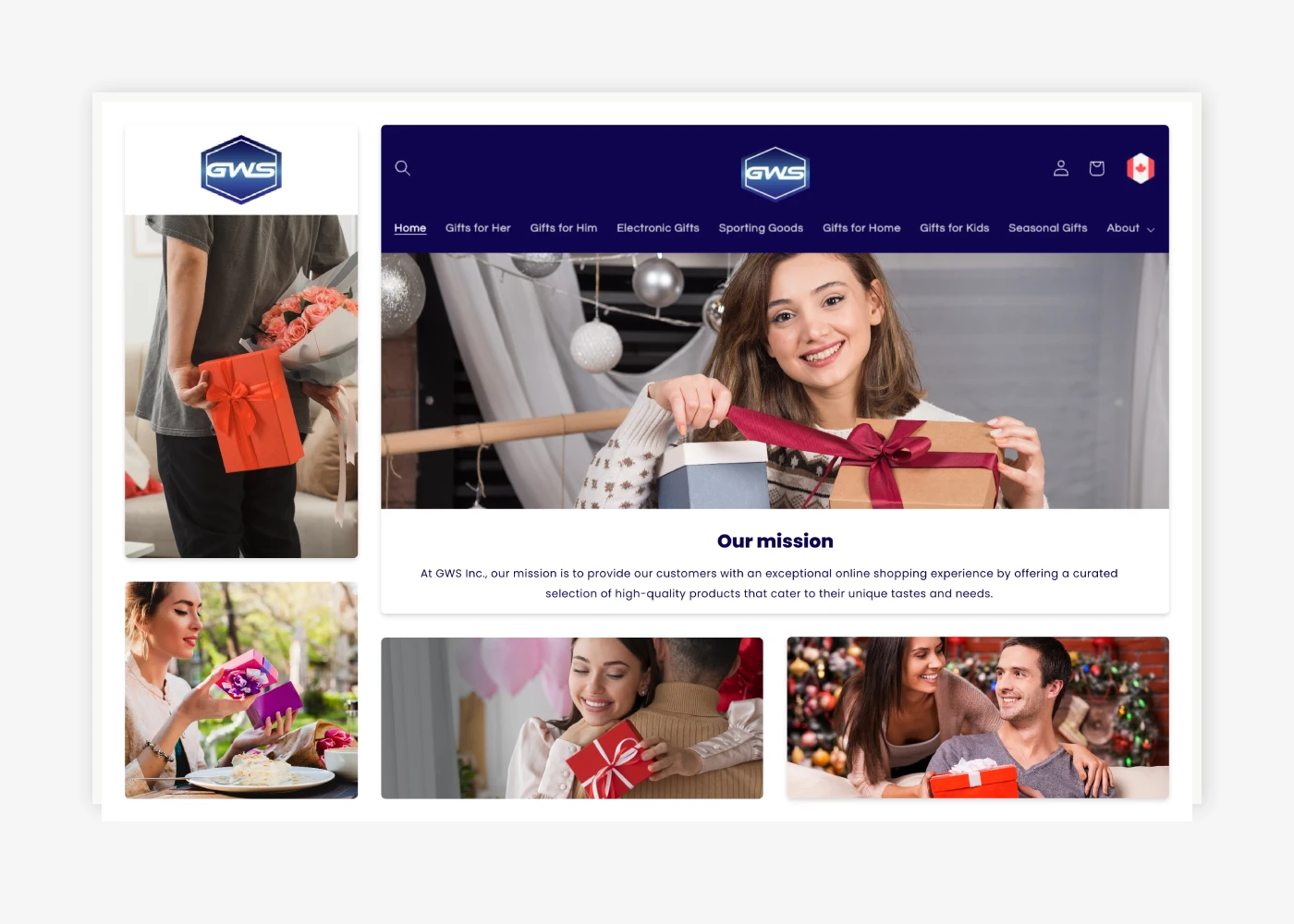
WebDesk Solution recognized early that branding GWS Inc. as a fixed-category store would create long-term constraints. Instead of designing around a niche that didn’t yet exist, we architected a brand system — not a brand aesthetic. This distinction mattered. A static identity would have required redesigns as product categories evolved. A system could flex without breaking cohesion.
We began by defining foundational brand principles — trust, clarity, and approachability — rather than category-specific messaging. From there, we developed a modular design framework: typography rules that scaled across content density, color hierarchies that supported both lifestyle and technical products, and spacing logic that preserved visual rhythm regardless of category mix.
On the UX side, Shopify theme architecture was treated as a structural asset. We implemented dynamic sections, reusable content blocks, and configurable layout patterns that allowed merchandising to evolve without code changes. Navigation logic was intentionally designed to support discovery across multiple verticals without overwhelming first-time visitors — a common failure point for early-stage dropshipping stores.
Crucially, we avoided over-design. Every UX decision balanced conversion psychology with operational simplicity. The outcome was a storefront that felt intentional and premium from day one, yet remained adaptable as the business refined its product focus — protecting both brand credibility and future scalability.

Controlled Deployment Execution and Post-Launch Operational Enablement
When domain access delays surfaced, WebDesk Solution treated the issue as an execution risk, not a blocker. Rather than pausing momentum, we preserved a fully staged production environment — preconfigured Shopify settings, validated integrations, finalized theme assets, and prepared publishing workflows. This ensured that once credentials were restored, launch execution would be immediate, clean, and uncompromised.
DNS configuration, SSL provisioning, and domain mapping were executed with zero rework, preventing the cascading delays that often derail first-time eCommerce launches. This approach protected timeline integrity and reduced founder anxiety during a critical pre-revenue phase.
Post-launch, we shifted focus from deployment to operational stability. Supplier volatility through Spocket presented fulfillment inconsistencies that could easily be misattributed to platform failure. WebDesk Solution conducted integration diagnostics to isolate supplier-side behavior from Shopify performance, allowing informed decision-making rather than reactive fixes.
Beyond troubleshooting, we enabled autonomy. We provided hands-on backend training covering order management, supplier exception handling, and customer communication workflows. Greg and Nadine were equipped not just to operate the platform, but to understand it — reducing dependency and increasing confidence.
The result was more than a successful launch. It was a controlled transition into live operations, with resilience built into both the system and the people running it.

Outcomes / Results
Turning Visitors into Customers
Within the first month post-launch, conversion improved by 7.82%. Optimized UX flows, clear product presentation, and a frictionless checkout guided visitors seamlessly from discovery to purchase, demonstrating the immediate impact of thoughtful design and automation.
Engaging Customers Across the Store
Customer engagement grew by 9.34% within 30 days. Intuitive navigation, dynamic product discovery, and responsive layouts encouraged longer browsing sessions, fostering trust, repeat interactions, and a stronger connection to the brand.
Scaling Operations with Ease
Order volume increased by 18.21% in the first quarter as the fully automated Shopify architecture handled higher transaction loads efficiently. Seamless supplier integrations and robust backend workflows eliminated bottlenecks, enabling smooth operations even at growing volumes.
Driving Higher-Value Purchases
Average order value rose 15.76% through optimized product layouts, category structuring, and subtle upsell opportunities. Customers naturally gravitated toward higher-value transactions, increasing revenue while maintaining a premium shopping experience.
Built for Longevity and Independence
The platform’s flexible architecture and modular UX ensured long-term scalability across product categories. Founders gained full operational control, managing orders, suppliers, and fulfillment independently, with secure, mobile-optimized deployment reinforcing reliability and customer trust.
Conclusion
What began as a bold entrepreneurial idea quickly revealed itself to be far more than a simple website build — it was a test of vision, strategy, and technical execution. Greg and Nadine entered the eCommerce space with ambition, creativity, and determination, but without the infrastructure, systems, or operational certainty to transform their vision into a functioning business. Every decision — from fulfillment architecture to brand identity, product layout to checkout workflows — carried significant risk. A misstep could have delayed launch, broken automation, or undermined customer trust before they ever generated revenue.
Through WebDesk Solution’s consultative leadership, that uncertainty became opportunity. We applied deep technical expertise and strategic insight to architect a fully automated Shopify platform, integrating dropshipping workflows, supplier management, and scalable backend logic. Simultaneously, we crafted a flexible, modular UX and brand framework capable of evolving with future product lines, ensuring the store could grow without sacrificing usability or credibility.
The result was more than a functioning store. Greg and Nadine gained operational independence, real-time control over suppliers and fulfillment, and the confidence to scale their business sustainably. The platform was built not just for launch, but for resilience, adaptability, and measurable business outcomes — from higher conversions and engagement to increased order volume and average order value.
This engagement exemplifies what WebDesk Solution does best: transforming complexity into clarity, strategy into execution, and ambitious visions into tangible digital excellence. It demonstrates that with the right combination of technical discipline, strategic planning, and collaborative partnership, even first-time founders can navigate high-stakes digital challenges and emerge with a thriving, future-ready business.