Is Your eCommerce Store Affected by PHP2Shell? Check Your Platform

Category
Magento
Currently, more than 95000 live websites globally are powered by Adobe Commerce, showing its vast presence in the eCommerce market. This popularity largely comes from its flexibility and scalability. Yet price is often the biggest question many eCommerce owners have to face before taking action.
Ever wondered how much it actually costs to run an online store on Adobe Commerce in 2026? Your total Adobe Commerce cost depends on factors like hosting, extensions, and licensing, which vary based on your store’s size and goals.
Understanding these factors helps you plan more effectively and keep your expenses under control. As an Adobe Commerce Partner, WebDesk Solution brings firsthand experience in building, managing, and optimizing Adobe Commerce stores for diverse business needs.
Let us break down the complete cost structure of Adobe Commerce and explore what makes it so worthwhile.
Adobe Commerce Pricing Packages
Adobe Commerce provides flexible pricing options tailored to different business sizes, technical setups, and performance requirements. Each plan is built for scalability and seamless integration. Here are some of the popular packages available today.
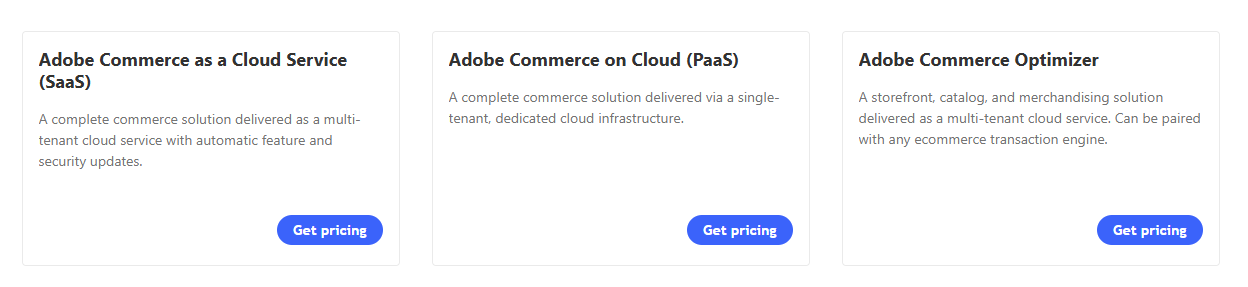
1. Adobe Commerce as a Cloud Service (SaaS)
Adobe Commerce as a Cloud Service marks a major milestone in Adobe’s move toward a fully managed eCommerce solution. This SaaS platform delivers faster performance, effortless updates, and global accessibility with minimal maintenance.
Core Features
- Versionless setup and automatic upgrades
- Multi-tenant system for global scalability
- AI-driven product suggestions and dynamic promotions
- Seamless integration with Adobe Experience Cloud apps
- Content creation and experimentation tool add-ons
- Data-driven personalization powered by Adobe ecosystem integrations
- Robust catalog and category management for large inventories
Companies that prioritize speed, automation, and minimal operational effort can benefit most from this package.
2. Adobe Commerce on Cloud (PaaS)
Adobe Commerce on Cloud gives you full control over your store environment through a single-tenant cloud setup. It’s ideal for businesses that need advanced customization, complex integrations, and enterprise-level flexibility.
Core Features
- Hosted infrastructure on AWS or Azure
- Source code access and advanced customization
- Advanced personalization with custom logic and third-party system integrations
- Global and B2B operations support
- Integrated compliance standards and 24/7 customer support
- Options for analytics, automation, and CI/CD pipelines
- Advanced catalog management with bulk updates, configurable products, and integrations
- Configurable privacy and security features supporting HIPAA and other compliance standards
- Commerce intelligence and data visualization tools for actionable analytics and insights
Firms looking for deeper customization and scalable performance tend to opt for this package.
Note: Adobe continues to support PaaS deployments, and this model is still a strong choice for businesses needing greater technical flexibility. However, Adobe is gradually moving away from legacy models like On-Premise and Managed Services, encouraging phased adoption of SaaS and Optimizer solutions for future scalability.
3. Adobe Commerce Optimizer
Adobe Commerce Optimizer suits businesses that want to enhance the storefront experience without changing their backend system. It is centred around speed, personalization, and compelling customer experiences.
Core Features
- Fast-loading storefronts with great performance scores
- AI-driven promotions and adaptive content
- A/B testing and content authoring capabilities
- Designed for composable and headless commerce environments
- Real-time personalization with A/B testing and adaptive storefront experiences
- Streamlined catalog navigation and frontend display management for improved shopper experience
Companies using existing eCommerce platforms can effectively expand their digital presence with this adaptable, modular solution.
Industry Tip: Agencies specializing in Adobe Commerce, for both PaaS and SaaS deployments, often offer structured packages for faster, safer launches. This can be especially valuable if your roadmap includes integrating Adobe Commerce Optimizer or transitioning towards SaaS solutions in the near future.
Adobe Commerce Pricing: How Much Does It Cost?
Building an Adobe Commerce store in 2025 requires careful budgeting across multiple expense categories. Some costs are fixed, while others depend on your store’s size and customization level. Adobe Commerce pricing is evolving toward cloud-native, flexible models that support modular commerce setups.
Adobe currently follows a quote-based pricing model, primarily determined by:
- Annual Gross Merchandise Value (GMV)
- Average Order Value (AOV)
- Selected package type (SaaS, PaaS, or Optimizer)
- Infrastructure, level of customization, and utilization of add-ons
Update (April 2025)
After Adobe Summit 2025, new pricing structures were introduced to align with the shift toward cloud-driven commerce. While Adobe keeps its official pricing confidential, industry benchmarks provide a realistic cost range for different business types.
| Types of Costs | Estimated Price |
|---|---|
| Mandatory License Fees | $22,000 – $125,000+ per year (based on GMV/AOV) |
| Hosting Infrastructure | Included in SaaS and PaaS (external for on-prem) |
| Development & Maintenance | $10 – $200 per hour, or up to $120,000 per year (agent/in-house) |
| SEO & Marketing Tools | $25 – $1,200+ per year (plugins, integrations) |
| Domain Name | $10 – $20 per year |
| Themes | $0 – $499 (depending on design needs) |
| Extensions (modules) | $0 – $75,000 (based on functionality required) |
Overall, annual Adobe Commerce costs typically range from $122,000 to over $450,000, depending on your store’s complexity, customization, and performance needs.
Package Estimates
- PaaS (Adobe Commerce on Cloud): Typically falls within the range of $40,000 to $200,000 per year, including hosting.
- SaaS (ACCS, launching June 2025): Expected to feature tier-based pricing with reduced infrastructure expense, although official rates aren’t public yet.
- Optimizer: Modularly priced, based on chosen merchandising and storefront components.
For exact pricing, companies should contact Adobe directly to receive a personalized quote based on their operational requirements.
7 Factors Affecting Adobe Commerce Pricing Estimations
Below are the most significant factors that influence Adobe Commerce pricing in 2026.
1. License Fees
License fees are one of the primary costs every Adobe Commerce merchant must plan for. They are based on your store’s Average Order Value (AOV) and Gross Merchandise Value (GMV). Higher revenue typically leads to higher license fees.
| Average Gross Sales Revenue | Adobe Magento Commerce Cost |
|---|---|
| Less than $1,000,000 | $22,000/year |
| $1,000,000 – $5,000,000 | $32,000/year |
| $5,000,000 – $10,000,000 | $49,000/year |
| $10,000,000 – $25,000,000 | $75,000/year |
| $25,000,000+ | $125,000/year |
Estimated Adobe Commerce cost for license fees: $22,000 – $125,000 annually.
2. Domain Name
A domain name acts as your store’s online address, directing customers to your Adobe Commerce site. You can buy a domain name from reliable providers such as Domain.com or Squarespace, which appears to have acquired Google Domains in 2023. The cost varies depending on your chosen domain extension and the provider’s reputation.
Estimated Adobe Commerce pricing for a domain name: $10 – $20 per year.
3. Hosting
Hosting is one of the most critical pricing factors because it directly affects performance, uptime, and scalability. Adobe Commerce offers multiple hosting options depending on the product package you choose and your business infrastructure.
Adobe Commerce as a Cloud Service (SaaS)
Launched in June 2025, Adobe Commerce as a Cloud Service (ACCS) is a fully managed, multi-tenant cloud platform. ACCS is designed for fast setup with versionless upgrades, automated scaling, and security enhancements.
Key Hosting Benefits:
- Adobe-managed auto-updates and selling
- Multi-tenant design for global availability
- Built-in PCI compliance and data protection with automated daily backups
- DevOps pipelines for staging environments and deployments
- Simplified infrastructure management and no manual configuration required
- Automatic feature and security updates
- Certified PCI Level 1 and SOC 2 compliance with optional privacy add-ons
Hosting Cost: Included in the SaaS subscription, although pricing is based on usage and business size.
Adobe Commerce on Cloud (PaaS)
Adobe Commerce on Cloud (PaaS) offers a single-tenant, dedicated infrastructure hosted by Adobe on AWS or Azure. Businesses gain complete control over codebases, configurations, and integrations. It is best suited for merchants who need customizations and enterprise-grade reliability.
Key Hosting Features:
- Single-tenant, dedicated infrastructure isolated per merchant
- Full codebase access and extensibility
- CI/CD pipeline integration for development effectiveness
- Scalability based on traffic and catalog needs
- Compliance standards for security and reliability
- High-availability infrastructure with global reach and real-time monitoring
- HIPAA-ready configuration as an optional add-on
Hosting Cost: Part of the PaaS license, with price varying based on resource consumption, performance needs, and customization.
External Hosting Services
Some merchants still use on-premises or hybrid hosting solutions managed by third-party providers. This configuration provides full control of the hosting environment but demands high technical competency.
Common Hosting Options:
- Dedicated server hosting
- Cloud hosting providers like AWS, Google Cloud, or Azure
- Virtual Private Servers (VPS)
- Shared hosting (not usually advisable)
Estimated cost of external hosting: $10 to $850 per month, based on:
- Server configuration (CPU, RAM, bandwidth, storage)
- Security features (firewalls, SSL certificates, automated backups, DDoS protection)
- Support quality (managed vs. unmanaged)
- Data centre location (regional vs. global)
Tips: Merchants handling their own infrastructure need to make sure that they are compatible with the technical requirements of Adobe Commerce, including PHP, database performance, and scalability. VPS hosting often provides a good balance between flexibility, security, and cost-efficiency. Stores using on-premises or hybrid setups should also plan ahead for potential migration to SaaS to stay aligned with evolving platform standards.
4. Themes
A visually appealing storefront improves both conversions and user engagement. Adobe Commerce comes with a number of free and paid themes that enable merchants to customize design aspects. Developers can also create custom templates using CSS and JavaScript for a fully tailored design.
To make sure your theme works with your Adobe Commerce setup, whether SaaS or PaaS, check that it is compatible with your package and follows Adobe’s coding guidelines. Focus on mobile-responsive themes for a smooth experience on all devices and test any theme in a staging environment before putting it live.

Source: Adobe Commerce Themes
Paid themes generally cost around $499.
5. Extensions
Extensions expand your store’s functionality, adding tools for payments, shipping, SEO, and analytics. The Adobe Commerce Marketplace contains more than 3800 plugins, ranging from basic utilities to advanced enterprise modules.
Key Points to Consider:
- Free plugins are available for essential functions
- Paid extensions vary significantly in price depending on functionality
- Integrations that are most commonly found include Stripe, Mailchimp, and Bolt Checkout
Estimated Adobe Commerce cost for extensions: $10 – $75,000, depending on type and use.
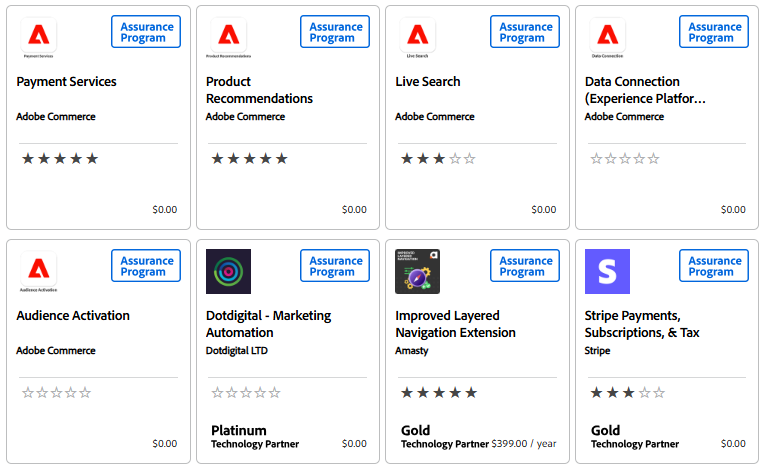
Source: Adobe Commerce Extensions
6. Development and Maintenance
Setting up and maintaining an Adobe Commerce store often requires ongoing technical work. Enterprises have a choice of doing the work with their own staff or hiring a professional service provider.
Typical Tasks:
- Custom theme and extension development
- API and third-party integrations
- Performance optimization and testing
- Storefront enhancements
- Regular security updates and patching
Common Development Options:
- Freelancer: $10 – $200 per hour
- Web Development Agency: $25 – $200 per hour
- In-house Team: $60,000 – $120,000 annually
Tip: Partnering with experienced Adobe Commerce developers minimizes downtime and increases deployment speed, particularly when using Adobe Commerce Optimizer integration or SaaS migration.
Estimated Adobe Commerce pricing for development and maintenance: Varies by project scope and provider type.
7. SEO & Marketing
Marketing and SEO are essential for visibility and customer acquisition. Adobe Commerce hosts a number of plugins that enhance ranking, automate campaigns, and measure analytics. Integrations for platforms such as Facebook, Instagram, and Pinterest can push your store’s reach further.
Popular Tools:
- SEO analyzers and metadata optimizers
- Email marketing integrations, such as Mailchimp
- Social commerce and remarketing extensions
Estimated Adobe Commerce expenses for SEO & Marketing: $25 – $1,200 per year, depending on the tools and integrations selected.
Wrapping Up
Setting up an Adobe Commerce store in 2026 requires careful planning, strategic budgeting, and expert technical support. Every cost factor, from licensing and hosting to development and marketing, plays a crucial role in your store’s long-term performance.
WebDesk Solution helps eCommerce businesses efficiently manage these costs through tailored Adobe Commerce development and cost-planning strategies. Contact our team today for a personalized quote that aligns with your goals and drives your eCommerce success.
Frequently Asked Questions
Adobe doesn’t publish a standard annual price for Adobe Commerce. Costs are custom and depend on things like your sales volume, deployment model, and feature needs. License and hosting costs for larger deployments are often discussed in the market, but to get an accurate number for your business you need a quote from Adobe or an official partner.
SaaS (Adobe Commerce as a Cloud Service) is fully managed, with automatic updates, hosting, and minimal maintenance, making it easier for businesses to get started quickly. PaaS (Adobe Commerce on Cloud) provides full control over code, infrastructure, and customizations, which is ideal for businesses needing advanced integrations and enterprise-level flexibility.
Adobe Commerce Optimizer is a modular, headless storefront and merchandising feature designed to enhance the frontend experience without requiring backend changes. It works with Adobe Commerce PaaS and can integrate with third-party commerce platforms. Key capabilities include personalized promotions, A/B testing, AI-driven content, and dynamic storefront management.
No immediate migration is required. Adobe Commerce on Cloud (PaaS) is still fully supported, but Adobe recommends considering a phased move to SaaS or Optimizer for future scalability, simplified maintenance, and access to new features.