


DealerMarket is an enterprise B2B dealership supply provider operating within the AutoSoft ecosystem, serving thousands of automotive dealers across the United States. Its business depends on a highly specialized product catalog that includes compliance-driven, custom-printed items tightly coupled with ERP logic, vendor fulfillment rules, and customer-specific pricing agreements. Over time, DealerMarket’s cloud-hosted Magento 2 platform became a growing operational liability. Performance degradation, rising maintenance costs, rigid architecture, and increasing difficulty supporting modern B2B purchasing workflows signaled that the platform could no longer scale with the business.
The challenge, however, was not a conventional platform migration. DealerMarket’s commerce environment was deeply embedded into day-to-day operations. The system supported complex Sage 300 ERP synchronization, approval-based B2B registrations, bulk ordering, live preview customization for regulated products, banking validation, and automated vendor file generation. Any disruption-pricing errors, data mismatches, or workflow failures-would immediately impact dealer trust, vendor fulfillment, and financial accuracy.
WebDesk Solution was engaged to lead a full-scale digital transformation, migrating more than 6,000 SKUs, 54,000+ historical orders, and 14,000+ customers to BigCommerce B2B Enterprise. The mandate was clear: modernize the platform without sacrificing the deeply customized logic that powered DealerMarket’s business. The goal was not replacement, but reinvention-architecting a future-ready commerce ecosystem that delivered performance, security, and scalability while preserving absolute operational continuity.

Approach
WebDesk Solution approached the DealerMarket engagement as a mission-critical systems re-engineering initiative rather than a storefront rebuild. From the outset, the strategy centered on protecting operational continuity while untangling years of tightly coupled platform logic, ERP dependencies, and fulfillment workflows. The team recognized that forcing BigCommerce to mimic Magento’s behavior would introduce risk and long-term technical debt, so the solution required a fundamentally different architectural mindset.
The engagement began with a deep discovery phase, analyzing Magento limitations, BigCommerce B2B capabilities, Sage 300 constraints, and the broader vendor ecosystem. This analysis informed the decision to design a custom middleware layer, allowing BigCommerce to function as a high-performance storefront while isolating complex business logic-ERP synchronization, live preview rendering, banking validation, and vendor file generation-into a scalable application layer.
Execution followed a phased, risk-controlled methodology. Data migration was validated using sample datasets before full execution. ERP sync workflows were tested in parallel environments to ensure accuracy across orders, customers, invoices, and partial shipments. Live preview products were rolled out incrementally, with real-world approval and fulfillment scenarios validated before launch. Throughout the process, every critical workflow-pricing, approvals, shipping, customization, and fulfillment-was tested against production-level scenarios. This disciplined, systems-first approach ensured zero downtime, zero data loss, and a seamless transition into a modern B2B commerce ecosystem built for long-term growth.
Challenges
Deconstructing a Legacy Magento Stack Without Breaking a Live B2B Business
DealerMarket’s Magento 2 platform was not just outdated-it had become structurally misaligned with how the business actually operated. Over years of incremental customization, Magento had evolved into a fragile system where storefront logic, ERP dependencies, pricing rules, and fulfillment workflows were tightly coupled and difficult to isolate. Every upgrade carried risk. Every performance issue required investigation across multiple layers. Maintenance costs were climbing while agility was declining.
The stakes were high. DealerMarket was supporting thousands of automotive dealers who depended on accurate pricing, fast ordering, and predictable fulfillment to run their own businesses. The catalog included over 6,000 SKUs, many of which were not standard products but compliance-driven, custom-printed items with strict operational requirements. Any data inconsistency, pricing mismatch, or order failure could immediately impact vendor fulfillment, accounting accuracy, and customer trust.
What made this challenge particularly complex was the need to migrate not just data, but behavior. Customer-specific pricing models, bulk discount logic, approval-based registrations, multi-user company accounts, and ERP-driven inventory rules all had to survive the transition intact. A traditional “lift-and-shift” migration would not work. Any loss of historical order data, customer templates, or pricing logic would disrupt daily operations and erode confidence among long-standing B2B customers. The migration had to be invisible to end users-yet technically precise at every level.
Maintaining Real-Time ERP Integrity Across Orders, Invoices, and Fulfillment
Sage 300 was the operational backbone of DealerMarket’s business. It controlled inventory availability, order processing, invoicing, and fulfillment coordination. Any failure in ERP synchronization would immediately cascade into accounting discrepancies, delayed shipments, and vendor confusion. The challenge was not just syncing data-it was preserving transactional integrity across systems with very different data models.
Orders needed to sync bi-directionally. Customers and products flowed unidirectionally. Invoices had to be pushed back to the storefront. Partial shipments, vendor-wise fulfillment, and AutoSoft-specific order references introduced additional complexity. On top of this, field-level mapping was highly customized, with non-standard attributes required for compliance and vendor processing.
Magento’s tightly coupled ERP logic had become brittle over time. Recreating this behavior inside BigCommerce without introducing latency or sync failures required a completely new architectural approach. The risk was clear: even a single failed sync could result in duplicated orders, incorrect invoicing, or broken fulfillment workflows-none of which were acceptable in a live B2B environment operating at this scale.
Embedding a Secure, Compliance-Driven Live Preview and Banking Validation Workflow Inside a B2B Checkout
DealerMarket’s product catalog included a subset of high-risk, compliance-sensitive products that fundamentally broke the mold of standard B2B eCommerce. These were not configurable SKUs with simple option sets-they were custom-printed, compliance-driven items that required customers to submit banking information, upload branding assets, configure imprint data, and visually approve a live preview before an order could legally and operationally proceed.
The challenge was multi-layered. First, the workflow had to be restricted exclusively to authenticated and approved B2B users. Any exposure of banking or compliance workflows to unauthorized users represented a serious security and liability risk. Second, the system had to validate sensitive banking data in real time, ensuring accuracy before the order entered ERP and fulfillment pipelines. Manual validation was slow, error-prone, and unscalable, but automation introduced its own risks if not implemented correctly.
Performance added another layer of complexity. Live preview rendering, file processing, and validation had to occur within the checkout flow without degrading speed or reliability. A slow or unstable preview experience would lead to abandoned orders and loss of customer trust. At the same time, all uploaded assets and generated files needed to meet strict print and vendor requirements, or downstream fulfillment would fail.
Finally, the system had to produce print-ready, vendor-consumable files automatically, without human intervention. Any break in this chain-invalid data, failed previews, missing approvals, or insecure file handling-would ripple through accounting, fulfillment, and compliance teams. The challenge wasn’t just building a feature; it was embedding a secure, legally sound, and operationally reliable workflow into the heart of a live B2B commerce engine.
Designing a High-Performance, Intuitive User Experience Without Breaking Complex B2B Logic
DealerMarket’s existing storefront struggled to balance usability with complexity. The platform had to support both B2B and limited B2C purchasing behaviors, while simultaneously accommodating customer-specific pricing, approval-based access, bulk ordering, and live preview customization. Over time, the user experience became fragmented. Navigation was rigid, product discovery was inefficient, and category structures failed to scale alongside the growing catalog.
The challenge wasn’t simply aesthetic. Every UX decision carried operational consequences. Incorrect product visibility could expose restricted pricing. Poor filtering could slow down purchasing teams placing bulk orders. Confusing configuration flows could lead to incorrectly submitted custom orders, increasing support load and fulfillment errors. The existing platform also failed to deliver consistent performance across devices, which further compounded usability issues for dealership teams working in fast-paced environments.
Adding to the complexity, DealerMarket’s catalog included multiple product types with entirely different purchase journeys-standard products, bulk items, and highly regulated live preview products. A single, generic product template could not support these divergent flows. Any attempt to oversimplify risked breaking compliance workflows or ERP dependencies tied to specific product behaviors.
The challenge, therefore, was to deliver a modern, intuitive, and fast user experience without abstracting away the underlying business logic that made DealerMarket’s platform operationally viable. The solution had to improve discoverability, reduce friction, and guide users through complex purchases-while preserving every rule, restriction, and dependency embedded in the B2B system.
Automating Vendor-Wise Fulfillment and Print File Generation Across a Distributed Supply Chain
DealerMarket’s fulfillment model relied on multiple third-party vendors, each with distinct file format requirements, delivery mechanisms, and processing timelines. A single customer order could contain products fulfilled by multiple vendors, requiring precise order splitting, file generation, and delivery coordination. On the legacy platform, much of this process relied on manual intervention, increasing processing time and introducing frequent errors.
Live preview products amplified this complexity. These orders required admin approval before fulfillment, followed by the generation of multiple print-ready file formats-including CSV, TIFF, and WEBP-each aligned with vendor-specific specifications. Any formatting inconsistency or delivery failure could halt production, delay shipments, and damage vendor relationships.
The challenge extended beyond file creation. The system had to ensure that only approved configurations entered the fulfillment pipeline, that files were securely transmitted to the correct destinations, and that ERP records reflected fulfillment status accurately. Manual handling made auditability difficult and increased operational risk as order volume scaled.
Coordinating this logic across BigCommerce, Sage 300, and vendor systems represented a high-stakes engineering problem. A failure at any point-approval, file generation, order splitting, or delivery-would cascade through accounting, fulfillment, and customer service teams. DealerMarket needed a system that could handle this complexity automatically, reliably, and at scale.
Resolving Shipping Cost Inaccuracies for Oversized and Complex Products
DealerMarket faced persistent shipping cost discrepancies, particularly for oversized and heavy products. In some cases, customers were presented with shipping estimates that exceeded actual costs by 300–400%, leading to abandoned carts, customer frustration, and lost revenue. These inaccuracies stemmed from inconsistent product dimension data, legacy configuration issues, and FedEx service limitations.
The challenge was compounded by the scale of the catalog. Thousands of SKUs needed to be reviewed, validated, and corrected without disrupting live operations. Additionally, shipping logic had to account for vendor-wise fulfillment, partial shipments, and ERP alignment-any miscalculation could ripple into invoicing and customer disputes.
Simply enabling FedEx live rates was not enough. Without accurate dimensional data and service mapping, live rates could still produce misleading results. DealerMarket required a systematic approach that aligned platform configuration with real-world shipping behavior and historical order data.
The risk was both financial and reputational. Inaccurate shipping estimates eroded customer trust and created friction at the most critical moment of the purchase journey. Solving this problem required a blend of technical configuration, data hygiene, and real-world validation.
Managing Vendor-Supplied Product Data Across Inconsistent and Unstructured Formats
As DealerMarket continued to expand its vendor network, product data ingestion became a silent but growing operational risk. Unlike modern API-driven suppliers, many of DealerMarket’s long-standing vendors still relied on traditional data delivery methods-sending product information through inconsistent CSV files, spreadsheets, and Excel documents. Each vendor followed its own conventions for SKU naming, attribute labeling, column order, and data completeness, with little to no standardization across files.
This inconsistency introduced significant friction into DealerMarket’s product onboarding workflow. Files that appeared structurally similar often contained subtle but critical differences: missing mandatory attributes, mismatched SKU references, duplicated columns, or non-standard value formats. Uploading these files directly into BigCommerce was not viable without extensive manual cleanup, reformatting, and repeated trial-and-error imports. Even small discrepancies could cause failed imports, partial data ingestion, or-worse-silent data corruption that only surfaced later in pricing, inventory, or customer-facing product details.
Beyond the technical challenges, the operational impact was substantial. Product imports required experienced administrative oversight, pulling time away from higher-value tasks. Errors were difficult to trace, as native import tools offered limited visibility into validation failures, row-level issues, or root causes. Without a structured mechanism for previewing data, mapping vendor-specific fields, validating formats, and logging errors, DealerMarket faced a scalability ceiling. As vendor volume increased, so did administrative overhead, onboarding delays, and the risk of inaccurate product data entering a mission-critical B2B commerce environment.
Efficiently Exporting Large Product Catalogs for Review, Analysis, and Bulk Updates
Managing a catalog of thousands of SKUs is not just about importing data-it also requires the ability to extract, analyze, and refine product information at scale. For DealerMarket, exporting product data was a recurring operational necessity, supporting internal audits, vendor collaboration, pricing reviews, SEO optimization, and large-scale bulk updates. However, native export capabilities proved rigid and inefficient for these real-world use cases.
Standard export tools generated oversized files packed with unnecessary fields, system-level metadata, and irrelevant attributes. Admins had little control over which products or data points were included, forcing teams to manually filter, clean, and restructure files before they could be used for analysis or shared externally. This process was time-consuming, error-prone, and particularly painful when working across departments or coordinating with vendors who required simplified, purpose-specific datasets.
The lack of selective exports also made iterative improvements harder. Simple tasks-such as reviewing pricing across a specific product group, auditing SEO attributes, or validating vendor-supplied updates-required manipulating massive spreadsheets that obscured insights rather than revealing them. As the catalog continued to evolve, this inefficiency compounded, slowing decision-making and increasing the risk of outdated or inconsistent data being reintroduced into the system.
Without a flexible, controlled export mechanism, DealerMarket faced growing friction between operational needs and platform limitations. What should have been a routine administrative function instead became a bottleneck-one that threatened data accuracy, collaboration efficiency, and the company’s ability to respond quickly to market and vendor-driven changes.
Key Metrics



Solutions
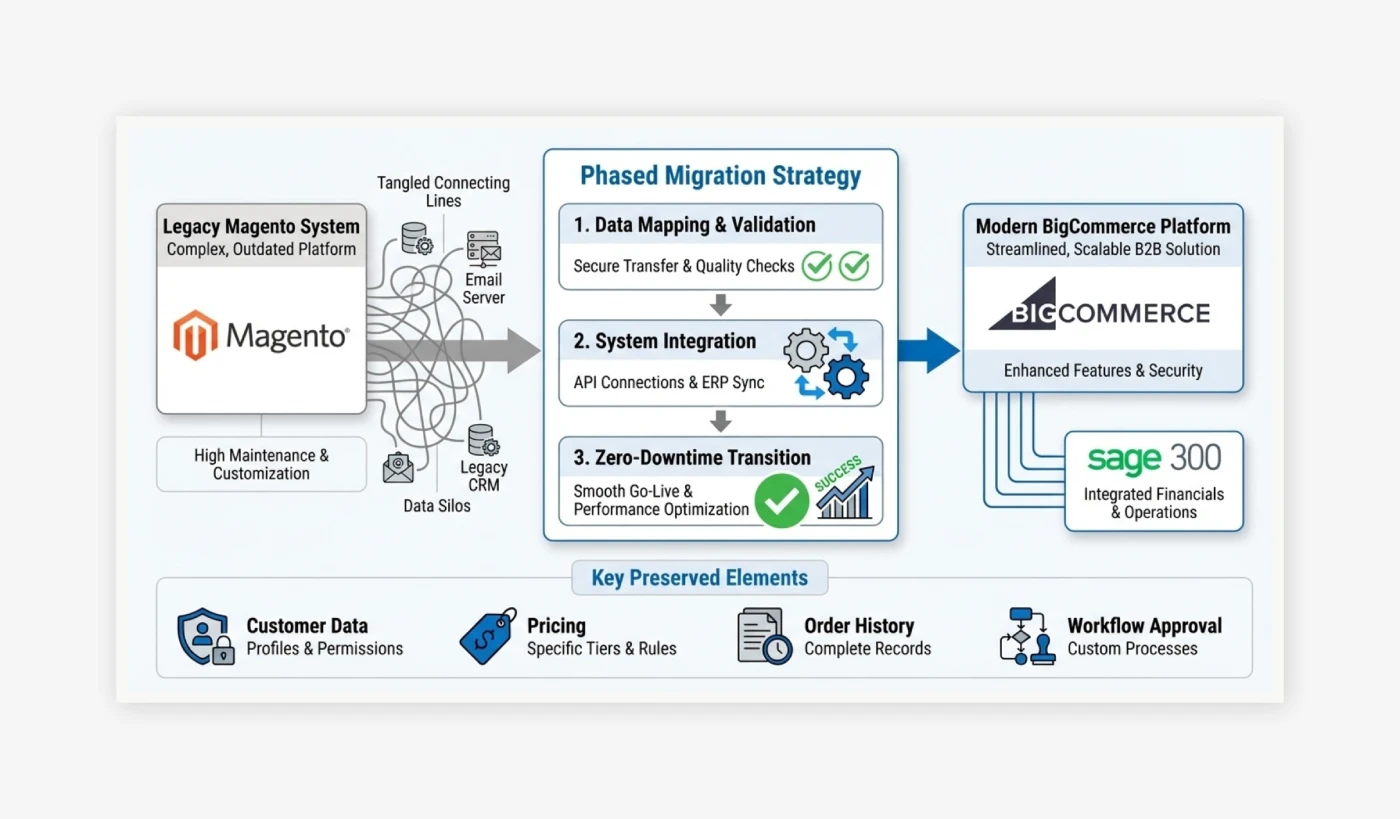
A Phased Magento to BigCommerce B2B Migration Engineered for Zero Business Disruption
WebDesk Solution approached the migration as a controlled systems transition, not a platform replacement. Rather than attempting to replicate Magento’s complexity inside BigCommerce, we decomposed the existing ecosystem into clearly defined responsibilities. BigCommerce was positioned as a high-performance B2B storefront, while complex operational logic was preserved and enhanced through a custom application layer.
We implemented a phased migration strategy backed by rigorous data mapping and validation. Every SKU, customer record, order, pricing rule, and category relationship was mapped, tested, and validated using real sample datasets before full migration. This ensured that edge cases-custom products, legacy pricing exceptions, and historical order structures-were identified early, not discovered after launch.
Customer groups, approval workflows, bulk discount logic, and company-level permissions were carefully aligned between BigCommerce and Sage 300. The migration preserved 100% of customer-specific pricing visibility, eliminating the risk of incorrect price exposure. Historical orders were migrated in full, ensuring continuity for accounting, customer service, and reporting teams.
Most importantly, the transition was executed with zero downtime. DealerMarket’s customers experienced no interruption to ordering, fulfillment, or account access. From their perspective, the platform simply became faster, more intuitive, and more reliable-while the underlying architecture was fundamentally transformed.
A Custom Middleware Layer Designed for Enterprise-Grade ERP Synchronization
To solve this, WebDesk Solution designed and built a dedicated middleware platform that acted as the system of orchestration between BigCommerce and Sage 300. This middleware was not an off-the-shelf connector-it was purpose-built to reflect DealerMarket’s real operational logic.
Using secure APIs, background cron processes, and intelligent queue handling, the middleware enabled real-time synchronization while gracefully managing exceptions. Orders synced bidirectionally with full context. Customers and products synced unidirectionally with validation safeguards. Invoices and shipment updates flowed back to BigCommerce automatically, keeping customers informed without manual intervention.
Advanced field-mapping logic ensured that every ERP-required attribute-from vendor identifiers to compliance fields-was transmitted accurately. Monitoring and logging mechanisms were implemented to surface issues before they became operational problems, dramatically reducing the need for manual reconciliation.
This architecture decoupled the storefront from ERP complexity while strengthening overall reliability. The result was a system that could scale, adapt, and process thousands of transactions without compromising financial or fulfillment accuracy.

A Secure, Access-Controlled Live Preview and Validation Engine Integrated with BigCommerce and ERP Workflows
WebDesk Solution addressed this challenge by designing a dedicated, access-controlled application layer that operated alongside BigCommerce rather than forcing sensitive logic directly into the storefront. This ensured that complex compliance workflows remained isolated, secure, and auditable while still delivering a seamless customer experience.
The solution began with strict access control. Live preview and banking validation features were made available only to authenticated, approved B2B users tied to verified company accounts. This eliminated the risk of unauthorized exposure and ensured that sensitive workflows aligned with DealerMarket’s internal approval processes.
For real-time banking validation, we integrated the Liftoff API, enabling instant verification of banking details during checkout. This removed the need for manual review, reduced compliance risk, and ensured that only validated orders progressed into ERP and fulfillment systems. Validation failures were handled gracefully, with clear customer feedback and no impact on system stability.
The live preview engine was built to process uploaded logos, imprint data, and configuration inputs in real time, generating accurate visual previews that customers could approve before purchase. Once approved, the system automatically generated print-ready files formatted to vendor specifications and securely delivered them downstream without manual handling.
Critically, this entire workflow was tightly integrated with the custom middleware layer, ensuring that approved configurations, validation results, and generated assets flowed cleanly into Sage 300 and vendor fulfillment processes. The result was a fully automated, secure, and scalable system that transformed a high-risk manual process into a reliable, compliance-ready B2B capability-without slowing down the checkout experience or compromising data integrity.

UX-Centric Redesign Engineered Around B2B Behavior, Performance, and Scale
WebDesk Solution approached UX as a functional system, not a visual layer. Using BigCommerce’s Camden theme as a foundation, we implemented a deeply customized design framework optimized for B2B purchasing behavior, performance, and scalability. Every layout, navigation element, and interaction was mapped back to a specific operational or conversion objective.
We introduced advanced navigation structures, including dynamic mega menus and role-aware category visibility, ensuring customers only saw products, pricing, and workflows relevant to their account permissions. Faceted filtering and optimized category layouts dramatically improved product discoverability across a large and diverse catalog, reducing time-to-purchase for repeat buyers and procurement teams.
To support divergent purchase journeys, we built three distinct product page templates, each engineered for a specific product type. Standard SKUs, bulk-order items, and live preview products each followed tailored flows that reduced cognitive load while enforcing compliance and validation rules behind the scenes. Configuration steps were sequenced logically, with real-time feedback to prevent incomplete or invalid submissions.
Performance optimization was embedded throughout the UX layer. Lightweight templates, optimized assets, and streamlined interactions ensured fast load times across desktop and mobile devices. The result was a storefront that felt simple and intuitive to users, while quietly supporting some of the most complex B2B logic in DealerMarket’s ecosystem.

A Fully Automated Vendor Fulfillment and Print File Management System
WebDesk Solution engineered a custom fulfillment automation engine within the middleware layer to eliminate manual processing and enforce consistency across vendors. The workflow began with an admin-controlled approval system for live preview orders, ensuring that only validated and compliant configurations progressed to fulfillment.
Once approved, orders were automatically split vendor-wise, with logic determining which products, files, and data sets belonged to each fulfillment partner. The system generated standardized, print-ready files in CSV, TIFF, and WEBP formats, dynamically populated using approved configuration data and vendor-specific templates.
Secure SFTP delivery was implemented to transmit files directly to vendor print servers, removing the need for email-based handoffs or manual uploads. Each transmission was logged and traceable, providing audit-ready visibility into fulfillment operations. Simultaneously, order status updates were synchronized back to Sage 300, ensuring accounting and fulfillment records remained aligned.
This automation eliminated processing bottlenecks, reduced errors to zero, and allowed DealerMarket to scale fulfillment volume without adding operational overhead. What was once a fragile, manual process became a reliable, repeatable system capable of supporting enterprise-level order throughput.

Shipping Rate Optimization Through Data Validation and Real-World Testing
WebDesk Solution implemented FedEx live shipping rates using BigCommerce’s native capabilities, but paired this with a comprehensive data validation and remediation framework. We conducted a detailed audit of product dimensions, weights, and packaging assumptions across the catalog, correcting inconsistencies that skewed rate calculations.
Historical order data was analyzed to compare quoted rates against actual shipping costs, allowing us to identify systemic discrepancies and fine-tune service configurations. Vendor-specific fulfillment scenarios were tested to ensure accurate rate presentation even for split shipments and oversized items.
Validation checkpoints were introduced to prevent incorrect dimensional data from entering the system going forward, ensuring long-term rate accuracy. The result was a significant reduction in shipping cost discrepancies, improved checkout transparency, and restored customer confidence in final order totals.
By aligning platform logic with real-world shipping behavior, DealerMarket achieved predictable, accurate shipping estimates that supported both customer satisfaction and operational efficiency.

Custom Product Import Module with Intelligent Field Mapping, Validation, and Error Transparency
To eliminate the bottlenecks created by inconsistent vendor data, WebDesk Solution designed and implemented a purpose-built Product Import Module that transformed product onboarding from a manual, error-prone task into a controlled, scalable workflow. Rather than forcing vendors to conform to rigid templates or relying on repeated manual cleanup, the module was engineered to adapt to real-world vendor data variability while enforcing platform-level consistency.
At the core of the solution was an intelligent field-mapping engine that allowed administrators to upload vendor-supplied CSV files-regardless of structure-and map vendor-specific column names directly to BigCommerce’s required product attributes. Fields such as alternate SKU identifiers, non-standard item codes, or vendor-defined product titles could be aligned precisely with the correct system attributes, ensuring accurate data normalization without rewriting source files.
The import workflow introduced multiple validation layers before data was committed. Administrators could preview mapped product data in real time, immediately identifying missing attributes, formatting issues, or invalid values before execution. This proactive validation significantly reduced failed imports and prevented flawed data from entering the live catalog. Once approved, the system executed imports with full status visibility, providing success summaries and granular error reporting.
For partial failures, the module generated downloadable reference sheets highlighting affected rows and error reasons, enabling rapid remediation and targeted re-imports instead of full restarts. This level of transparency eliminated guesswork, reduced dependency on technical staff, and gave DealerMarket full operational control over catalog growth. As a result, product onboarding became faster, more predictable, and scalable-supporting expansion without sacrificing data integrity.

Flexible Product Export Module with Attribute-Level Control and Operational Precision
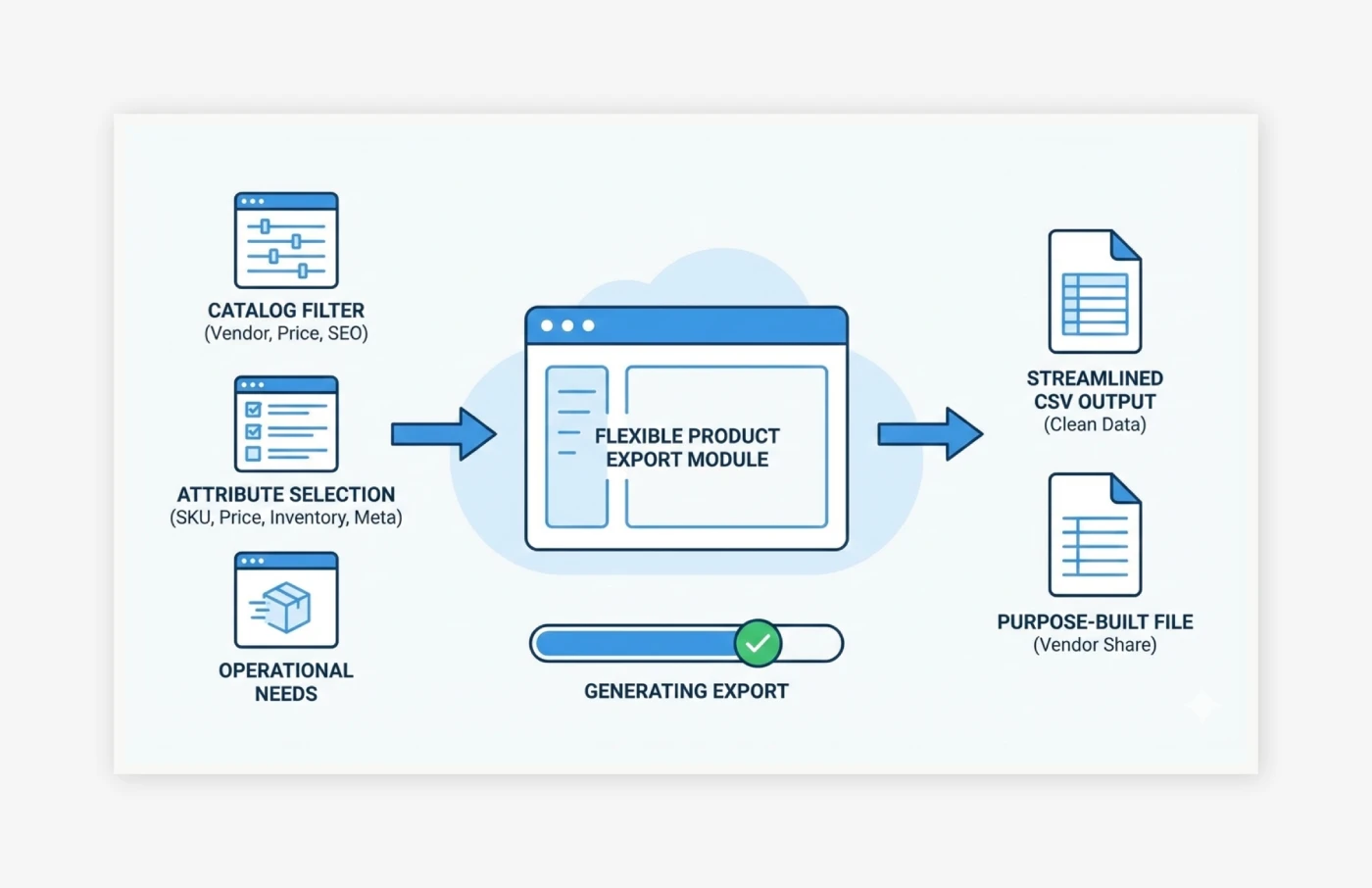
To address inefficiencies in catalog extraction and downstream data management, WebDesk Solution developed a dedicated Product Export Module designed for precision, flexibility, and real-world operational use. Unlike native export tools that produced bloated, one-size-fits-all files, this module empowered administrators to extract exactly the data they needed-nothing more, nothing less.
The export interface was built with usability and control in mind. Administrators could choose to export the entire catalog or selectively target specific product sets based on operational needs, such as vendor-specific reviews, pricing audits, inventory analysis, or SEO optimization initiatives. This eliminated the need to manually filter massive spreadsheets after export, saving time and reducing human error.
More importantly, the module introduced attribute-level selection. Admins could choose which data points to include-SKUs, pricing, inventory levels, dimensions, availability settings, SEO metadata, custom fields, or vendor-specific attributes-ensuring each export remained purpose-built and immediately usable. This granular control made collaboration with vendors and internal teams far more efficient, as shared files were clean, relevant, and easy to interpret.
Once configured, the system generated streamlined CSV files optimized for analysis, updates, or reintegration. By reducing file complexity and improving data clarity, the export module strengthened data governance and accelerated decision-making across merchandising, operations, and vendor management teams. What was once a tedious administrative task became a strategic capability-allowing DealerMarket to manage a large, evolving catalog with confidence, speed, and accuracy.
Outcomes / Results
Zero-Downtime Migration with Complete Data Integrity
The entire Magento to BigCommerce B2B migration was executed with zero downtime and zero data loss, ensuring uninterrupted business operations. Over 6,000 SKUs, 54,328 historical orders, 14,612 customers, and 938 categories were migrated with 100% accuracy. All customer pricing rules, order histories, and approval workflows remained fully intact post-launch.
Major Operational Time Savings Through ERP Automation
Automated, real-time synchronization between BigCommerce and Sage 300 eliminated manual order entry, customer updates, and invoice reconciliation. This reduced operational overhead by more than 40 hours per month, allowing internal teams to shift focus from administrative tasks to higher-value operational and customer support initiatives.
Dramatic Reduction in Custom Order Processing Time
Live preview and custom product order processing time was reduced from more than 15 minutes per order to under 2 minutes. Automated data validation, template population, and print-ready file generation removed delays and eliminated manual touchpoints in the approval and fulfillment process.
Complete Elimination of Order Processing and Compliance Errors
By automating vendor-wise order splitting, admin approvals, and print file generation, DealerMarket achieved a 100% reduction in manual order processing errors. Bank account validation via the Liftoff API delivered 100% accuracy, removing compliance risks and eliminating the need for manual verification.
Shipping Cost Accuracy and Checkout Confidence Restored
FedEx live rate integration combined with structured dimensional data validation significantly reduced shipping cost inaccuracies, particularly for oversized products. Customers now receive reliable, real-time shipping estimates at checkout, reducing cart abandonment and restoring confidence in total order pricing.
Fully Automated, End-to-End Fulfillment for Live Preview Products
A complete automation pipeline was established for live preview products, spanning admin approval, vendor-wise order splitting, print-ready file generation, and secure SFTP delivery. This end-to-end workflow removed manual intervention entirely and ensured consistent, audit-ready fulfillment across all vendor partners.
Conclusion
The DealerMarket engagement exemplifies how WebDesk Solution approaches enterprise B2B eCommerce transformation-not as a platform swap, but as a strategic re-architecture of mission-critical systems. When Magento became a barrier to scale, we didn’t simply migrate data. We rebuilt the operational foundation.
By pairing BigCommerce B2B Enterprise with a custom middleware layer, we preserved every essential workflow while eliminating the fragility that had accumulated over years of customization. ERP synchronization, live previews, compliance validation, and vendor fulfillment now operate as a cohesive, automated system rather than a collection of manual processes.
Today, DealerMarket runs on an architecture designed for scale, resilience, and future growth. Orders flow cleanly. Custom products are configured in seconds. ERP data stays in sync without intervention. The technology no longer slows the business down-it enables it.
This project stands as a clear demonstration of WebDesk Solution’s ability to lead high-stakes, enterprise-grade Magento to BigCommerce B2B migrations and deliver custom B2B application development that performs where it matters most: in real-world operations.


