

The eCommerce CRO Agency That Ships the Fix, Not Just the Findings
We find where your store leaks revenue, ship the fix on your platform, and prove the lift with data – like the 92% conversion increase we delivered for Parts Connexion.
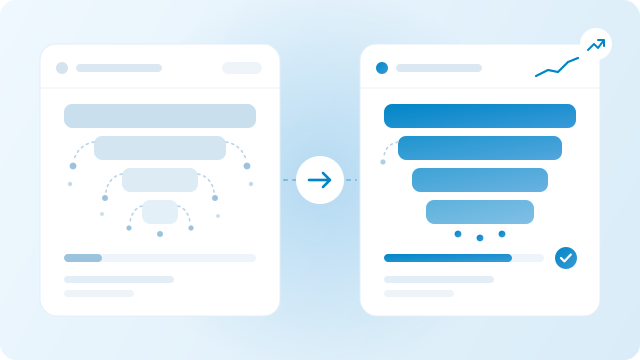
What does WebDesk Solution’s eCommerce
CRO Service Include?
WebDesk Solution is a North American eCommerce CRO agency. We run conversion research, build and test the fixes, and ship them into your live store on Shopify Plus, BigCommerce, Adobe Commerce or WooCommerce. Engagements cover product pages, site search, cart and checkout, mobile, and analytics. For Parts Connexion, that work produced a 92% conversion rate increase after their BigCommerce migration.
CLIENT RESULTS
Trusted by 500+ Brands Across North America
Proof, not promises. These are the brands that chose us, the platforms that vetted us, and the review sites where our clients posted verified scores.



 4.9/5★★★★★
 5.0/5★★★★★
 Top eCommerce Agency★★★★★
 Top Developer★★★★★
 Recommended★★★★★



14+ years. 500+ clients. Two offices across North America. The kind of track record you cannot manufacture in a pitch deck.
CRO Fit
Is WebDesk the right CRO Partner for your store?
Most eCommerce CRO engagements fail for one of two reasons: the store does not have enough traffic to test properly, or the agency can find the problem but cannot fix it. We would rather tell you that now than three months in.
You’re a good fit if
- You run a store on Shopify, Shopify Plus, BigCommerce, Adobe Commerce, WooCommerce or Shift4Shop
- Revenue sits somewhere between $500K and $50M+ a year
- You have enough traffic to reach statistical significance in a reasonable window – roughly 10,000 monthly sessions and 200+ orders
- You want the winning variant deployed to your live store, not handed over as a recommendation
- Your team can give us a technical contact and access to analytics
We’re probably not the right call if
- You are pre-revenue or pre-traffic. Testing needs volume; below the threshold above, A/B results are noise. We would run qualitative research and heuristic fixes instead – say so and we will scope that honestly.
- You want a research deck with no implementation. There are excellent firms that do exactly that, and buying one from us would be an expensive way to get it.
- You need a full rebuild rather than optimization. That is a different engagement – see our eCommerce development services.
Revenue Leaks
Where eCommerce Revenue Leaks
High traffic with a flat conversion rate is the most expensive problem in eCommerce – every dollar of acquisition spend gets taxed by the same friction. In the audits our eCommerce CRO agency runs, the leaks cluster in six places, and rarely the ones teams expect.

Checkout abandonment
Close to 70% of carts are abandoned, per Baymard Institute’s aggregated research. The causes are usually mundane: surprise shipping costs revealed at the final step, forced account creation, or a payment method the buyer expected and did not find.

Product pages that don’t answer the buying question
Shoppers leave when a spec, fit detail or compatibility answer is missing. For Anderson Pens we built ink and nib comparison tools because the catalogue could not answer “which one is right for me” without them.

Site search and filtering that hides inventory
If a store carries thousands of SKUs and the filters are slow or shallow, most of the catalogue is effectively invisible. Outdoor Limited’s faceted filtering and search rebuild was a conversion project wearing a search-engineering costume.

Mobile experiences that diverge from desktop
Most stores take the majority of sessions on mobile and convert a fraction as well. Tap targets, form fields and sticky add-to-cart behaviour explain more of that gap than design taste does.

Speed drag on the buying moment
Largest Contentful Paint above Google’s 2.5-second threshold costs conversions on exactly the templates that matter most – category and product pages.

B2B-specific friction
Gated pricing, quote workflows, net terms and purchase orders are conversion problems, not just features. We built a custom purchase order payment system for a B2B store whose checkout was blocking the orders it existed to capture.
CRO Services
What our eCommerce CRO Services Cover
eCommerce CRO spans research, design, engineering and analytics. Here is what an engagement actually contains.

Conversion research and audit
Analytics audit, funnel analysis, heatmaps, session replay and – where traffic supports it – user testing. The output is a ranked list of where revenue leaks and what each fix is worth.

Product page optimization
Layout, imagery, specification depth, cross-sell placement and review presentation. Product templates carry more conversion weight than the homepage on a catalogue of any size.

Checkout and Cart Optimization
The surface with the most revenue riding on it, and the one most constrained by platform. Covered in detail below.

Site search and faceted filtering
Search-led sessions convert well above browse-led sessions in most catalogues. Filter architecture, synonym handling, result relevance and zero-result recovery sit here.

Mobile conversion optimization
We treat mobile as its own conversion surface with its own tests, not as a responsive afterthought.

Speed and Core Web Vitals
Performance affects conversion, but page speed is its own discipline with its own engineering. Where speed is the primary constraint, we hand the work to our Shopify speed optimization service rather than absorbing it into a testing programme.

A/B testing and experimentation
Hypothesis design, variant build, QA across devices, statistical monitoring and rollout. Winners ship; losers get documented so the next cycle starts smarter.

Analytics, tracking and attribution
Most conversion programmes fail at measurement before they fail at design. We rebuild GA4 and Google Tag Manager so events, funnels and revenue attribution are trustworthy before any test runs. Our conversion tracking setup guides cover the platform specifics.
Checkout Optimization
Checkout and Cart Optimization
Checkout is where intent turns into revenue, and where the smallest changes move the biggest numbers. It is also the part of the funnel with the hardest platform limits – what you can change depends entirely on what you are running on.

Form and flow design.
Guest checkout, field reduction, autofill, address validation and error handling. Every removed field is a removed reason to leave.

Payment coverage.
Buyers abandon when the method they expect is missing. We implement and test across Stripe, Authorize.Net, Square, Shop Pay and the wallet options relevant to your market.

Cost transparency.
Late shipping and tax disclosure is the most cited abandonment cause. Moving it earlier costs a little top-of-funnel volume and returns more at the end.

B2B checkout.
Purchase orders, net terms, quote-to-order and approval workflows – built because standard checkout could not carry how these customers actually buy.

Platform constraints, stated plainly.
Shopify Plus gives real control over checkout steps through checkout extensibility. On non-Plus plans the checkout is largely off-limits, so the work moves to cart, pre-checkout and post-purchase surfaces. Adobe Commerce and BigCommerce allow deeper customisation but need more engineering to do safely. We tell you which category you are in before scoping.
Platform Expertise
eCommerce CRO by Platform
The conversion principles hold across platforms. What changes is what you are allowed to touch, and how much engineering each change costs.

Shopify and Shopify Plus CRO Service
On Plus, checkout extensibility and Shop Pay open the highest-value surfaces. On standard plans, theme-level testing and cart-page work carry the programme instead. We build and test inside your theme rather than layering client-side scripts that slow the page.
See our Shopify Plus development and Shopify development services.

BigCommerce CRO Service
Stencil architecture makes variant builds clean, and faceted filter performance is often the single biggest conversion lever on large catalogues. B2B price lists and customer groups add a layer of conversion logic that generic CRO firms tend to miss.
See our BigCommerce development service.

Adobe Commerce (Magento) CRO Service
The frontend usually decides the ceiling. Replacing the default Luma frontend with Hyvä removes a large amount of JavaScript and improves Largest Contentful Paint, which is why so many Adobe Commerce conversion projects start as frontend projects. Checkout customisation depth is excellent; the cost is engineering discipline.
See our Adobe Commerce development and Hyvä theme development services.

WooCommerce CRO Service
Plugin conflicts at checkout and hosting-bound performance are the two recurring constraints. Conversion work here often begins by removing weight rather than adding features.
See our WooCommerce development service.
Every other platform we support
The four above get their own section because they carry the search demand and the deepest engineering constraints. The process is the same everywhere else. We run conversion work on Shift4Shop – see the storefront redesign for higher conversions – plus PrestaShop multi-store, CS-Cart multi-vendor, Shopware, Volusion and Wix. If you are on Volusion, the honest answer is often that migration beats optimization; we will tell you which one your numbers support.
CRO Process
How a WebDesk CRO Engagement Runs
Every eCommerce CRO engagement runs through five stages. The point of naming them is that you can tell where a programme is and what comes next.
- 1
Research
Analytics audit first, because bad measurement invalidates everything after it. Then heatmaps and session replay through Lucky Orange, funnel analysis in GA4, and a heuristic review of the templates carrying the most revenue.
- 2
Hypothesis and prioritisation
Every finding becomes a written hypothesis with an expected effect and a measurement plan. We score them on impact, confidence and effort, and run the top of the list first. Scoring is visible to you, so priorities are a conversation rather than a black box.
- 3
Build and QA
Variants are built by the same engineers who work on the platform, then tested across browsers, devices and – for stores with them – B2B customer groups and multi-storefront contexts. Nothing reaches your live store without QA.
- 4
Test and measure
Tests run to a pre-agreed sample size and a 95% significance threshold, not until the numbers look good. We report the result either way. A test that disproves a hypothesis has done its job.
- 5
Ship and compound
Winners are deployed permanently into the theme. Findings are documented so the next cycle inherits what the last one learned – over four to six cycles, that compounding produces most of the total lift.
Research and testing stack:



On stores below the testing threshold: if traffic cannot reach significance, we say so and switch to qualitative research, heuristic fixes and before/after cohort measurement. That is a legitimate method. Running underpowered A/B tests and calling the noise a result is not.
FEATURED WINS
Conversion Results We’ve Delivered
Numbers without a client name attached are marketing. Here are our eCommerce CRO results with the engagements behind them.
Also worth reading: the Shift4Shop storefront redesign for higher conversions, and Outdoor Limited’s faceted filtering and AI search rebuild on BigCommerce.
Visual reference: BigCommerce redesign and optimization · Outdoor Limited replatform and UI/UX
Engagement Options
How to Engage Us on CRO
Four ways to start an eCommerce CRO engagement, depending on where you are.
| Engagement | What it is | Typical timeline |
|---|---|---|
| Conversion audit | Research, funnel analysis and a ranked list of fixes with expected impact. Delivered as a working document, not a sales deck. | 2–3 weeks |
| Optimization sprint | A fixed scope of prioritised fixes, built and shipped. Best when the audit has already told you what to do. | 4–8 weeks |
| Ongoing CRO programme | A continuous research, test and ship cycle with monthly reporting. Where compounding lift comes from. | Monthly |
| CRO inside a build or migration | Conversion work folded into a replatform or rebuild, so the new store launches optimised rather than getting fixed later. | Project-length |
Pricing depends on catalogue size, platform, traffic volume and how much engineering each fix needs. We scope after the audit, never before.
Why Work With Us
WebDesk vs a Specialist CRO Firm vs in-house
Three models, three different things to buy. This table states what each one is, not which is better – the right answer depends on what your bottleneck actually is.
| WebDesk Solution | Specialist CRO firm | In-house team | |
|---|---|---|---|
| What you’re buying | Research, build and deployment | Research, experiment design and analysis | Headcount |
| Who writes the code | Our engineers, in your repository | Your team or a third party | Your team |
| Platform coverage | Certified partner on Shopify Plus, BigCommerce, Adobe Commerce and Klaviyo; also Shift4Shop, PrestaShop, CS-Cart | Platform-agnostic by design | Whatever you run |
| Typical structure | Fixed-scope audit, sprint, or monthly programme | Monthly retainer | Salary plus tooling |
| Adjacent work available | Design, development, SEO, paid ads and email from the same team | Conversion only | Whatever you have hired for |
| Choose this when | Findings pile up because nobody has capacity to ship them | You already have engineers and want the deepest experimentation science available | You have the volume for continuous testing and can hire for it |
| The honest trade-off | We are not a dedicated experimentation lab | You still need someone to build the winning variant | Hiring and tooling costs land before the first test runs |


If your last CRO engagement produced a document that never got implemented, that is the specific problem we exist to solve. If it produced tests you could not analyse properly, a specialist firm is the better call and we will say so on the first call.
We have worked this way for 14+ years across 500+ stores. As an eCommerce CRO agency built inside a development agency, the research and the engineering come from the same team – which is why the gap between “we found the problem” and “the fix is live” is measured in days rather than quarters.
Industry Expertise
eCommerce CRO by Industry
eCommerce CRO patterns are not universal. What moves a B2B distributor is not what moves a jewellery brand. Each box below names the conversion problem specific to that vertical and the engagement where we solved it.

B2B & industrial commerce
The problem:
gated pricing, quote workflows, purchase orders and customer-group catalogues – none of which consumer CRO playbooks address.

Industrial equipment
The problem:
deep technical catalogues where buyers need compatibility answers before they will add to cart.

Jewelry & luxury
The problem:
high consideration, high average order value, and buyers who abandon when imagery or information architecture cannot carry the price tag.

Firearms & outdoor
The problem:
enormous SKU counts and compliance constraints that make search and filtering the whole conversion story.

Fashion & apparel
The problem:
fit, returns anxiety and mobile-heavy traffic that converts well below desktop.

Health, beauty & wellness
The problem:
buyers who cannot self-select the right product without guidance, and abandon rather than guess.
FAQ


