

Overview
Elite Cards Toronto is a fast-growing Canadian collectibles retailer serving a deeply passionate audience of sports card and Pokémon collectors. Led by founder Sam Dirracolo, the business operates in a high-pressure environment where limited releases, group breaks, and timed pickups leave no room for operational mistakes. As traffic and order volume surged, the backend of the business began to crack under pressure. What once worked at a smaller scale quickly became a liability.
Pickup scheduling was manual and inconsistent, customer data lived in scattered systems, and staff spent hours chasing confirmations instead of serving customers. Communication gaps led to missed pickups, frustrated collectors, and rising operational stress. Each new order added complexity instead of momentum. Sam knew growth would stall unless the operational backbone was rebuilt with intention.
WebDesk Solution was brought in to do more than patch problems. The mandate was clear and high-stakes: design a scalable, secure, and automated Shopify ecosystem that could support growing demand without sacrificing customer experience. This meant rethinking scheduling, centralizing customer and product data, automating workflows, and enabling precise, targeted communication, all while integrating seamlessly with Shopify. The goal wasn’t just efficiency. It was control, clarity, and long-term scalability.

Approach
When WebDesk Solution entered the picture, Elite Cards Toronto wasn’t just facing inefficiencies; it was fighting daily operational fires. Orders surged unpredictably, collectors expected precision, and internal workflows were buckling under manual effort. Our approach was not incremental improvement; it was structural transformation.
We began with deep discovery, mapping every operational touchpoint from storefront interactions to backend admin workflows. This allowed us to identify hidden bottlenecks, security risks, and data blind spots that weren’t visible on the surface. Rather than forcing Shopify to behave outside its native limits through fragile plugins, we designed a custom architecture that respected Shopify’s strengths while extending its capabilities through custom development.
Our strategy centered on three pillars: operational control, data centralization, and intelligent automation. We built a standalone admin dashboard that acted as the command center for pickups, customer data, group breaks, and communications. From there, we engineered tightly integrated workflows, syncing data via webhooks, enforcing login-based validation, and automating notifications and reporting.
Every feature was designed with scale in mind. Rules could evolve. Communication could be targeted. Data could be trusted. By the end of the engagement, Elite Cards Toronto wasn’t just operating more efficiently, it was operating with confidence.
Challenges
Scheduling Breakdown at Scale with No Systemic Control
As Elite Cards Toronto scaled rapidly, pickup scheduling shifted from a minor inconvenience into a structural threat to daily operations. The business was processing a growing volume of time-sensitive orders, many tied to collector expectations around exact pickup windows. However, there was no formal scheduling system capable of enforcing rules, capacity limits, or preparation timelines. Customers selected pickup options without visibility into real operational availability, and staff were left to manually reconcile conflicts after the fact.
This manual approach created compounding problems. Orders were prepared either too early or too late, occupying valuable space and staff time. Same-day pickup requests slipped through without validation, forcing last-minute rushes that disrupted fulfillment priorities. Overlapping pickup times overwhelmed staff during peak hours, while other time slots were underutilized. There was no mechanism to block holidays, manage blackout dates, or control booking cutoffs.
More critically, there was no centralized reporting or forecasting capability. Leadership could not reliably predict daily pickup volume or staffing needs. Every exception required human intervention, turning routine fulfillment into constant firefighting. In a collector-driven business where trust and precision define brand loyalty, these failures carried reputational risk. Without systemic control, continued growth would not just increase workload, it would exponentially increase operational failure points.
Fragmented Operations and Data Silos Blocking Visibility and Decision-Making
Elite Cards Toronto operated across multiple operational dimensions including standard product orders, Group Breaks participation, customer pickup scheduling, and ongoing communication with collectors. However, these dimensions existed in silos. Shopify held transactional data, Group Breaks logic lived outside standard workflows, customer histories were fragmented, and staff relied heavily on manual cross-referencing between tools.
This fragmentation made even basic operational tasks inefficient and error-prone. Identifying which customers participated in a specific Group Break required manual filtering and data exports. Tracking upcoming pickups involved navigating individual orders without a consolidated view. Customer communication lacked context because there was no unified dashboard tying products, orders, and customer profiles together.
The lack of centralized visibility prevented proactive management. Staff reacted to issues only after customers raised concerns. Leadership lacked reliable insights into operational bottlenecks, fulfillment patterns, or engagement opportunities. Strategic planning was compromised because data was incomplete and difficult to access in real time.
As order volume increased, the cost of this fragmentation grew. Manual work consumed hours that should have been spent on growth initiatives. Errors became more frequent. Opportunities for targeted engagement and operational optimization were missed. Without a centralized operational foundation, the business faced a hard ceiling on scalability.
Insecure Customer Journeys and the Absence of System-Level Accountability
As Elite Cards Toronto expanded its pickup operations and Group Breaks participation, the customer journey became increasingly complex and risky. Customers were moving through scheduling and order-related workflows without enforced authentication, meaning there was no guaranteed link between a pickup booking and a verified customer account. This opened the door to duplicate bookings, accidental misuse, and inconsistent records that staff had to manually untangle.
Without login validation, accountability was fragile. Admins could not easily trace who booked a pickup, when it was booked, or whether it was modified. Resolving disputes or correcting errors required cross-checking Shopify orders, email threads, and internal notes. This manual reconciliation consumed valuable time and increased the likelihood of mistakes.
The challenge intensified with the introduction of third-party pickup locations. Each location required accurate coordination, clear ownership, and precise fulfillment timing. However, the existing workflow lacked structured tagging or system-level logic to manage these variables. Staff relied on memory and informal processes to ensure orders were routed correctly.
From a risk perspective, sensitive customer and order data passed through loosely controlled workflows. There were no role-based access restrictions or clear separation between customer-facing actions and admin-level controls. As order volume increased, these gaps threatened data integrity, customer trust, and operational confidence. Without a secure, validated system, scaling further would amplify risk rather than efficiency.
Communication Bottlenecks That Undermined Customer Trust and Growth
Elite Cards Toronto relied heavily on timely communication to maintain trust with collectors, particularly for Group Breaks where updates, confirmations, and announcements directly affected customer satisfaction. However, email communication was fragmented, manual, and increasingly unsustainable as the business grew.
Admins lacked a centralized interface to manage outreach. There was no ability to preview templates, customize messaging efficiently, or send bulk emails with confidence. Customer lists had to be manually exported and filtered outside of Shopify, increasing the risk of sending incorrect messages to the wrong recipients. Each campaign required repetitive effort, and errors were difficult to catch before messages were sent.
Targeting specific customer groups, such as buyers of a particular Group Break or product, was especially challenging. Without segmentation tools tied directly to purchase data, admins could not execute precise outreach. Communication often arrived late, lacked personalization, or failed to reach the intended audience.
The absence of integration with professional email platforms like Outlook further reduced reliability and brand consistency. Staff juggled multiple tools, workflows, and inboxes, slowing response times and increasing frustration. As engagement demands increased, communication shifted from being a relationship-building tool to a bottleneck that drained time and limited scalability. Without automation and structure, the business risked weakening customer loyalty and missing growth opportunities.
Solutions
The Dashboard That Solved What Shopify Couldn’t
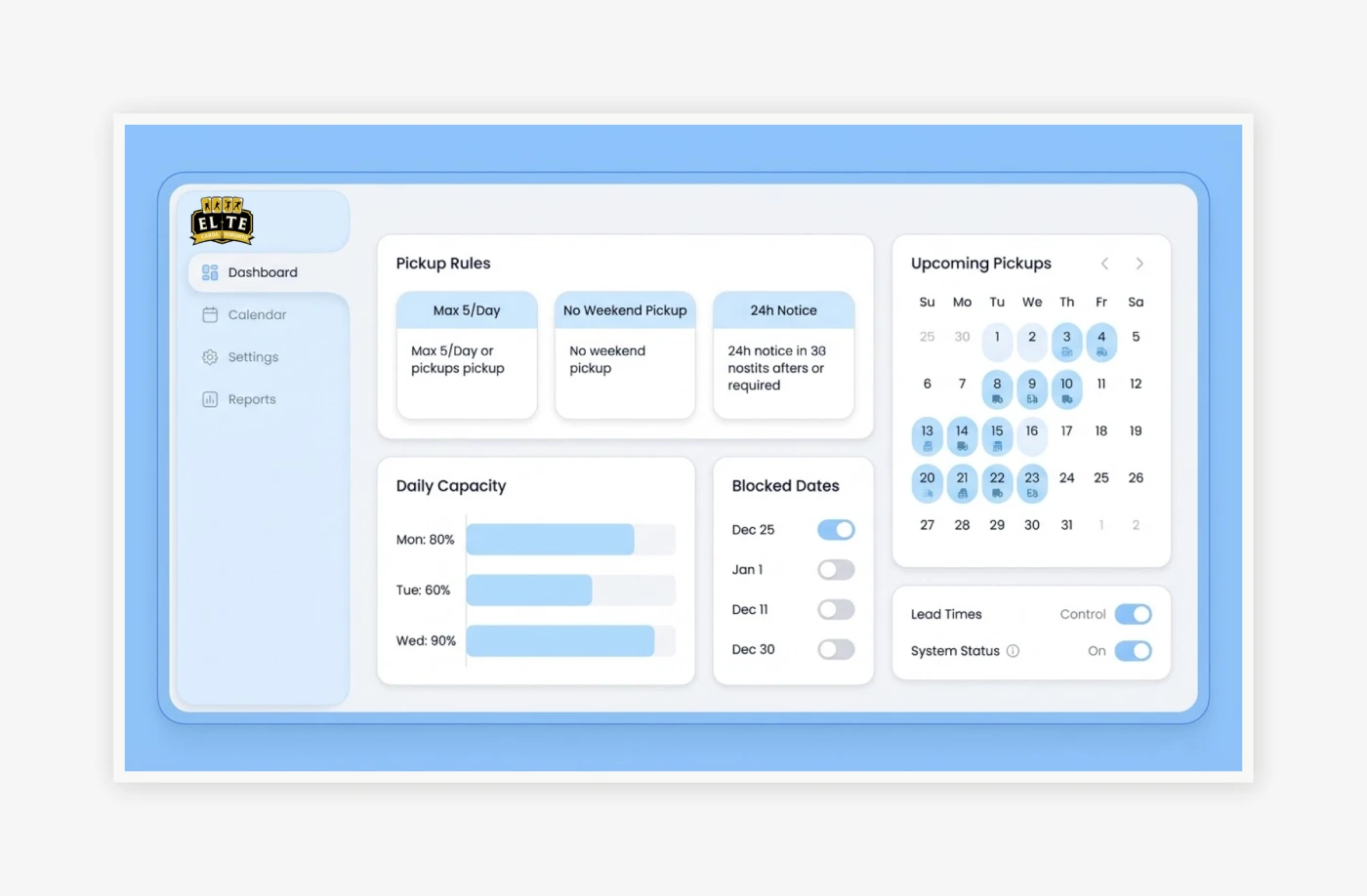
WebDesk Solution addressed the scheduling crisis by designing a custom operational control system that functioned independently of Shopify’s native limitations. Rather than relying on rigid platform workarounds, we engineered a standalone admin dashboard that acted as the authoritative layer for pickup logic, rules, and operational governance.
This dashboard allowed administrators to define and manage pickup rules dynamically. Lead times, daily capacity limits, blocked dates, holidays, and preparation windows could all be configured through a secure interface without developer involvement. The system enforced these rules consistently across every customer interaction, removing ambiguity and preventing invalid bookings before they occurred.
By separating operational logic from the storefront, the business gained flexibility and resilience. Changes in demand, staffing, or seasonal volume could be accommodated instantly. Reporting capabilities provided visibility into upcoming pickups, enabling better resource planning and workload distribution.
This solution transformed pickup scheduling from a reactive process into a controlled operational system. Staff no longer relied on memory or manual checks. Leadership gained confidence that the system could support growth without introducing instability. The result was a scalable foundation designed around real-world operational needs, not platform constraints.
Centralizing Data and Workflows into a Unified Admin Dashboard
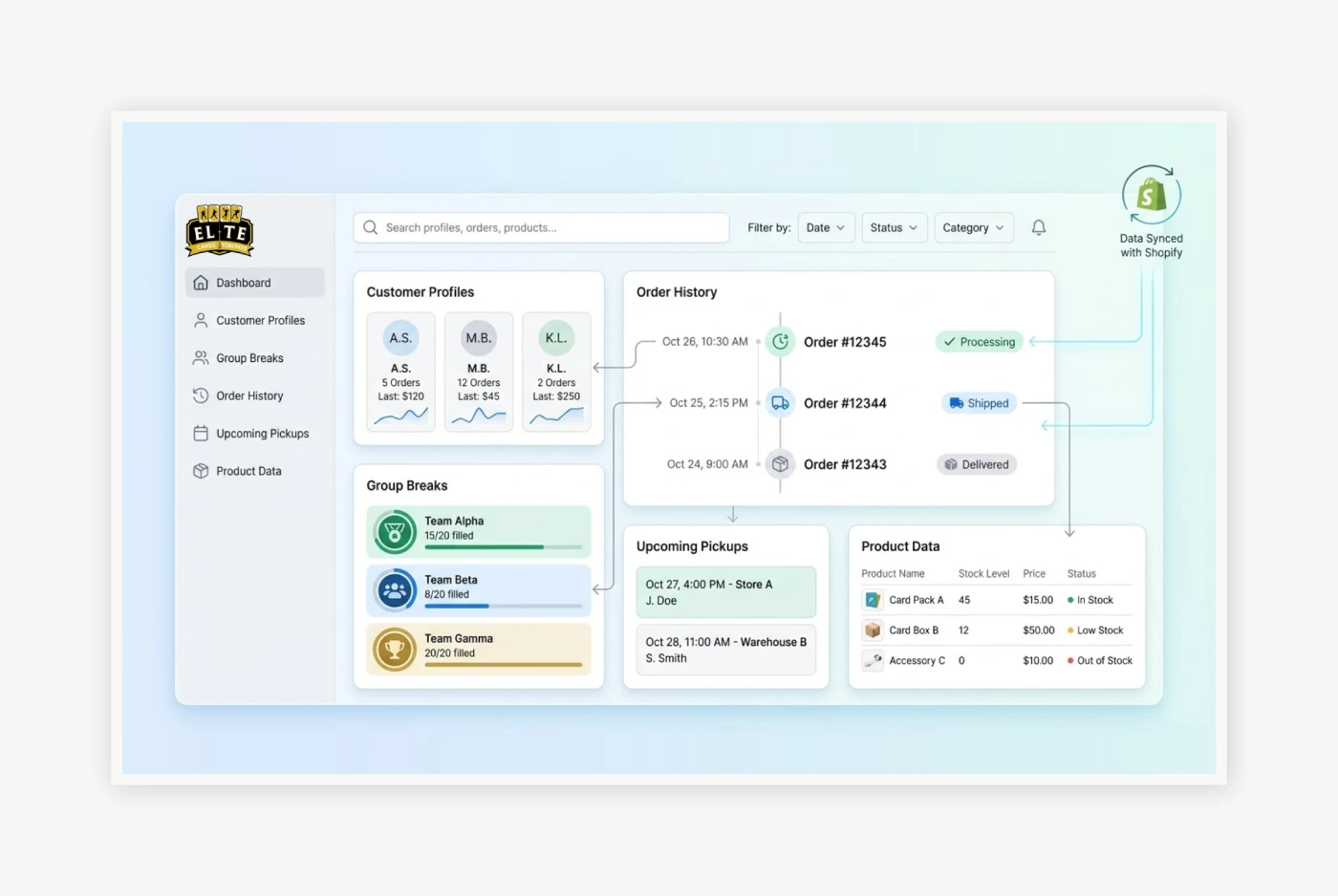
To eliminate operational blind spots, WebDesk Solution built a centralized admin dashboard that unified product data, Group Breaks participation, customer profiles, and order history into a single authoritative interface. This dashboard became the operational source of truth for the entire business.
Admins could view customer purchase history, identify Group Break participation, track upcoming pickups, and manage communications without switching between systems. Advanced filtering and search capabilities allowed staff to segment customers based on products, breakout groups, or order status. What previously required hours of manual cross-referencing became instantly accessible.
The dashboard also synchronized data automatically with Shopify, ensuring accuracy and consistency across all workflows. This eliminated duplicate records, reduced errors, and ensured staff were always working with real-time information.
By centralizing data and workflows, the business shifted from reactive problem-solving to proactive management. Leadership gained visibility into operations, enabling better planning and decision-making. Staff productivity improved, errors decreased, and operational confidence increased. The dashboard did not just organize data, it empowered the team to operate strategically at scale.
Implementing Secure, Login-Validated Workflows with Role-Based Control
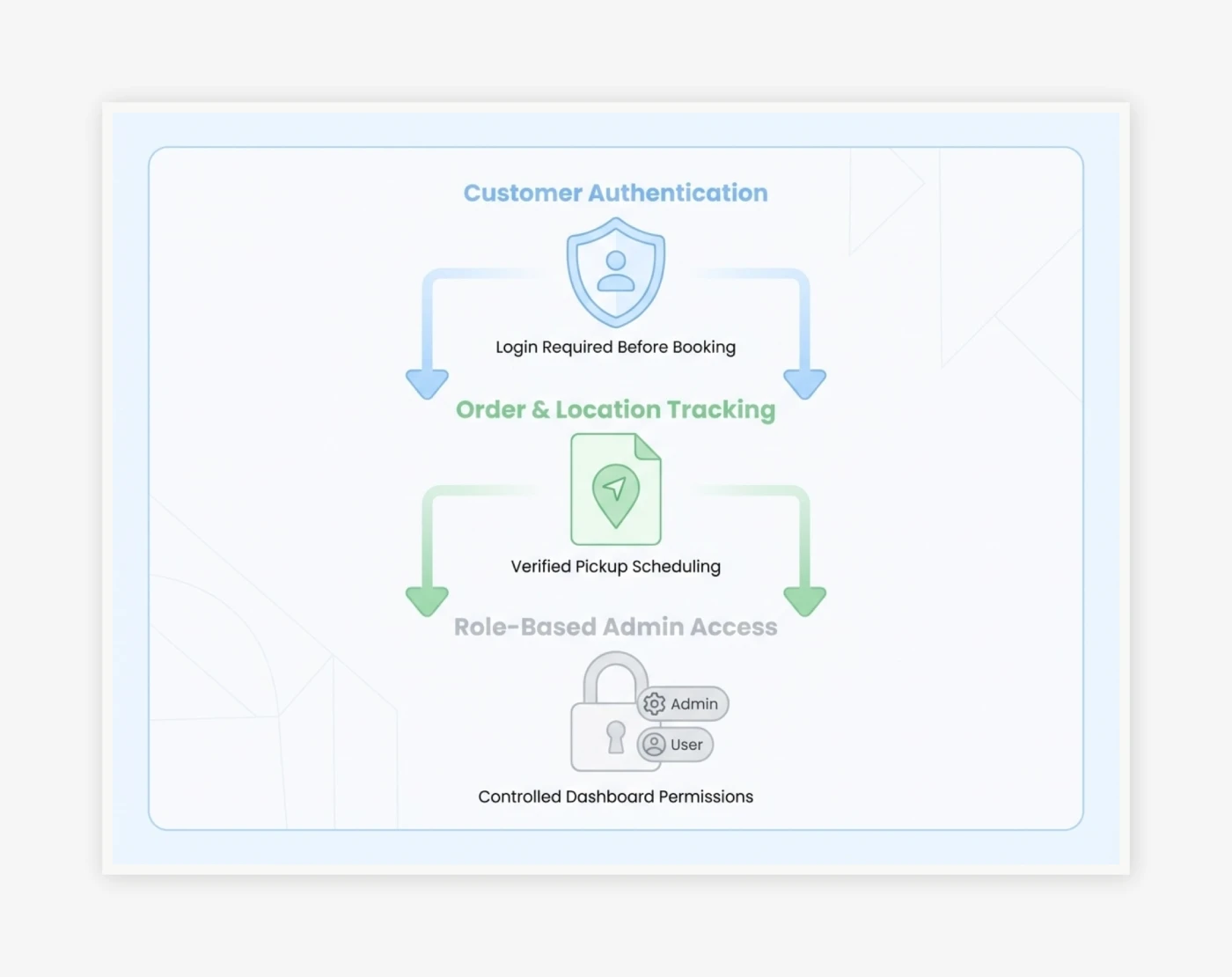
WebDesk Solution addressed the security and accountability gaps by implementing a login-first workflow that required customers to authenticate before scheduling pickups or interacting with sensitive order-related features. Every pickup booking was now directly tied to a verified customer account, eliminating duplicate entries and stabilizing data integrity across the system.
This authentication layer ensured that each action within the workflow was traceable and intentional. Admins could confidently identify who booked a pickup, when it was scheduled, and how it aligned with the associated order. Disputes and corrections could be resolved quickly using system records rather than manual investigation.
To support third-party pickup locations, WebDesk introduced structured tagging and mapping logic within both the storefront and the admin dashboard. Orders were clearly associated with specific locations, reducing reliance on staff memory and preventing fulfillment errors.
Access to the admin dashboard was restricted through role-based controls, ensuring only authorized personnel could view or manage sensitive customer and order data. This separation reduced risk while increasing internal confidence. Security was not treated as an afterthought but embedded directly into the workflow. The result was a system that supported growth without sacrificing trust, accountability, or operational clarity.
Building a Centralized, Automated Communication Engine for Precision Outreach
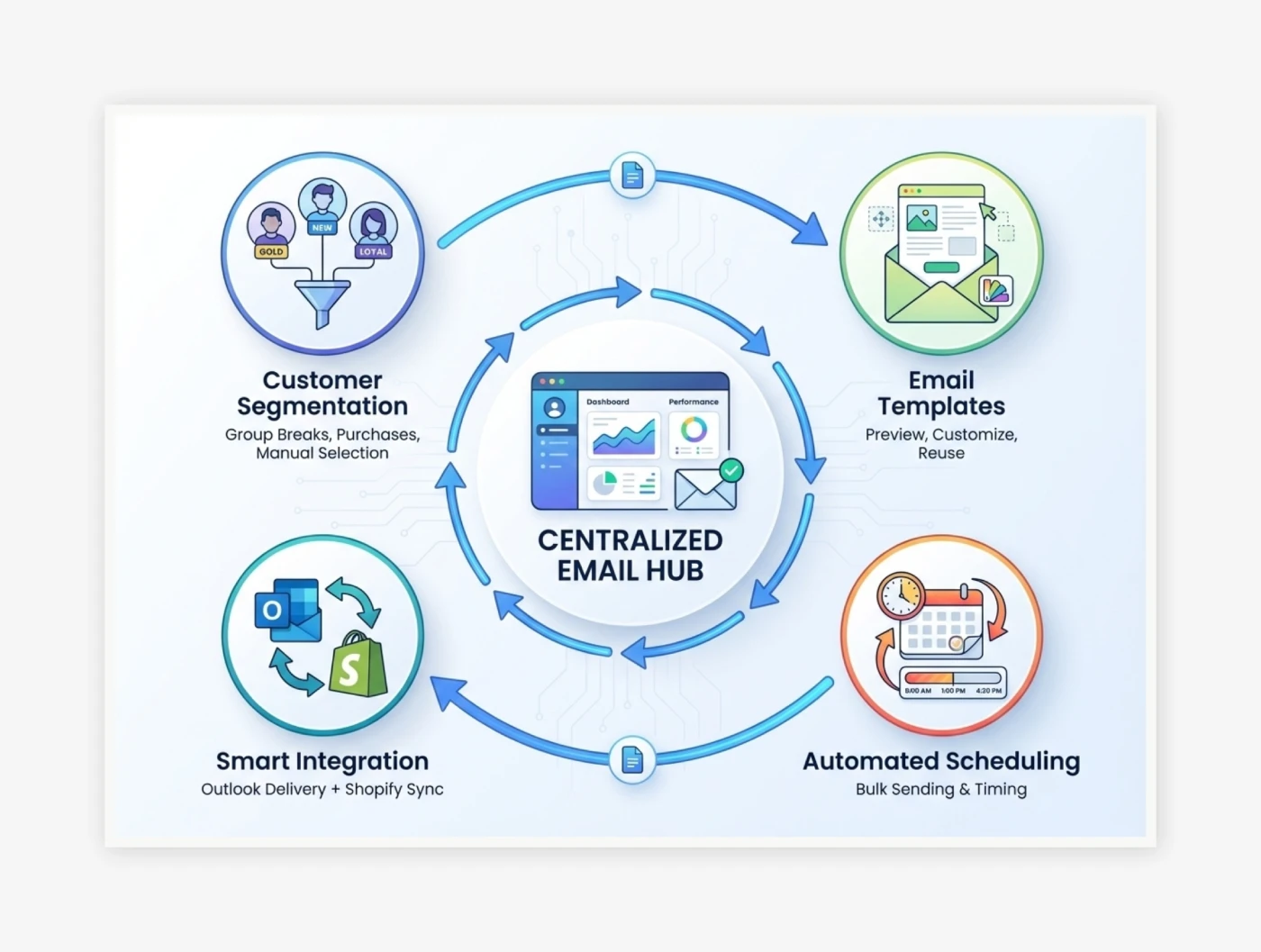
To eliminate communication bottlenecks, WebDesk Solution built a centralized email management system directly into the custom admin dashboard. This system allowed admins to manage outreach from a single interface, removing the need for external exports, manual filtering, or repetitive setup.
Admins could segment customers based on Group Break participation, product purchases, or manual selection. Email templates could be previewed, lightly customized, and reused with confidence. Bulk sending and scheduling capabilities ensured messages reached customers at the right time without manual intervention.
Integration with Outlook provided professional delivery standards and consistency in branding. Automated synchronization with Shopify ensured recipient data was always current, reducing errors and improving targeting accuracy. Reporting tools gave admins visibility into outreach activity and engagement performance.
This solution transformed communication from a manual task into a strategic capability. Staff spent less time managing logistics and more time building relationships with collectors. Messaging became timely, relevant, and reliable. By centralizing and automating outreach, Elite Cards Toronto gained the ability to scale customer engagement without increasing operational strain.
Outcomes & Results
Seamless Pickup Scheduling
Customers can now select precise pickup dates and times with full confidence, knowing that only valid and available slots are shown. The system automatically enforces scheduling rules, preventing conflicts before they occur. Staff receive real-time visibility into upcoming pickups, eliminating confusion and last-minute adjustments. As a result, missed pickups were virtually eliminated and daily fulfillment became predictable and controlled.
Operational Efficiency
Automated scheduling rules, validations, and reporting replaced manual coordination and follow-ups. Staff no longer spend time resolving booking conflicts, confirming pickup details, or correcting preventable errors. Daily workflows became structured and repeatable, significantly reducing operational friction. This freed the team to focus on customer experience, fulfillment quality, and business growth initiatives.
Centralized Customer & Product Management
All customer profiles, product data, Group Breaks participation, and order history are now accessible from a single admin dashboard. This centralization removed the need to switch between systems or manually cross-reference information. Admins can quickly retrieve accurate data, make informed decisions, and manage operations with confidence. Clean, unified data improved speed, accuracy, and overall workflow clarity.
Targeted Communication
Admins can now segment customers based on Group Breaks, product purchases, or manual selection directly within the dashboard. Messages are sent only to relevant audiences, improving engagement and reducing noise. Targeted outreach enables timely updates, promotions, and operational notifications without unnecessary manual effort. Communication became strategic, intentional, and far more effective.
Professional, Error-Free Messaging
Email template previews and light customization allow admins to review content before sending, reducing mistakes. Outlook integration ensures consistent delivery standards and professional presentation. Automated data synchronization guarantees messages are sent to the correct recipients using up-to-date information. This consistency strengthened brand credibility and reduced communication errors.
Stronger Customer Trust
The combination of reliable pickup scheduling and timely, accurate communication significantly improved the customer experience. Collectors consistently praised the clarity of pickup instructions and the professionalism of updates. Reduced friction and improved transparency strengthened confidence in the brand. As trust increased, customer loyalty and repeat engagement followed naturally.
Conclusion
This engagement highlights WebDesk Solution’s ability to deliver deeply customized Shopify ecosystems built for real operational complexity. By replacing manual chaos with intelligent automation, secure workflows, and centralized control, we empowered Elite Cards Toronto to scale without compromise.
Today, Sam Dirracolo operates with clarity instead of stress, confidence instead of guesswork. With WebDesk Solution as a long-term technology partner, Elite Cards Toronto is positioned for continued growth, operational excellence, and exceptional customer experiences.