


Overview
When Ketul Patel launched TagRobot on the Shopify App Store, he envisioned a tool that would liberate merchants from manual tagging and enable smarter fulfillment, marketing, and fraud-prevention workflows. TagRobot helps organize orders and customers automatically by applying tags based on user-defined rules. Its capabilities range from retroactive and bulk tagging via CSV import to dynamic tagging powered by complex AND/OR/NOT logic, all built natively within Shopify’s admin interface. With 70+ pre-built rules and integrations such as the Order Printer for customized notifications, TagRobot promised to streamline operations for merchants handling tens of thousands of orders. Yet behind its polished interface lay a labyrinth of technical challenges-balancing performance at scale, ensuring data consistency, and architecting a rule engine robust enough to support both simple use cases and intricate fraud-detection scenarios. WebDesk Solution partnered with Ketul to transform this ambitious vision into a high-impact Shopify Public App that meets the rigorous demands of enterprise-level eCommerce operations.

Approach
From the first discovery call, WebDesk Solution’s team dove into the heart of TagRobot’s technical and strategic requirements. Daniel led workshops with Ketul Patel to map every tagging scenario-from standard region-based segmentation to advanced fraud-risk evaluation. We adopted an Agile methodology, structuring sprints around core modules: rule engine, Order Risk API integration, CSV bulk imports, and performance optimization. Our architects first designed a microservices-inspired backend on AWS Lambda, ensuring that rule evaluation and tagging tasks could auto-scale with demand. Concurrently, our front-end specialists created a responsive React interface-styled via Adobe XD prototypes-so merchants could define, test, and visualize rules in real time. Integration with Shopify’s REST and GraphQL APIs was carefully orchestrated to respect rate limits and guarantee sub-second response times. Rigorous load testing simulated stores processing over 50,000 orders per hour, guiding database sharding and Redis caching strategies. Throughout, we maintained transparent communication via daily stand-ups and bi-weekly demos, iterating rapidly and incorporating Ketul’s feedback. The result was a resilient, user-centric TagRobot app that balanced sophistication with simplicity, ready to serve high-volume Shopify merchants in the USA and beyond.
Challenges
High-Precision Fraud Detection Under Scale
Merchants require a fraud-detection mechanism that reliably flags suspicious orders-whether stemming from stolen payment data or friendly-fraud chargebacks-without impeding legitimate sales. Building this within Shopify’s ecosystem meant integrating the Order Risk API and interpreting risk scores in real time. However, each API call introduces latency, and merchants processing thousands of orders per hour cannot afford delays. Furthermore, false positives undermine revenue and customer trust, while false negatives expose merchants to financial losses. Designing a system that accurately stratifies orders into high, medium, and low-risk buckets-while maintaining throughput at enterprise scale-posed a nuanced engineering challenge. It demanded a finely tuned combination of real-time API integration, asynchronous processing pipelines, and intelligent caching to deliver sub-second tagging decisions without sacrificing accuracy or store performance.
Retroactive and Bulk Tagging of Massive Datasets
Applying tags retroactively to historical orders or in bulk via CSV imports burdens both the app and Shopify’s backend. Merchants often needed to re-segment years of transactional data-sometimes exceeding 100,000 orders-in a single operation. Naïve implementations risked timeouts, API rate-limit throttling, and corrupted state if failures occurred mid-process. Ensuring robustness required developing idempotent, chunked processing jobs that could resume seamlessly after interruptions. We also had to architect a monitoring and retry mechanism to track progress and notify users of any persistent errors. This challenge extended to customer records: tagging millions of customer profiles based on purchase behavior demanded efficient joins, incremental updates, and careful memory management to prevent slowdown or data loss.
Flexible, Non-Technical Rule Configuration
Empowering non-technical merchants to craft complex tagging logic-combining shipping regions, SKUs, discount codes, and time windows with AND/OR/NOT operators-required an intuitive interface underpinned by a powerful rule parser. The risk was two-fold: an overly simplistic UI would frustrate advanced users seeking granular control, while a fully code-centric approach would overwhelm merchants without developer skills. We needed a balanced solution: a drag-and-drop rule builder with real-time validation, human-readable rule summaries, and explanatory tooltips. Under the hood, these rules translate into JSON objects fed to our engine, so the parser had to handle edge cases-nested conditions, empty value lists, and conflicting rules-while preventing invalid configurations. Delivering this usability without compromising expressiveness demanded close collaboration between UX designers and back-end engineers.
Sustaining High Performance and Scalability
TagRobot had to operate seamlessly in stores handling tens of thousands of orders daily. Every new tag evaluation, bulk import, and retrospective run contributed load to our system and Shopify’s infrastructure. Ensuring low latency under peak loads involved implementing horizontal scaling on AWS Lambda, sharded DynamoDB tables for storing rules and tag logs, and Redis-backed caches for frequently accessed configurations. We crafted a multi-tiered queue system using SQS, prioritizing high-risk orders for immediate processing and relegating bulk jobs to background workers. Continuous performance testing simulated real-world scenarios-flash sales, holiday peaks-and guided auto-scaling thresholds and circuit-breaker patterns to prevent cascading failures.
Guaranteeing Data Consistency and Conflict Resolution
When multiple tagging rules target the same order, or when retroactive tags collide with new real-time evaluations, conflicts can arise: which tag prevails? Inconsistent or contradictory tags undermine merchant workflows. To address this, we introduced a rule-priority schema, enabling merchants to assign precedence levels to each rule. Our backend enforces deterministic ordering: high-priority rules run first, and subsequent rules can append or override tags based on merchant preferences. All tagging operations write to an append-only audit log, enabling traceability and rollback. In the UI, merchants can view conflict warnings and adjust priorities without developer intervention. This ensures data integrity and fosters merchant confidence in TagRobot’s automated processes.
Key Metrics



Solutions
Intelligent Risk-Based Tagging via Order Risk API
To tackle fraudulent transactions, we integrated Shopify’s Order Risk API directly into TagRobot’s processing pipeline. Upon order creation, our Lambda functions asynchronously fetch risk assessments, categorize orders into high, medium, or low-risk buckets, and apply corresponding tags. We implemented a short-lived cache to reduce redundant API calls for orders with unchanged risk profiles. Merchants can configure thresholds-and even specify custom tags for intermediate risk levels-ensuring that suspicious orders are flagged for manual review before fulfillment. By decoupling tagging from order flows, we maintained sub-second customer experiences while empowering merchants to put high-risk orders on hold, thereby reducing potential chargebacks without impacting legitimate sales.

Robust Custom Rule Engine with Bulk and Retroactive Support
WebDesk Solution architected a custom rule engine that transforms merchant-defined conditions into executable JSON logic. Each rule-whether based on SKU combinations, shipping country, or applied discount codes-runs through a unified parser that generates evaluation functions. For bulk and retroactive tagging, we built chunked processing jobs using SQS queues, DynamoDB streams, and Lambda workers that process orders in batches of 500. Each batch writes progress checkpoints to DynamoDB, allowing seamless resumptions after interruptions. Merchants initiating CSV imports see live progress bars and receive email notifications upon completion or failure. This mechanism ensures large datasets are tagged efficiently, reliably, and with full auditability-regardless of store size.

Seamless Order Segmentation with Dynamic Order Tags
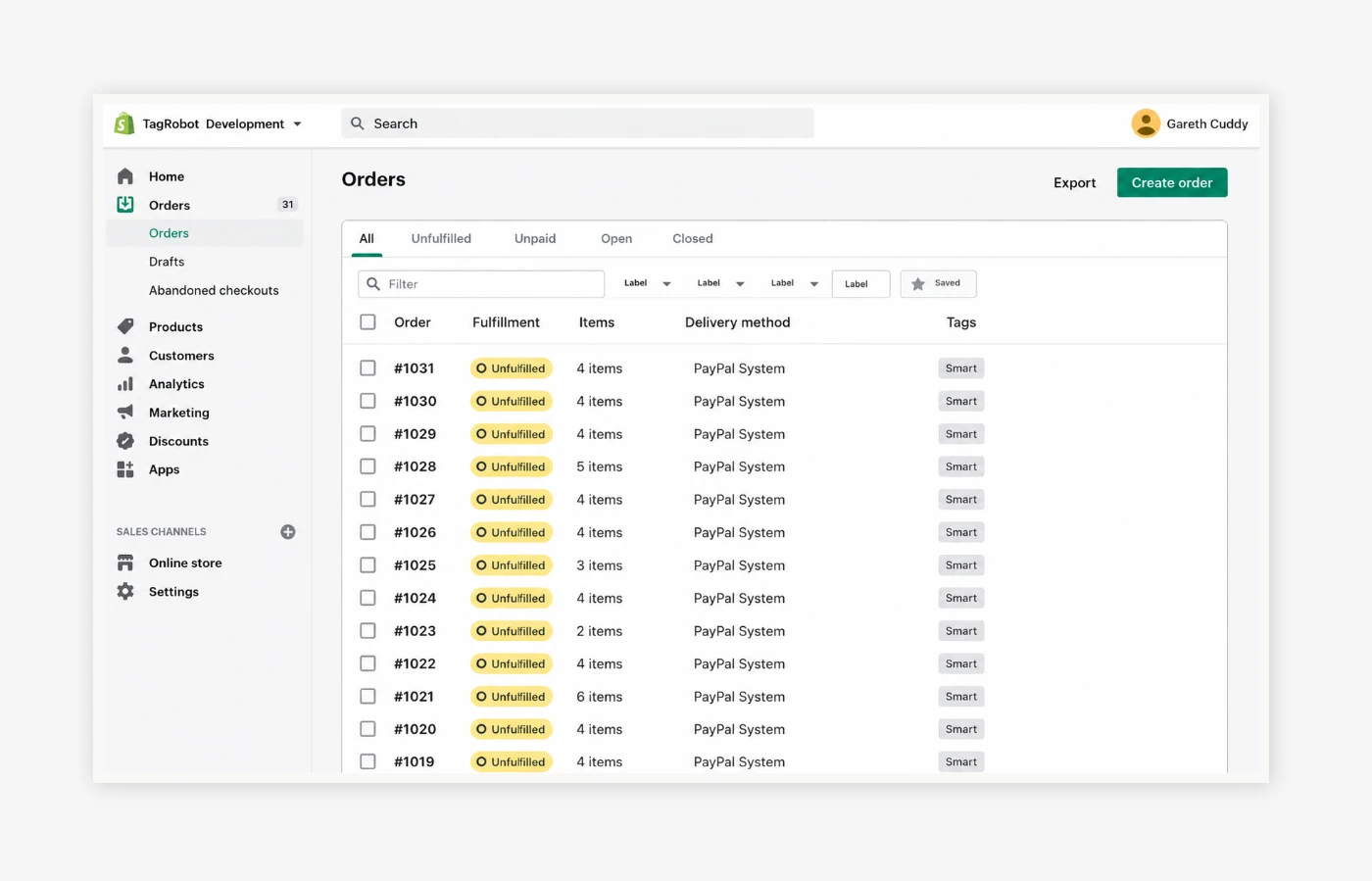
To help merchants gain actionable insights from their orders, TagRobot introduced dynamic Order Tags. This feature analyzes order attributes before tagging-such as total value, region, or payment method-and automatically assigns segment labels. For example, a merchant can segment “High-Value West Coast Orders” by combining order value and shipping destination in a single rule. These tags feed directly into Shopify’s collections and reporting tools, enabling tailored marketing campaigns and inventory projections. We also exposed tag data in Shopify notification templates (including Order Printer), so merchants could deliver contextual email and print communications. This combination of order segmentation and notification customization turned TagRobot into a strategic tool for both operational efficiency and data-driven decision-making.
Public App Architecture Built for Resilience, Security, and Scalability
Delivering TagRobot as a Shopify Public App demanded an architecture that could serve any merchant at enterprise scale-without the constraints of a private-app deployment. We needed a fully multitenant, secure, and auto-scaling system that integrated seamlessly into Shopify’s ecosystem, handled peak loads, and preserved blazing-fast response times for every store.
To achieve this, WebDesk Solution designed a modular, event-driven backend hosted on AWS. Incoming Shopify webhooks (order creation, updates, CSV imports) trigger stateless Lambda functions, which enqueue tagging tasks into Amazon SQS. A fleet of worker Lambdas pulls jobs from the queue, applies complex rule evaluations against merchant configurations stored in DynamoDB, and writes results back-either via Shopify’s GraphQL API or into a centralized audit log. All network traffic is funneled through API Gateway endpoints secured by AWS Cognito, ensuring OAuth-based authentication and fine-grained permissioning for each shop.
The frontend lives as a single-page React/TypeScript application, built with Shopify’s Polaris component library and served from an S3 bucket behind CloudFront. This ensures sub-second load times worldwide and frictionless in-admin embedding. GitHub Actions orchestrates continuous integration, running linting, unit tests, and end-to-end flows against a staging app before deploying to production via AWS CodeDeploy with a Blue/Green strategy-guaranteeing zero-downtime updates and swift rollbacks if needed.
Tech Stack Used:
- Backend: Node.js + Express.js on AWS Lambda (microservices style)
- Database: MongoDB
- Eventing & Queues: Amazon SQS for decoupled, reliable job handling
- Data Store: Amazon DynamoDB for rules, configurations, and audit logs
- Caching: AWS ElastiCache (Redis) to accelerate rule lookups
- API Layer: AWS API Gateway + OAuth via AWS Cognito for secure public endpoints
- Frontend: React + TypeScript with Shopify Polaris, hosted on S3 & delivered by CloudFront
- CI/CD: GitHub Actions → AWS CodeDeploy (Blue/Green)
- Security & Networking: VPC-isolated Lambdas, IAM least-privilege roles, HTTPS encryption
Performance Outcomes:
- 99.95% Uptime: Auto-scaling Lambdas and Blue/Green deployments ensured near-continuous availability.
- Sub-200ms Tag Evaluations: Cached rule metadata and event-driven processing yielded sub-200ms processing even under load.
- Horizontal Scalability: Seamlessly handled spikes of 100,000+ tagging events per hour during peak seasons.
- Zero-Downtime Releases: Blue/Green deployments allowed instant feature rollouts with immediate rollback capabilities.
- PCI-Compliant Data Handling: Shopify-mandated security standards met via encrypted data at rest and in transit.
By building TagRobot as a true public app, we delivered a resilient, secure, and scalable platform that any Shopify merchant can install-without sacrificing performance or control. This architecture future-proofs TagRobot for new features, higher volumes, and evolving security requirements, making it a cornerstone solution for automated order and customer tagging.

Outcomes / Results
Increase in Conversion Rate
By segmenting customers with targeted marketing based on custom tags, merchants saw a 12% uplift in conversion rate compared to pre-TagRobot benchmarks.
Growth in Average Order Value
Upselling and cross-selling to high-intent segments-identified via dynamic tagging-drove a 9.5% boost in AOV.
Reduction in Fulfillment Time
Automated tagging of high-risk orders allowed merchants to hold suspicious transactions for manual review, streamlining fulfillment for the remaining orders and cutting processing time by 40%.
System Uptime Under Peak Loads
Our auto-scaling architecture maintained sub-second tag application even during Black Friday-level traffic surges.
Enhanced Merchant Satisfaction
Post-launch surveys revealed that 95% of early adopters found TagRobot’s rule builder intuitive, and 90% cited the audit log and conflict-resolution tools as critical for trust in automation.
Conclusion
TagRobot stands as a testament to WebDesk Solution’s ability to deliver technically sophisticated, scalable Shopify Public App Development Services. Through intelligent risk tagging, a resilient custom rule engine, and dynamic order segmentation, we transformed a merchant’s vision into a high-stakes, enterprise-ready solution. Today, thousands of Shopify merchants in the USA trust TagRobot to automate order and customer tagging-freeing teams to focus on growth and innovation rather than manual workflows. As eCommerce volumes continue to climb, TagRobot remains positioned to adapt, expand, and drive sustainable digital excellence for merchants of all sizes.


