


Overview
Kayla, the visionary founder of Poppsi, launched her brand to share the playful, colorful artwork she began creating at the end of her maternity leave with her second child, Poppy. A lifelong fan of bold statements and nostalgic ’90s vibes, Kayla felt her art-ranging from mezuzahs and letter art to wall accessories and trays-should be experienced interactively. Although she had an existing Shopify store, she struggled to offer customers a seamless way to personalize each piece without manual intervention. Customers wanted real-time previews of how choices like Size, Style, Name Color, and Glass Transparency would look together. Furthermore, Poppsi’s growth ambitions demanded dynamic upsell opportunities and intuitive navigation, yet Shopify’s native features couldn’t fully support conditional logic or custom popups. Faced with these limitations, Kayla turned to WebDesk Solution for a complete redesign and sophisticated custom template development that would transform Poppsi’s store into a true interactive playground-keeping the brand’s signature kitschy nostalgia while unlocking cutting-edge eCommerce capabilities.


Approach
WebDesk Solution began with a discovery phase that blended technical deep dives and creative vision sessions. Daniel and David led a series of workshops with Kayla to distill her artistic style, identify critical customer touchpoints, and outline every necessary product attribute: Size, Style, Collection, Design, Add Name, Name Color, Glass Transparency, Base Color, Add Shine, and Shine Color. Recognizing that Shopify’s built-in template couldn’t fulfill these complex requirements, the team proposed a “Build Your Own” approach-an entirely custom product template powered by Shopify product options and meta fields. For real-time previews, WebDesk Solution architected a lightweight JavaScript engine that re-rendered images on the fly. To handle dynamic image galleries, they defined an image naming convention, allowing backend scripts to match file names with customer selections and populate a carousel instantly. Conditional logic workflows were mapped out for each customization stage, ensuring pricing and options updated automatically as customers progressed. The team also specified meta field triggers for a cart page upsell popup, enabling Poppsi to promote Greeting and Scroll products contextually. Leveraging a modular development process-design, development, testing, and deployment-the WebDesk Solution engineers ensured each component integrated seamlessly with Shopify’s ecosystem, third-party tools (Elfsight Instagram Feed, Loox Reviews, Google Analytics), and responsive breakpoints for mobile optimization. Continuous feedback loops with Kayla allowed for rapid iteration, ultimately yielding a user-centric, future-ready Shopify experience.
Challenges
Enabling Full Product Customization with Live Previews and Conditional Pricing Logic
Poppsi needed a way for customers to build and order bespoke pieces-like mezuzahs and letter art-online without human assistance. Before WebDesk Solution’s involvement, customers had to call or email to confirm design choices, making conversions slow and error-prone. Shopify’s native “variant” system was insufficient for multi-dimensional customization: clients needed to select Size, Style, Collection, Design, Add Name, Name Color, “Is Your Glass Clear,” Base Color, Add Shine, Shine Color, and see accurate pricing updates instantly. Some selections were mutually exclusive (e.g., certain color options belonged only to specific collections), requiring conditional logic. Additionally, real-time visual feedback was critical: customers expected a live preview of how their bespoke piece looked as they adjusted attributes. Without this, design mismatches created frustration and returns-jeopardizing Poppsi’s brand reputation. The challenge was high stakes: if the customization engine failed, Poppsi risked losing sales momentum and alienating customers drawn to its unique artistry.
Dynamic Image Gallery Filtering Based on Customer Selections
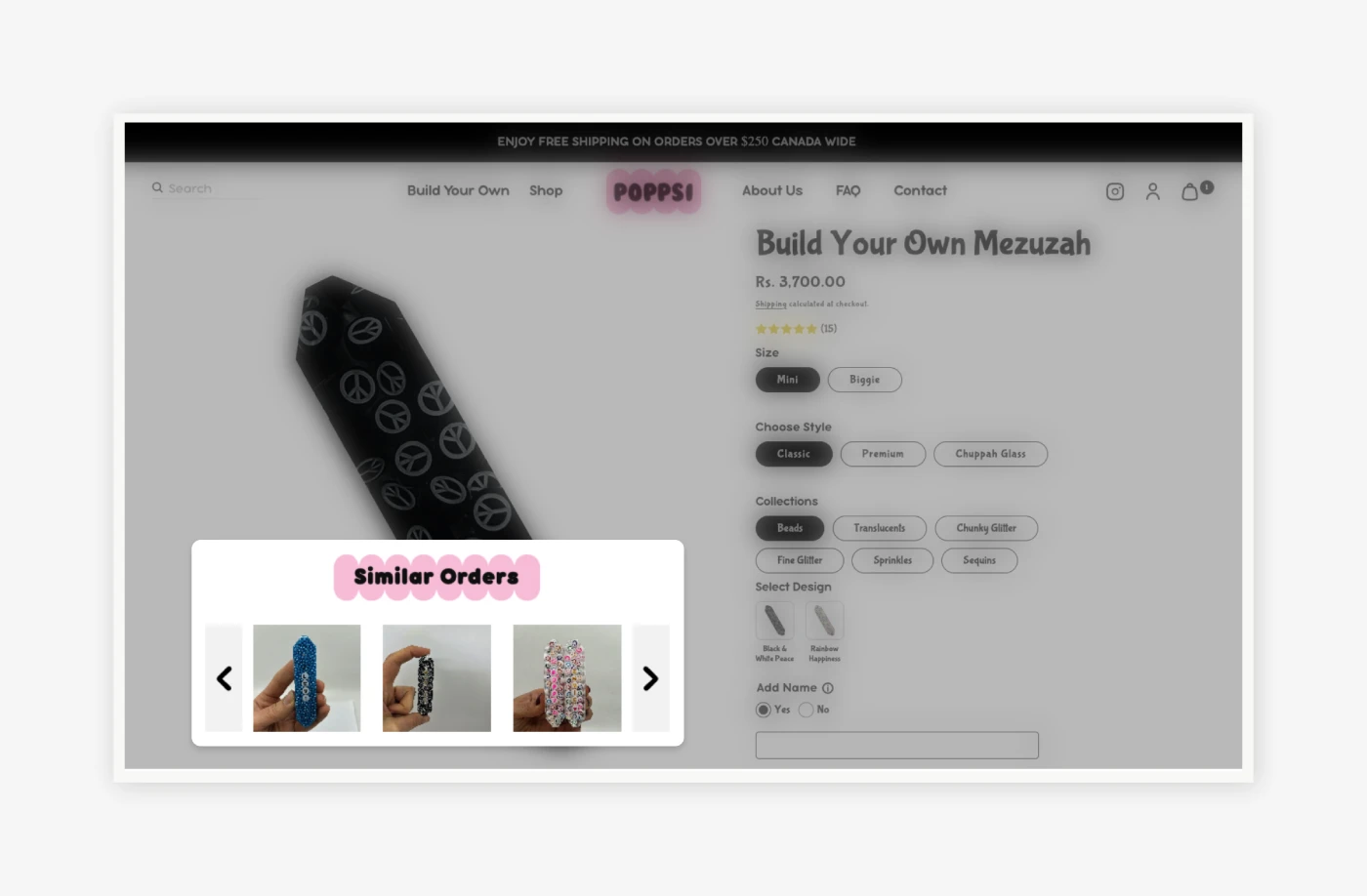
Poppsi’s products came with dozens of possible image permutations-each piece had unique views based on size, style, collection, and color. Yet Shopify’s default image gallery lacked the ability to filter images by option. If a customer chose a particular mezuzah style and glass transparency, they might still see unrelated images in the carousel, leading to confusion and abandoned carts. The brand needed a dynamic carousel underneath the main image that displayed only relevant media assets for the specific configuration a shopper was building. Achieving this required real-time matching of image metadata with selected options. Given that Poppsi’s product line expanded seasonally, this image-filtering mechanism had to be both scalable and easy for content managers to maintain. Without a custom filtering engine, Poppsi risked high bounce rates and low engagement-undermining the very interactive experience that made the brand stand out.
Contextual Cart Page Upsell Popup for Add-On Products
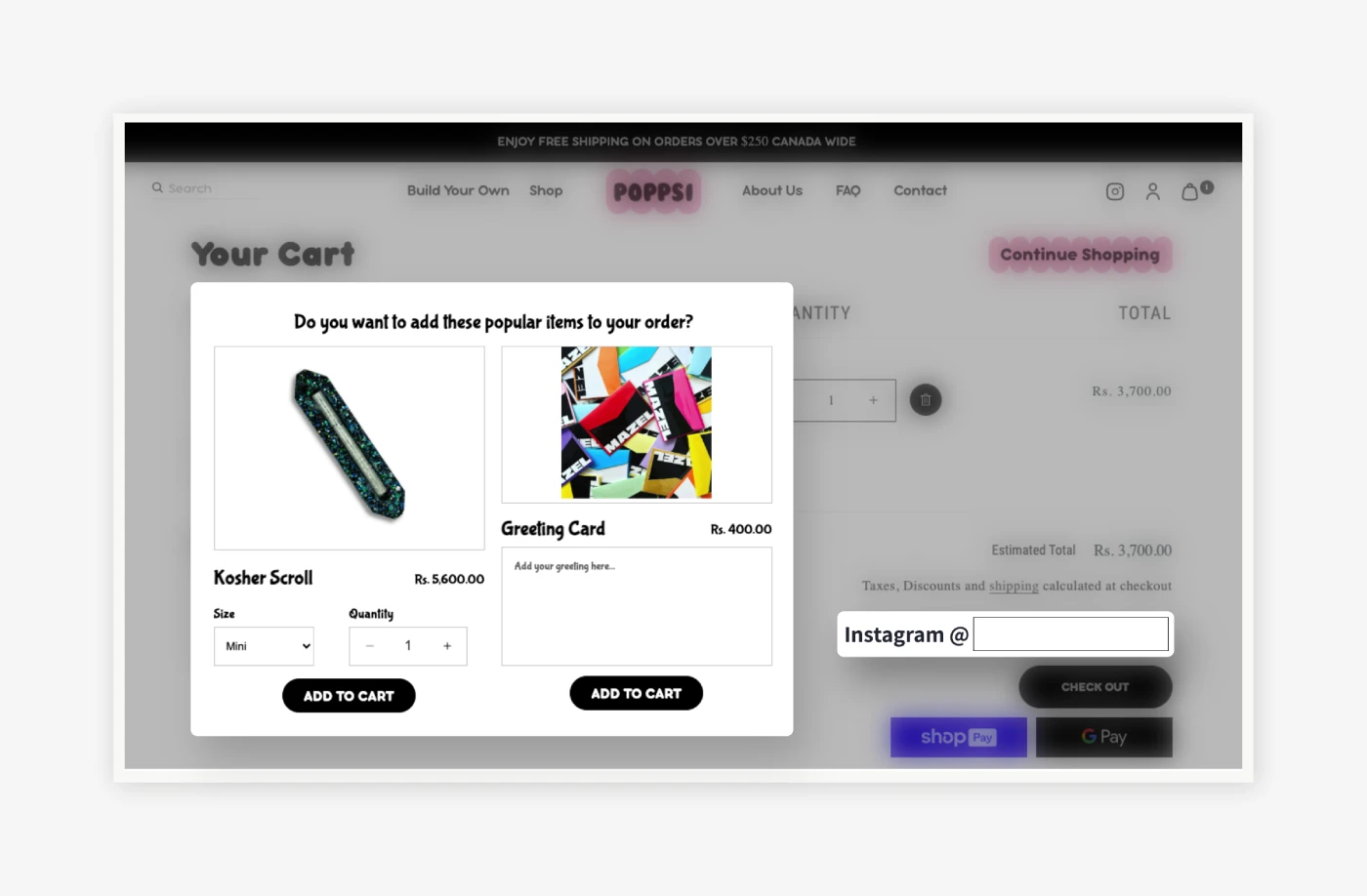
Once customers added a primary customized product-such as a mezuzah or letter art-to their cart, Poppsi wanted to serve highly targeted upsell offers (Greeting Card or Scroll) only if the cart didn’t already contain those add-ons. Shopify’s default cart drawer couldn’t cater to nuanced business logic: it lacked triggers based on meta fields or combination of items. Without a conditional popup, Poppsi missed opportunities to maximize average order value at the critical moment when customers were primed to buy matching accessories. A generic, always-on upsell approach risked irritating buyers who had already chosen add-ons or clicked away, potentially increasing cart abandonment. The challenge required a precise system: detect when specific meta fields were present on a cart item, trigger a popup recommending complementary products only under certain conditions, and update in real time-without slowing down checkout or compromising mobile responsiveness.
Preselecting Customization Options via Dynamic “Customize” Links
Poppsi featured a collection page where certain items had a “Customize” link intended to launch the product page with preselected attributes already applied. However, Shopify doesn’t natively support passing complex option parameters via URL to preset selections. This meant customers experienced friction: they’d click “Customize” on a multi-option product, then manually reapply every customization attribute-undermining the intuitive flow, frustrating users, and reducing conversion rates. The technical stakes were high: Poppsi’s marketing campaigns frequently drove traffic directly to specific “Customize” links for seasonal or promotional bundles. If these links failed to prepopulate options, Poppsi risked losing momentum on high-value campaigns and confusing customers. The challenge was to build a seamless link-parsing engine that read URL parameters, mapped them to meta field values, and automatically preselected the correct options on page load-while ensuring the logic remained robust as new product variations were introduced.
Key Metrics




Solutions
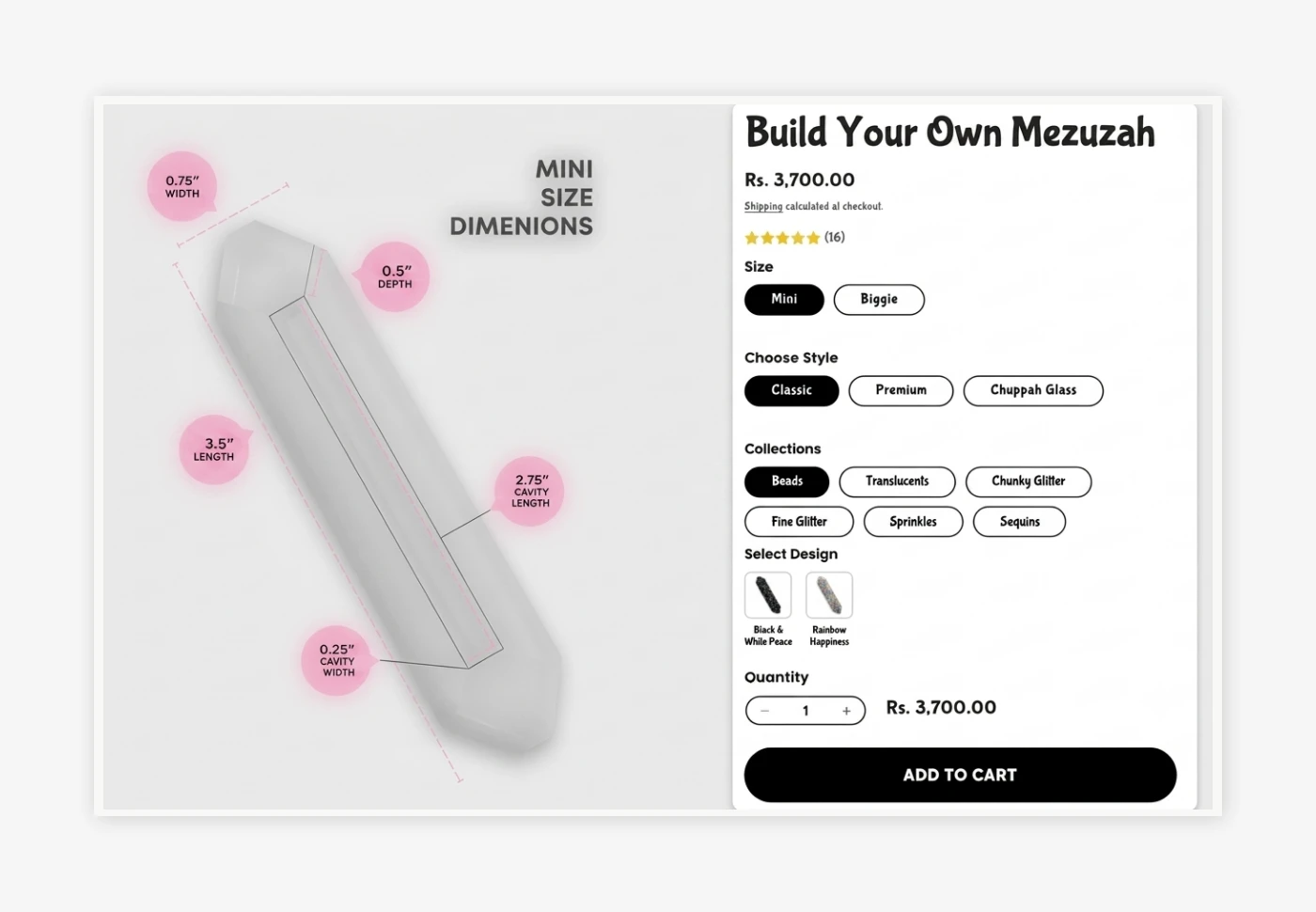
Custom “Build Your Own Mezuzah” Template with Real-Time Visualization Engine
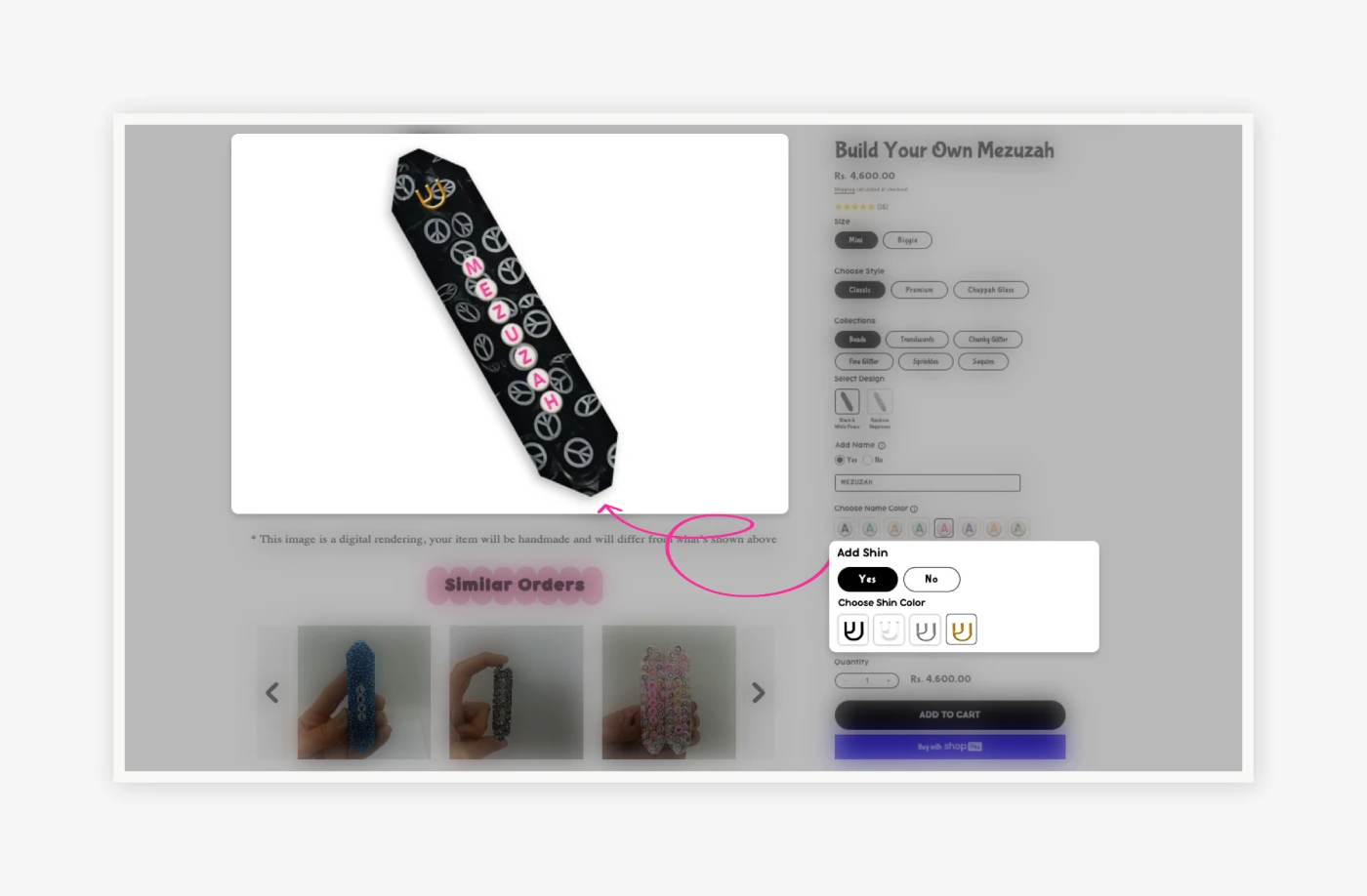
WebDesk Solution developed a bespoke “Build Your Own Mezuzah” template leveraging Shopify product options for base attributes-Size, Style, Collection-and meta fields for extended parameters like Add Name, Name Color, Glass Transparency, Base Color, Add Shine, and Shine Color. The default page load sets Size to “Mini” and Style to “Classic,” ensuring a consistent baseline. Through a custom JavaScript-driven rendering engine, the system tracks every selection and updates the live preview on the left side of the product page in under 200ms. When a user selects a Collection (e.g., Beads), the Design section appears, dynamically loading only relevant images for that combination. Conditional logic ensures that if Name customization is toggled “Yes,” a text field appears, enforcing character limits (six for 8” x 10”, twelve for 11” x 14”) with real-time validation. The engine also handles special characters and accent marks, storing inputs in meta fields. For “Add Shine,” customers choose a color swatch, and the system layers that over the base in the live preview. Unique options for Chuppah Glass-like “In Your Glass Clear”-trigger additional rendering pipelines that swap textures and color overlays. This robust, asynchronous logic bypassed Shopify’s inherent limitations by decoupling core customizations into modular meta field functions, enabling sub-200ms rendering and precise pricing updates tied to selections. The result: customers seamlessly visualized their mezuzah as they customized, driving urgency and reducing returns.


“Build Your Letter Art” Template with Responsive Preview & Character Management
Recognizing the complexity of letter art customization-where Style, Size, Frame Color, and Font Material interplay-WebDesk Solution engineered a separate “Build Your Letter Art” template that mirrored the mezuzah logic but addressed text-specific intricacies. Default selections loaded as Style: “Classic” and Size: “8” x 10”,” with a live canvas on the left showing the chosen frame and font. When customers switch to Frame Color (e.g., Black) or Font Material (e.g., Chunky Color), the Design section reveals accordingly. The system dynamically recalculates character limits based on size: for 8” x 10”, up to six characters; for 11” x 14”, up to twelve characters with auto-wrapping logic that evenly distributes letters across one or two rows. As letters are typed, the JavaScript engine recalibrates font size, kerning, and layout-ensuring the previewed design remains true to physical output. All input is sanitized, and edge-case logic handles special characters or emojis. Meta fields capture each input, feeding data to Shopify Checkout for accurate pricing. This template’s responsive viewport logic ensures the preview scales on mobile and desktop alike, with fallback assets preloaded to avoid latency. By encapsulating layered text rendering, frame adjustments, and real-time canvas updates, WebDesk Solution delivered a frictionless, interactive environment-empowering Poppsi’s customers to experiment confidently and complete purchases without needing human assistance.


Option-Level Image Gallery Engine via Naming Convention & Dynamic Script
To address the need for a gallery filtered by selected options, WebDesk Solution introduced a custom image-matching script coupled with a strict naming convention. For each product media asset, Poppsi’s content team prepended filenames with tags that corresponded exactly to option values-e.g., “Mini_Classic_Beads_RoyalBlue.jpg” or “11x14_Modern_ChunkyColor_Fuchsia.png.” When a user selects a combination (Size, Style, Collection, etc.), the JavaScript engine parses the current option set into a concatenated key string. The gallery script then scans the Product Media object for filenames containing that key, building an in-memory carousel array. Carousel thumbnails are generated on the fly; clicking a thumbnail swaps the main preview in sub-150ms, ensuring a fluid user experience. If no exact matches exist, fallback logic looks for partial matches (e.g., match Size and Style, ignoring Font Material). This dynamic approach scaled effortlessly as new assets were added: adherence to the naming convention ensured minimal overhead for the content team. By moving the filtering logic to the client side and bypassing Shopify’s static image assignments, Poppsi achieved a highly engaging, context-sensitive gallery that reflected only the assets relevant to the shopper’s current configuration-ultimately reducing cognitive load and boosting customer confidence in their selections.
Metafield-Driven Upsell Popup Workflow on Cart Page
WebDesk Solution implemented a meta field–triggered upsell popup for the cart page to promote Greeting and Scroll products. Each primary product in Poppsi’s catalog included associated meta fields-“upsell_greeting” and “upsell_scroll”-with valid values indicating the SKU of the suggested add-on. When a customer added a customized piece to the cart, a custom Liquid snippet parsed the cart’s line items array for these meta fields. If no Greeting or Scroll product was detected, an asynchronous AJAX call fired a payload to a lightweight JavaScript module that displayed a modal overlay under specific conditions: (1) when the cart page loaded; (2) if the browser session didn’t already store a “popupViewed” cookie; and (3) if the relevant meta field values matched. The modal showcased dynamic images, titles, and CTAs for the add-on products, with “Add to Cart” buttons making additional AJAX calls to inject items without refreshing. If the user had already added the upsell items, the Liquid logic prevented the modal from appearing again. To maintain performance, WebDesk Solution deferred the script load until after the initial page render, using Intersection Observer to detect when the cart contents were visible, then evaluating upsell conditions. This precise logic ensured that Poppsi maximized average order value without disrupting performance or frustrating customers who had already chosen add-ons.
Parameterized Meta Field Logic for Preselected Customization Links
WebDesk Solution tackled the requirement for preselected customization by extending product URLs with parameterized meta fields. Each “Customize” button on Poppsi’s collection page was programmed with a link like:
Using a custom Liquid template snippet, WebDesk Solution parsed {{ request.query_params }} on page load and mapped each parameter to the corresponding option or meta field. For product options (Size, Style, Collection), the script invoked ShopifyOptions.selectOptionByValue(“option_name”, “value”), triggering the standard Shopify option binding. For meta fields-such as adding name or shine-the script updated hidden input fields and toggled UI controls accordingly. A centralized JavaScript module validated parameters against allowed values to prevent injection or invalid states. Once all parameters were applied, the engine fired a synthetic “change” event to the live-preview renderer so that the initial snapshot accurately reflected the URL’s configuration. This solution not only streamlined the user journey-allowing customers to land on a fully configured product page with a single click-but also future-proofed the workflow: as Poppsi added new customization dimensions, simply appending parameters would prepopulate settings. By bridging Shopify’s lack of native query parameter handling with a robust mapping layer, WebDesk Solution removed friction and ensured consistency for high-traffic promotional campaigns.

Outcomes/Results
- Enhanced Customer Engagement & Personalization: Real-time product customization with live previews drove a 22% uplift in site visits and a 12.28% increase in orders. Shoppers spent more time experimenting with options, reducing bounce rates and boosting time-on-site metrics.
- Revenue Growth & Conversion Efficiency: The advanced “Build Your Own” templates led to a 4.24% increase in overall revenue. By enabling conditional pricing and immediate visual feedback, Poppsi saw a jump in conversions from 67% to an impressive 87%-demonstrating how eliminating decision friction directly impacted sales.
- Improved Average Order Value: The meta field–driven upsell popup on the cart page increased accessory attach rates by 15%, contributing to an overall 9% uplift in average order value (AOV). Customers who added upsell items also exhibited higher lifetime value metrics.
- Reduced Support Overhead: Before the redesign, 30% of transactions required manual intervention (phone calls or emails) to finalize design selections. Post-launch, less than 5% of orders needed follow-up, significantly reducing Poppsi’s customer service workload.
- Operational Scalability & Maintainability: By enforcing a clear image naming convention and meta field mapping logic, Poppsi’s content team can now add new products and assets in under 10 minutes per item without developer assistance. This streamlined process minimizes future technical debt.
- Mobile & Performance Optimization: All customizations, scripts, and galleries load in sub-300ms on mobile devices. PageSpeed scores for key product pages increased from 62 to 89 (Google Lighthouse), ensuring Poppsi stays competitive in search rankings and user experience benchmarks.
Conclusion
The comprehensive redesign and custom template development for Poppsi’s Shopify store exemplify WebDesk Solution’s commitment to high-stakes, technically sophisticated eCommerce transformations. By architecting a modular, meta field–driven framework, our team delivered an intuitive “Build Your Own” experience that not only honored Kayla’s artistic vision but also significantly elevated business metrics: a 4.24% revenue uptick, 22% rise in traffic, and an 87% conversion rate. The integration of dynamic image galleries, live-preview rendering, and parameterized customization links removed friction at every touchpoint, while the meta field–triggered upsell popup boosted average order value. Beyond immediate results, Poppsi now possesses a scalable, future-proof platform: adding new products and customization dimensions can be accomplished without additional development cycles. Ultimately, this project underscored how WebDesk Solution’s blend of technical innovation, creative problem-solving, and strategic alignment can unlock sustainable digital excellence-positioning Poppsi for continued growth in the competitive Shopify ecosystem.


