


Client Overview
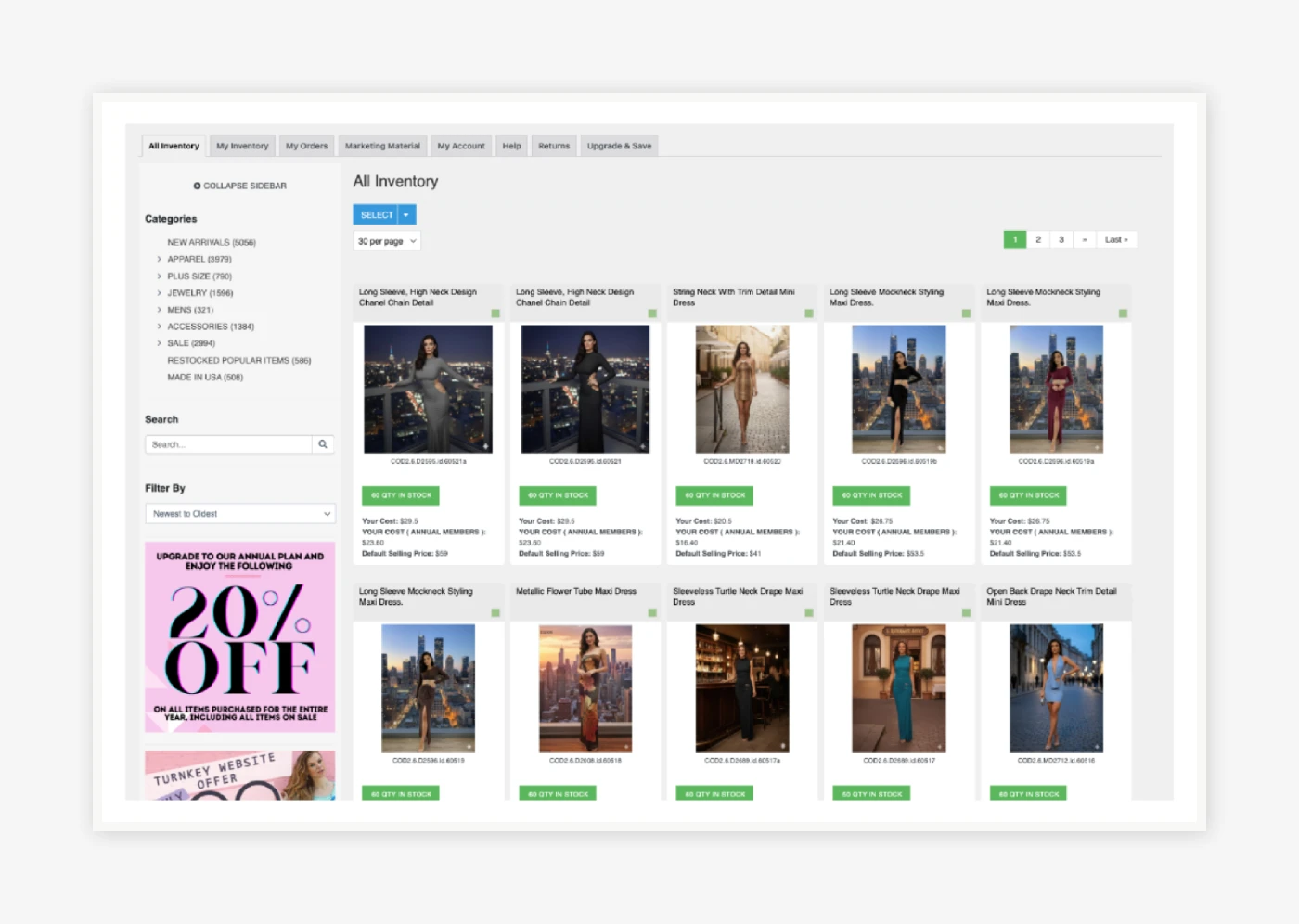
Edmond is a well-established wholesale distributor and manufacturer operating a centralized Shift4Shop platform that serves as the foundation for product governance, inventory control, pricing management, and fulfillment operations. This centralized infrastructure enables Edmond to support a large network of independent retailers operating across multiple eCommerce ecosystems.
Following the successful deployment of its Shopify Dropshipping App, BigCommerce Dropshipping App, and Wix Dropshipping App, Edmond identified WordPress, powered by WooCommerce, as a critical channel for expanding its vendor network. Many merchants within Edmond’s ecosystem preferred WordPress for its open-source flexibility, extensive plugin marketplace, and ability to combine commerce with advanced content management.
However, unlike SaaS-based platforms, WordPress operates in decentralized hosting environments with varying performance standards, security configurations, and plugin dependencies. This variability introduced new technical risks and operational challenges. Edmond’s objective was to deliver a WordPress Dropshipping Application that matched the automation depth, governance controls, and scalability of its Shopify, BigCommerce, and Wix implementations, while remaining stable within highly customized vendor environments.
This initiative allowed Edmond to serve customization-focused and content-driven merchants without sacrificing centralized oversight.
Our Approach
Building on the architectural foundations established through the Shopify Dropshipping App, BigCommerce Dropshipping App, and Wix Dropshipping App, we approached the WordPress expansion as a system-hardening and modularization initiative. Unlike controlled SaaS ecosystems, WooCommerce operates within self-managed infrastructure, where server resources, caching layers, security plugins, and third-party extensions vary significantly across installations.
To ensure consistency and reliability, automation logic had to be decoupled from site-specific configurations and centralized within middleware services. We began with a comprehensive technical assessment of WooCommerce REST APIs, webhook infrastructure, WordPress cron scheduling mechanisms, plugin compatibility patterns, database schema extensions, metadata structures, and hosting and caching configurations.
Based on this analysis, our development strategy focused on creating a lightweight, plugin-safe integration framework, externalizing core automation workflows, designing fault-tolerant synchronization pipelines, isolating business logic from third-party dependencies, and standardizing vendor onboarding processes.
Throughout the implementation, Shift4Shop continued to function as the authoritative system for catalog data, inventory rules, and pricing governance, with all WordPress storefronts operating as synchronized endpoints within Edmond’s unified ecosystem. This approach ensured that WooCommerce vendors achieved full functional parity with merchants using the Shopify, BigCommerce, and Wix Dropshipping Apps while maintaining operational stability and scalability across a decentralized environment.
The Problem: Scaling Without Automation
While WordPress offers unmatched flexibility, it was not originally designed for large-scale, multi-vendor dropshipping automation. Translating Edmond’s enterprise workflows into self-hosted environments introduced several critical challenges.
Infrastructure and Hosting Variability
WooCommerce stores operated across diverse hosting providers with inconsistent server performance, memory limits, and security policies. This affected synchronization reliability and processing stability.
Plugin Ecosystem Conflicts
Third-party plugins frequently modified core WooCommerce behaviors, interfering with order processing, inventory updates, and API responses.
Limited Reliability of Native Scheduling
WordPress cron jobs depend on site traffic and server configurations, making time-sensitive automation unreliable without external orchestration.
Database Customization Complexity
WooCommerce stores large volumes of transactional data in meta tables. Managing high-volume synchronization without degrading performance required advanced query optimization.
Security and Authentication Constraints
Variations in firewall rules, authentication methods, and security plugins complicated secure API communication.
Inconsistent Webhook Execution
Webhook delivery and event handling varied across hosting environments, creating gaps in real-time order and inventory workflows.
Without a specialized architecture, these limitations would have led to fragmented operations, delayed updates, and increased support overhead.
Key Metrics



The Solution Architecture and Capabilities
To address the decentralized nature of WordPress, we extended Edmond’s established multi-platform framework, validated through the Shopify Dropshipping App, BigCommerce Dropshipping App, and Wix Dropshipping App, into a hardened, WooCommerce-optimized solution. Rather than relying solely on native automation, we implemented a hybrid architecture that combined centralized middleware with lightweight WordPress extensions.
Plugin-Based Integration Layer
We developed a lightweight, secure WordPress plugin that acts as the bridge between WooCommerce storefronts and Edmond’s middleware. This plugin handles authentication, configuration, and environment-specific adaptations, enabling seamless integration regardless of hosting variations or third-party extensions. It ensures that critical operations-such as catalog updates, pricing changes, and inventory synchronization-are executed reliably without requiring manual intervention.

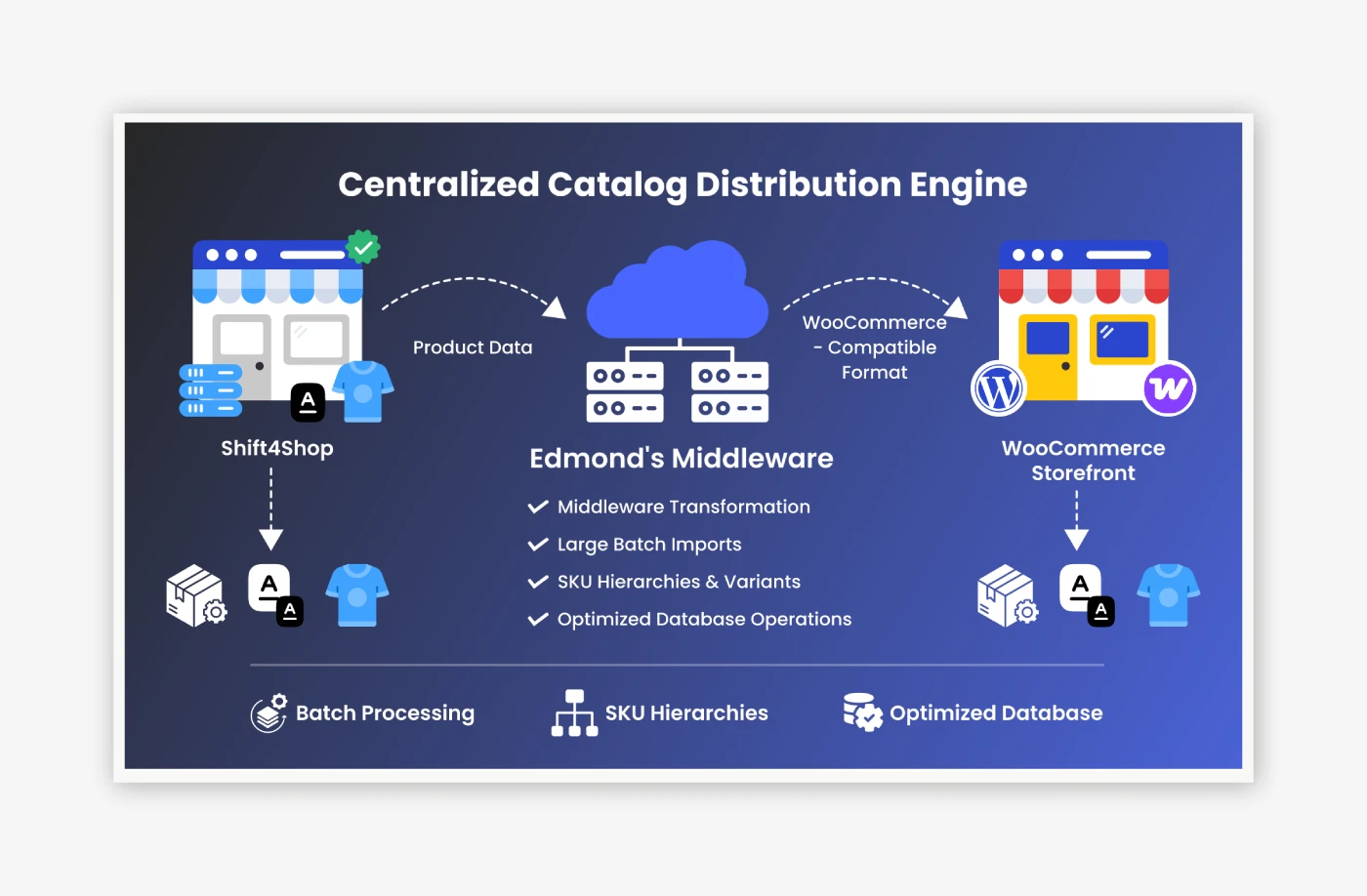
Centralized Catalog Distribution Engine
Products approved in Shift4Shop are transformed through a middleware layer into WooCommerce-compatible formats. The engine manages large-scale product imports, SKU hierarchies, and variant relationships while preserving data integrity. Batch processing and optimized database operations prevent performance degradation, even in stores with thousands of SKUs or complex variant structures.
Advanced SKU and Variant Normalization
WooCommerce’s product and variation structures differ from Shift4Shop’s multi-SKU catalog. We implemented a transformation engine that maps multiple backend SKUs into WooCommerce-supported variants, maintaining traceability and inventory governance while ensuring storefront listings remain clear and user-friendly. This solution preserves the consistency of automation workflows across Shopify, BigCommerce, and Wix.

External Automation Scheduler
To overcome the limitations of WordPress cron jobs, which rely on site traffic for execution, we implemented a centralized scheduling system within the middleware. Time-sensitive workflows-such as inventory updates, order status synchronization, and pricing adjustments-are triggered reliably, regardless of hosting environment or traffic patterns, ensuring near real-time consistency across all stores.

Secure Pricing Governance System
Dynamic pricing rules and wholesale markups are calculated externally in the middleware and pushed to WooCommerce stores via secure API pipelines. This prevents local overrides, ensures alignment with Edmond’s centralized pricing strategy, and allows consistent implementation of promotional or vendor-specific pricing across all platforms.

Performance Optimization Framework
We incorporated caching strategies, optimized query structures, and background processing queues to maintain system responsiveness and stability during high-volume operations. This framework mitigates the risk of slowdowns or conflicts caused by third-party plugins, database load, or server resource limitations.

Monitoring and Recovery Infrastructure
A comprehensive monitoring system tracks all synchronization and automation workflows. Automated retries, failure alerts, and rollback protocols ensure that any discrepancies in product, inventory, or order data are detected and corrected promptly, minimizing operational disruption and vendor support requests.

By combining these solutions, Edmond’s WordPress Dropshipping App delivers full functional parity with the Shopify, BigCommerce, and Wix Dropshipping Apps, while addressing platform-specific challenges such as plugin conflicts, hosting variability, and unreliable native scheduling. This architecture enables a seamless vendor experience, automated catalog management, accurate inventory updates, and consistent pricing, even within the diverse WordPress ecosystem.
Results and Business Impact
By integrating WordPress into its enterprise ecosystem, Edmond successfully extended its automation framework without compromising reliability or governance. Key outcomes included:
Vendor onboarding time reduced by over 50%
Product synchronization failures decreased by nearly 40%
Inventory reconciliation issues dropped by more than 70%
Technical support requests declined by approximately 45%
Pricing updates executed in near real-time. Cross-platform operational alignment strengthened significantly. Most importantly, Edmond achieved full functional parity across WordPress, Shopify, BigCommerce, and Wix environments.
Conclusion
By extending its dropshipping infrastructure to WordPress, Edmond transformed a highly customizable but fragmented platform into a reliable, enterprise-grade commerce channel.
Rather than depending on native WooCommerce automation, the solution was engineered through modular plugins, centralized orchestration services, hardened security layers, and resilient synchronization pipelines.
Despite challenges related to infrastructure variability, plugin conflicts, and scheduling limitations, the implemented framework ensures stable execution of onboarding, catalog management, inventory synchronization, and pricing automation.
The resulting system delivers operational consistency with the Shopify Dropshipping App, BigCommerce Dropshipping App, and Wix Dropshipping App, while leveraging WordPress’s unmatched flexibility and content capabilities.
This adaptive and resilience-focused approach positions Edmond for sustained growth, broader merchant adoption, and long-term platform independence in an evolving eCommerce ecosystem.


