

Quick Summary
Bony Levy, a luxury fine jewelry brand, ran a BigCommerce store with outdated theme layouts, weak mobile responsiveness and a deteriorated information architecture that left shoppers without clear pathways. WebDesk Solution delivered an ecommerce website redesign: a rebuilt information architecture across organization, labeling, navigation and search, plus a redesigned Artisan theme aligned with luxury standards.
Overview
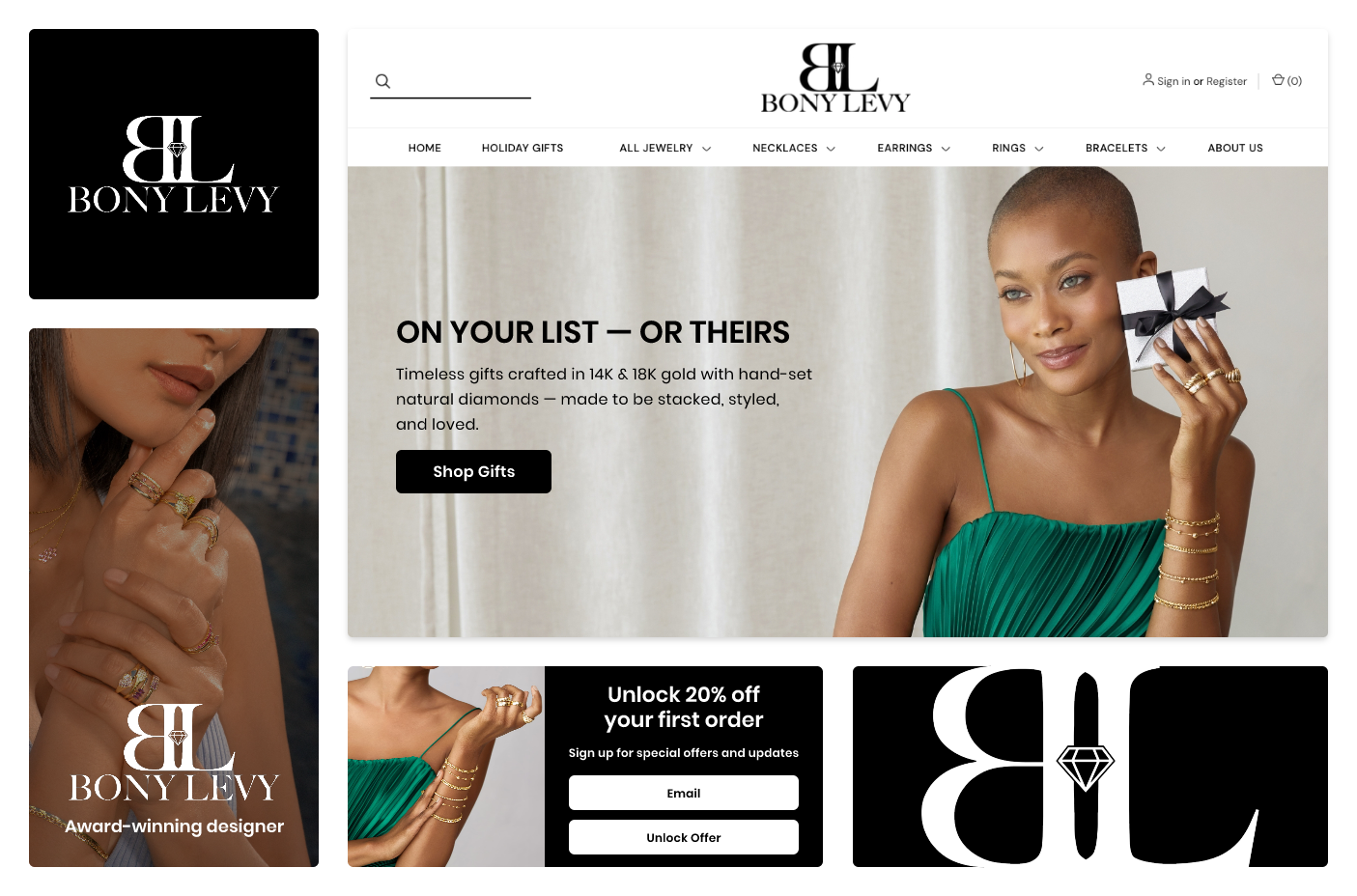
WebDesk Solution handled the jewelry website design for Bony Levy, a luxury fine jewelry brand, rebuilding the information architecture and redesigning the Artisan theme of its BigCommerce store. Bony Levy’s own website presents the brand as the work of an award-winning designer, built on timeless craftsmanship and contemporary elegance. By the same account, the brand has captivated high-end buyers for more than two decades with refined pieces that transition effortlessly between daily wear and statement luxury. But as their digital footprint expanded, their online storefront no longer reflected the sophistication of their brand.
The existing BigCommerce store struggled with significant structural limitations – outdated theme layouts, inconsistent visual language, weak mobile responsiveness, and an information architecture that had deteriorated over time. Instead of guiding customers toward the perfect piece, the site’s fragmented navigation and missing pathways created friction, confusion, and abandoned journeys. Bony Levy recognized that their digital presence needed to match the elegance of their products. They approached WebDesk Solution, seeking not just a template upgrade but a full transformation of their online experience.
Approach
WebDesk Solution began by facilitating a series of detailed discovery and strategy sessions to understand Bony Levy’s long-term goals, brand essence, and customer expectations. Early insights made one thing clear: this project required a complete rethinking of the digital experience. It wasn’t simply a theme switch-it was a structural and experiential overhaul grounded in strategic design, technical modernization, and data-driven decision making.
To meet the client’s vision, we selected the Artisan theme as the foundation but architected a phased customization strategy to transform it into a luxury-grade storefront. Our approach combined high-impact UI/UX refinements, a mobile-first responsive layout, and upgraded technical SEO structures to ensure sustainable long-term performance. Every decision-from menu structure to filter logic-was rooted in detailed competitor benchmarking, luxury retail patterns, ecommerce navigation best practices, and user behavior analysis.
We created design mockups for all major screens, enabling a shared visual language throughout the project. Every development sprint was backed by analytics integration via Google Analytics 4, Facebook Pixel, and engagement tracking tools. Beyond visual improvements, we restructured category taxonomy, rebuilt navigation systems, styled system pages, optimized CMS pages, and ensured cohesive cross-device responsiveness. The result: a fully modernized BigCommerce storefront aligned with luxury industry standards.
What challenges did Bony Levy face before its BigCommerce store revamp?
Bony Levy’s BigCommerce store carried outdated theme layouts, inconsistent visual language, weak mobile responsiveness and an Information Architecture that had deteriorated over time. Three problems followed: a fractured navigation that left key pages as orphan links, essential pages missing from any structured hierarchy, and a high bounce rate driven by poor structural flow.
Bony Levy’s fractured navigation left key pages as orphan links
Bony Levy’s website faced a deep-rooted architectural issue: a fractured navigation system that left customers wandering without direction. The top menu included only a few vague categories, failing to communicate the depth and elegance of their jewelry offerings. Many key pages-product families, educational pages, and category subsets-existed as orphan links, meaning users could not reach them through any logical pathway. This structural weakness created user confusion, as shoppers frequently bounced between unrelated pages or hit dead ends. The lack of a comprehensive jewelry taxonomy or clear buyer pathways severely damaged product discoverability. For a luxury brand where browsing experience influences purchasing decisions, this architectural breakdown had high stakes: loss of trust, lower engagement, and diminished brand perception.
Bony Levy’s essential pages were missing, incomplete or buried outside a structured hierarchy
Bony Levy’s Information Architecture had a major systemic flaw: many essential pages simply did not exist within a structured hierarchy. Some were incomplete; others were buried several layers deep with no intuitive route connecting them. Without clearly defined category groups, labels, or supporting content, users had no framework to understand how to browse or explore the brand’s catalog. Critical elements like jewelry-specific educational pages, category landing pages, and product collections were missing the clarity required for high-intent shoppers. This ambiguity weakened trust and prevented users from developing a strong sense of the brand or its product story. The absence of a unified IA created a chaotic experience – a costly obstacle for any luxury eCommerce operation.
Bony Levy’s storefront had a high bounce rate driven by poor structural flow
The compounding issues of orphan pages, hidden categories, and limited navigation options fueled a high bounce rate that significantly undermined site performance. Heatmapping revealed customers repeatedly clicking on non-interactive areas or attempting to find categories that weren’t visible. Because the flow didn’t follow standard eCommerce patterns used by leading jewelry competitors, users quickly lost confidence and exited. Each broken pathway contributed to friction and lowered conversion potential. Without a structured and predictable flow, even the most compelling products could not keep customers engaged. The problem went beyond the interface: the navigational pathways did not carry the brand’s story.
Key Metrics




How did WebDesk Solution solve Bony Levy’s BigCommerce store revamp challenges?
WebDesk Solution paired each challenge with one piece of work: rebuilt navigation and search, a website information architecture of structured categories and consistent labels, and a redesigned Artisan theme.
WebDesk Solution rebuilt Bony Levy’s navigation and search around the new category hierarchy
We redesigned the navigation to follow the new category hierarchy and upgraded search for high-intent jewelry shoppers.
The Navigation Systems were redesigned to reflect the newly structured hierarchy. The main navigation expanded dramatically from just seven items to more than thirty, offering a complete and transparent representation of the entire product catalog. Our mega menu design pairs intuitive dropdowns with thoughtfully designed mega menus to allow deeper exploration without overwhelming the user. Breadcrumb trails were added to guide customers through the site with clarity and orientation, while the footer navigation was reworked to include essential but secondary pathways. All orphan pages were eliminated, resulting in a frictionless and interconnected browsing experience.
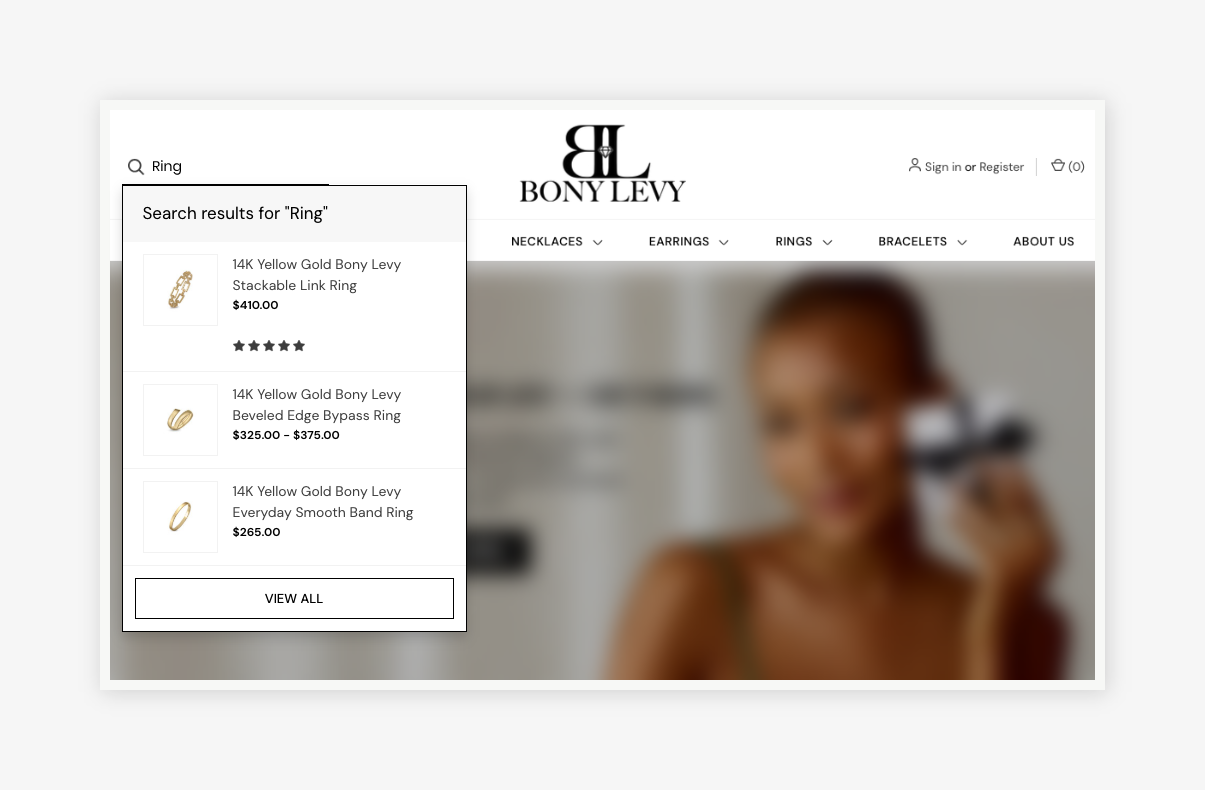
Finally, the Search Systems were upgraded to meet the needs of high-intent jewelry shoppers. Search bar accessibility and usability were enhanced across all devices, creating an uninterrupted entry point into the product catalog. Advanced dynamic filters were introduced, allowing users to refine products based on carat, gemstone type, metal type, price, style, occasion, and other detailed attributes. On the backend, search indexing was strengthened to deliver faster, more accurate results, and the search interface was optimized to provide instant visual updates when users applied sorting, filtering, or pagination actions.
Key deliverables:
- Main navigation: dropdowns and mega menus redesigned to follow the new category hierarchy and allow deeper exploration without overwhelming shoppers.
- Breadcrumbs and footer: breadcrumb trails added for orientation, and footer navigation reworked to include essential but secondary pathways.
- Dynamic filters: shoppers can refine products by carat, gemstone type, metal type, price, style, occasion, and other detailed attributes.
- Search: search bar accessibility and usability enhanced across all devices, with search indexing strengthened on the backend for faster, more accurate results.
- Result: the search interface gives instant visual updates when shoppers apply sorting, filtering, or pagination actions.
WebDesk Solution rebuilt Bony Levy’s category structure and labels inside one hierarchy
We began with an Information Architecture audit, which found that many essential pages did not exist within a structured hierarchy.
To resolve foundational structural issues, WebDesk Solution performed a full-scale Information Architecture rebuild, applying the four core IA systems: Organization Systems, Labeling Systems, Navigation Systems, and Search Systems. We mapped every product, category, and content asset into a new hierarchical blueprint designed for clarity, scalability, and luxury-grade UX.
Within the Organization Systems, the team reconstructed the product taxonomy based on fine-jewelry industry best practices, ensuring it reflected the sophistication and browsing expectations of luxury consumers. A multi-tiered Parent → Category → Subcategory model was created with zero orphan links, establishing a clean and logical flow throughout the catalog. The structure was further refined by benchmarking leading luxury jewelry competitors to ensure the appropriate depth, grouping, and naming conventions. Products were then grouped by buyer intent-such as Bridal, Everyday Wear, High Jewelry, and Personalized Jewelry-giving shoppers an intuitive and emotionally aligned way to explore the brand’s offerings.
Under the Labeling Systems, WebDesk Solution standardized naming conventions across all categories and subcategories to eliminate inconsistencies and confusion. The terminology was carefully selected to match consumer search behavior, using industry-recognized phrases like “Diamond Stud Earrings,” “Pavé Bands,” and “Layered Necklaces.” Metadata and tagging structures were also updated to strengthen SEO alignment and improve search relevance. To ensure long-term consistency, the team developed a detailed labeling guideline document that the client could use for future content updates.
Key deliverables:
- Product taxonomy: a multi-tiered Parent → Category → Subcategory model built on fine-jewelry industry best practices and benchmarked against leading luxury competitors.
- Naming conventions: labels standardized across all categories and subcategories, using phrases such as “Diamond Stud Earrings,” “Pavé Bands,” and “Layered Necklaces.”
- Metadata and tagging: structures updated to strengthen SEO alignment and improve search relevance.
- Labeling guideline: a detailed document the client can use to keep future content updates consistent.
- Result: products, categories, and content assets sit in one hierarchical blueprint with consistent labels.

WebDesk Solution redesigned the Artisan theme and its header navigation to reinforce an intuitive user flow
Recognizing the importance of brand identity in the luxury market, we redesigned the existing Artisan theme to elevate Bony Levy’s digital presence. Transforming a prefabricated theme into a high-end luxury storefront took deep BigCommerce theme customization and strategic UX thinking. The original template lacked cohesion, visual hierarchy, and the refined aesthetics expected from a premium jewelry retailer.
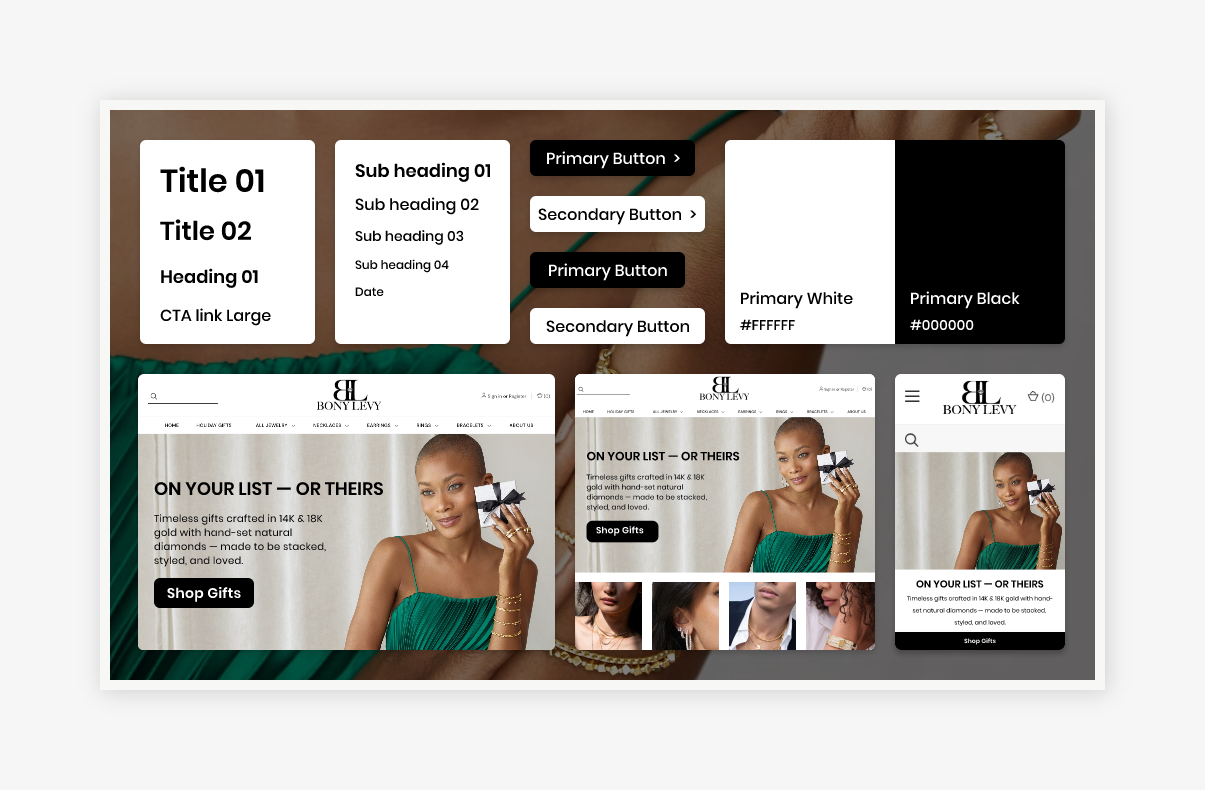
In terms of key enhancements, we refined the typography and color palette to align with luxury industry standards, ensuring the visual language immediately communicated sophistication. Spacing, layout structure, and overall visual fluidity were improved to create a premium, airy aesthetic that allowed the jewelry to stand out. We also redesigned critical interface elements such as banners, product tiles, call-to-action buttons, and content blocks to create strong visual uniformity across the entire storefront. The header and navigation styling were updated to integrate seamlessly with the newly developed Information Architecture, reinforcing intuitive user flow. In addition, custom product display logic and high-impact imagery were introduced to highlight craftsmanship, detail, and the brand’s signature artistic approach to fine jewelry.
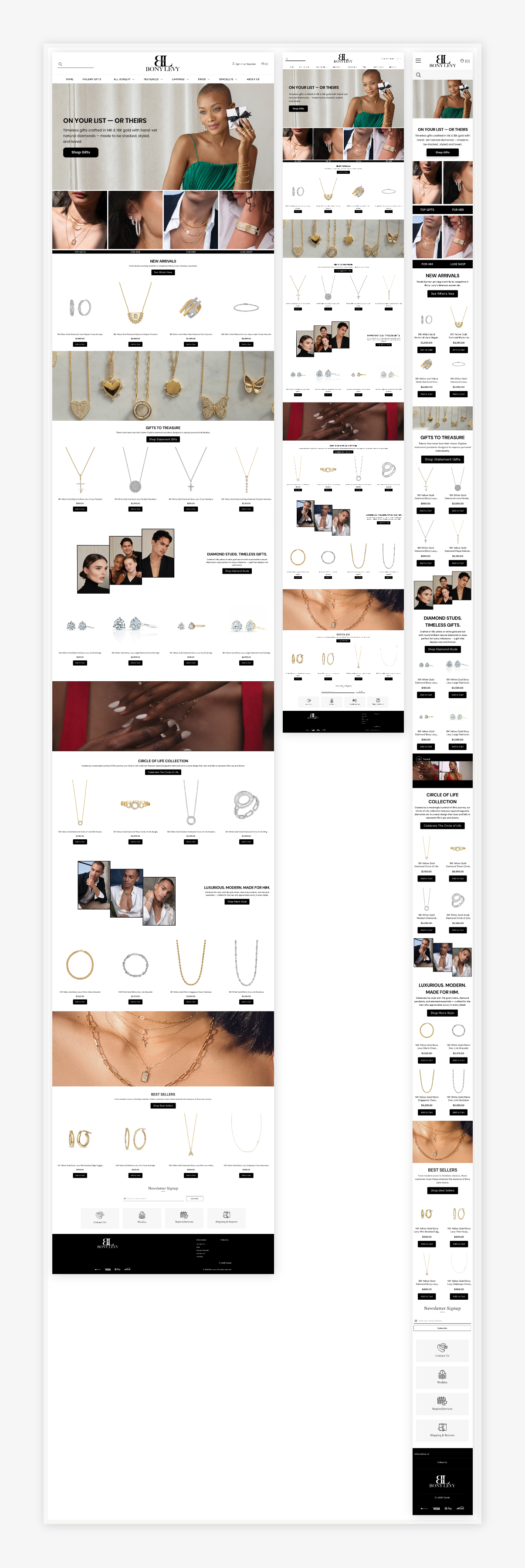
From a UI/UX deliverables standpoint, we produced high-fidelity mockups for the Home Page, Category Page, and Product Page, giving the client a clear preview of the redesigned experience. Three iterative rounds of revisions ensured the final visuals aligned perfectly with the client’s expectations and brand requirements. To support long-term scalability, we also provided visual documentation that outlined styling guidelines and ensured consistency for future updates.
Key deliverables:
- Typography and color: refined to align with luxury industry standards so the visual language immediately communicates sophistication.
- Layout and spacing: improved for a premium, airy aesthetic that lets the jewelry stand out.
- Interface elements: banners, product tiles, call-to-action buttons, and content blocks redesigned for strong visual uniformity across the storefront.
- Header and navigation: styling updated to integrate with the new Information Architecture and reinforce an intuitive user flow.
- Result: the storefront carries one visual language, with styling guidelines documented for future updates.
Similar Project?
Need a store that guides shoppers toward the perfect piece?
Outcomes / Results
Increase in Revenue
Fueled by improved UX and clearer product pathways.
Growth in Traffic
Attributed to stronger SEO and better engagement metrics.
Increase in Average Order Value (AOV)
Demonstrating higher customer confidence and improved catalog exploration.
Increase in Conversion Rate
Within the first three months post-launch.
Conclusion
Bony Levy’s revamp shows that a luxury jewelry store depends on its structure as much as its styling. Organization, labeling, navigation and search were rebuilt as four connected systems, and the Artisan theme was redesigned so the header and navigation follow the same hierarchy as the catalog, giving shoppers one consistent structure from the menu to the product. For any jewelry retailer weighing a similar redesign, the lesson is to decide how products are grouped, named and reached before refining how the storefront looks.
Questions About Bony Levy’s BigCommerce Store Revamp
How does the main navigation on Bony Levy’s BigCommerce store guide shoppers?
How is the product catalog organized on Bony Levy’s revamped store?
Which four systems define the ecommerce site structure of Bony Levy’s revamped store?
What labeling guidance did Bony Levy receive for future content updates?
How do shoppers narrow Bony Levy’s jewelry catalog by carat, metal or occasion?
How did Bony Levy’s orphan pages get a route back into the store?
How was the Artisan theme customized for Bony Levy’s luxury jewelry store?
Which tracking tools and integrations support Bony Levy’s revamped BigCommerce store?