
Adobe Commerce B2B Features: What Magento Gives You Natively, and Where Custom Work Starts

Category
Artificial Intelligence

Too little time and too much work? Emails, reports, and daily tasks can quickly overwhelm your schedule. AI voice agents are here to make this easier and faster. These innovations hear your voice, understand your intent, and take action immediately without needing repeated input.
According to Statista, the number of voice assistant users in the U.S. is projected to reach around 157.1 million in 2026, reflecting broad adoption, with businesses reporting measurable gains in efficiency and customer engagement after integration. These voice agents can take care of customer support, manage bookings, and even hold full conversations without missing a beat. They respond instantly, sound natural, and reduce your workload without added costs or delays. More small businesses now rely on them to stay efficient and focused.
Take a look at this list of the 10 best AI voice agents in 2026. Explore their features, compare their strengths, and pick the one that fits your workflow best so you can get more done in less time.
1. Rossy AI
Rossy AI is a 24/7 AI voice agent built to handle every incoming call with a human-like voice. It helps businesses with booking appointments, capturing leads, and answering FAQs. It starts answering instantly (no scripts needed), escalates to human agents when required, and sends summaries of conversations via SMS or email so you’re always informed.

You can set it up without technical skills by configuring your business hours, preferred greetings, and call routing. Rossy AI takes care of the rest, like order tracking, meeting reminders, appointment scheduling, and stays on duty even on holidays or outside business hours. It integrates with Twilio, OpenAI, Zendesk, Slack, Salesforce, Zapier, HubSpot, Google Calendar, and many more tools to smoothly connect voice calls with your existing workflow.
Key Features- Picks up every call instantly, with a natural-sounding AI voice
- Books appointments, tracks orders, and handles FAQs using your policies & support content
- Sends call summaries, transcripts, and notifications via email/SMS
- Transfers to human agents when needed and escalates urgent or complex calls
- Fully operational 24/7, scalable to manage unlimited simultaneous calls
- Rossy offers a demo/onboarding first.
- Pricing is custom depending on usage and features.
2. VAPI
VAPI is a developer platform that allows you to create voice AI agents with your preferred Speech-to-Text (STT), Large Language Model (LLM), and Text-to-Speech (TTS) providers. It provides you with complete control over how the agent responds, understands, and sounds. The platform offers a comprehensive list of models and integrations that support complex task automation and voice-based business workflows.
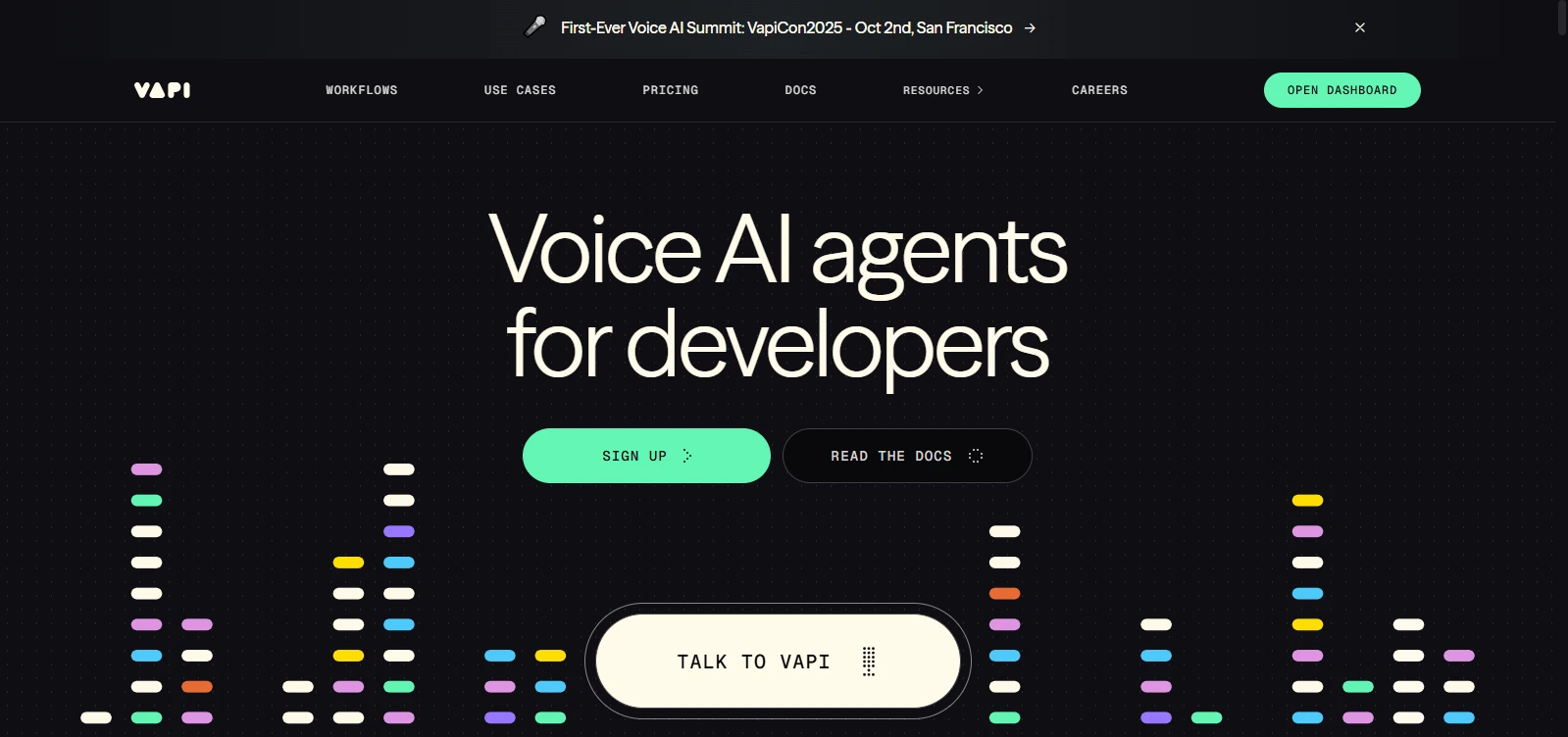
You can even create teams of agents that handle multiple tasks within a conversation—for example, a sales agent can seamlessly pass a lead to a support agent during a call. With the new Blocks feature, you can break conversations into modular blocks to improve the flow and reduce errors. The platform connects with 40+ tools, including OpenAI, Claude, Gemini, Groq, Deepgram, ElevenLabs, Twilio, HubSpot, Salesforce, Zapier, Slack, and Google Calendar.
Key Features- Real-time voice orchestration with sub-500ms latency
- Multilingual support (100+ languages)
- Visual Flow Studio & Blocks for conversation logic
- Automated testing, A/B experiments, and AI guardrails
- Block-based flow designer and Squad configuration for multi-agent processing
- Free plan with usage restrictions
- Agency plan: $400/month
- Startup plan: $800/month
3. Retell AI
Retell AI is designed for companies that need to automate voice conversations, such as appointment scheduling, lead qualification, or surveys. With their builder, you can create intelligent AI voice agents and preview them with LLM tools before deploying them live. These agents can be deployed on calls, web pages, or SMS.

They automatically sync with your company’s knowledge base. Retell AI can manage multiple simultaneous phone calls at once and operates in over 18 languages, offering multilingual voice support efficiently. A real-time dashboard displays disconnection causes, call records, and user sentiment after each call. It integrates with telephony platforms like Twilio, Vonage, Siptrunk, plus Zapier, Make, n8n, CRMs (HubSpot, Zendesk, Salesforce), and calendar tools like Cal.com.
Key Features- Smart agent builder with integrated LLM tools
- Deploys across phone, web, and SMS
- Utilize the knowledge base to answer more effectively
- Multilingual and can handle lots of calls
- Call tracking and sentiment analysis dashboard
- Voice AI: From $0.07/min
- Chat AI: From $0.002/message
4. Ultravox
Ultravox.ai delivers advanced voice technology services, including voice cloning, speech-to-text conversion, and voice recognition. This tool proves valuable in many fields, including teaching, medical services, and content creation. It allows users to build voice agents that address customer service, automate workflows, and improve efficiency.

You may utilize the system for voice-to-text conversion, creating personalized audio, or designing full customer support agents. Everything is handled through a single dashboard for easy setup and management by non-technical users. Teams may personalize agent logic, upload documents for context-aware responses, and connect them to existing systems, enhancing both workflow efficiency and team collaboration. It integrates with telephony systems (Twilio, Telnyx, Plivo), document databases (RAG), WebSocket/SDKs, and CRMs for seamless deployment.
Key Features- Audio generation, speech-to-text, and transcription tools
- Supports customer support workflows and enterprise automation
- Voice, sound, and chat capabilities are all built into the AI agents.
- Easy integration with other tools
- Works in education, healthcare, and content creation
- Basic tools are available for free
- Paid options start at $100/month
- Enterprise options are available upon request
5. Deepgram
Deepgram functions as a live speech-to-text service, converting spoken language into precise written text without delay. It is for developers creating voice agents, IVRs, or assistants that require rapid, reliable transcription. Deepgram performs effectively even in loud settings and recognizes a wide range of accents accurately.

You can stream call audio using WebSockets, making it easy to integrate with live systems. The tool also supports model customization, allowing it to recognize industry-specific jargon more efficiently than generic tools. Responses are delivered quickly, making it suitable for triggering real-time actions. Although it focuses on transcription, Deepgram integrates seamlessly with telephony platforms like Twilio (via Voice Agent API), automation tools like Make.com / Zapier, and orchestration via Latenode for full agent pipelines.
Key Features- Real-time, low-latency transcription
- High accuracy in noisy conditions
- Model customization for improved results
- WebSocket streaming of phone calls
- Functions seamlessly with voice agent software
- Free trial: 200 credits
- Pay-as-you-go: $0.004/sec
- Custom growth plan
6. Voiceflow
Voiceflow lets users build AI voice agents and chat agents without coding. Its drag-and-drop interface makes it easy to design, test, and launch conversations quickly. Voiceflow was initially designed for Alexa and Google Assistant but now fuels corporate AI assistants in voice, chat, and app spaces. Teams can collaborate on shared dashboards. It integrates with 300+ apps—like HubSpot, Zendesk, Salesforce, Shopify, Slack, Google Sheets, and Make—for seamless data flow and trigger automation.

It supports API connections, integrates with external apps, and lets users run tests before going live. It’s ideal for product teams and designers to create smart interfaces without needing developers. The platform also has user testing capabilities and analytics to assist in enhancing agent performance based on usage.
Key Features- No-code drag-and-drop constructor
- Supports voice, chat, and in-app bots
- API integrations and testing functionality
- Integrated analytics and collaboration tools
- Well-suited for teams and rapid prototyping
- Free tier available
- Pro: $60/month
- Business: $150/month
7. ElevenLabs
ElevenLabs is an AI voice synthesis platform capable of producing natural-sounding and lifelike AI voices. It offers multilingual support, emotional representations, and voice-cloning capabilities. The platform is useful for businesses and creators looking to produce audio content such as voice-overs, narrator voices, or chatbots.

Voices can be cloned or personalized to match your brand’s tone and identity. ElevenLabs is suitable for use in call centers, virtual assistants, and content platforms where voice matters. The system enables quick generation and integration with other AI platforms. It also supports expressive tone delivery to make voices sound more human-like.
For automating support or storytelling, ElevenLabs offers high-quality, natural-sounding voice synthesis. It integrates easily via API and WebSocket with platforms like ChatGPT (for voice interaction), Twilio ConversationRelay, Make (Integromat), Pipedream, and Voiceflow for seamless voice deployment.
Key Features- Natural voice generation
- Multilingual and emotional support
- Voice cloning for customization
- Quick processing and integration-capable
- Suitable for content and business purposes
- Free plan offered
- Starter: $5 per month
- Creator: $11 per month
- Pro: $99 per month
Ready to Turn Voice AI into Real Business Results?
Leverage our AI voice agent development services. We help businesses automate workflows and engage customers with intelligent voice solutions.
Talk to Experts8. JustCall
JustCall is a business communication platform that provides AI-driven voice, SMS, and WhatsApp support. It enables global businesses to handle customer calls from local or international numbers, with agents using desktop, mobile, or web apps.
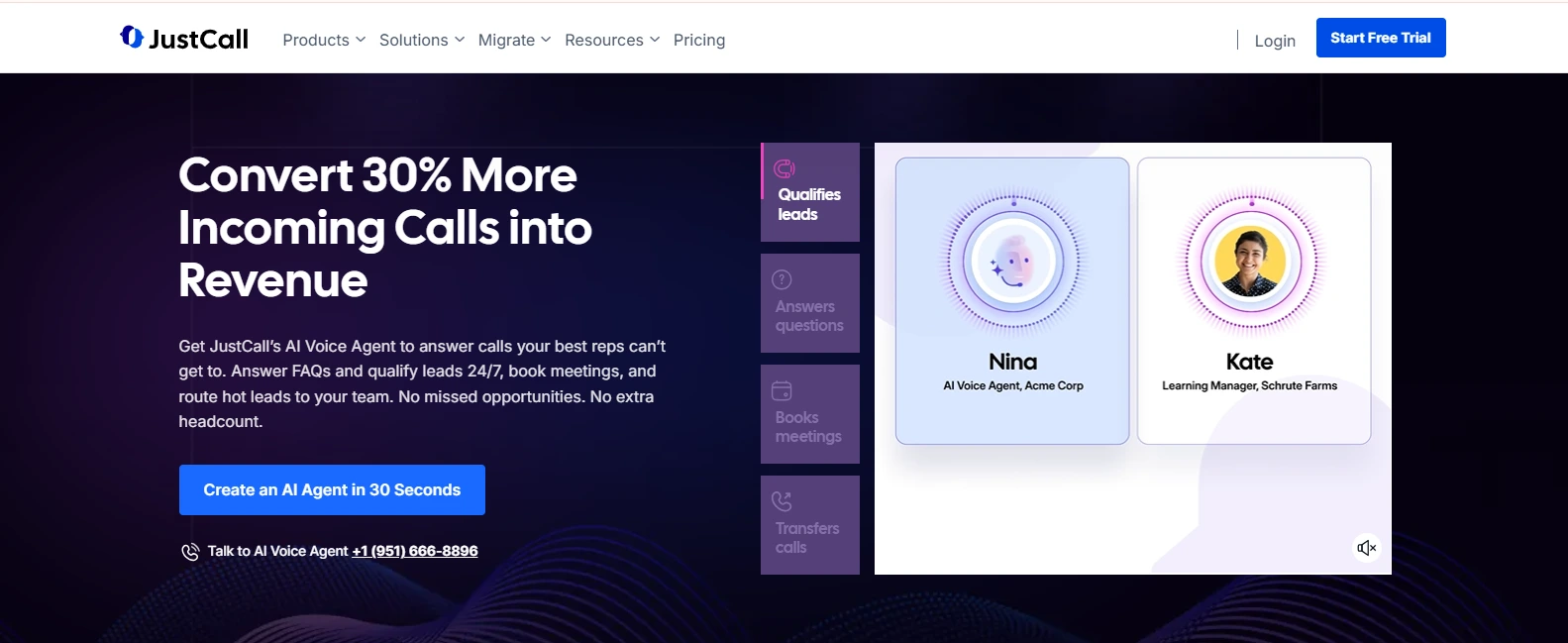
JustCall offers VoIP services, bulk SMS, auto-dialers, call tracking, analytics, real-time coaching, call summaries, sentiment analysis, and voicemail analytics — all managed through a clean, centralized dashboard.
It’s ideal for remote teams and globally distributed employees. It integrates with over 100 tools, including HubSpot, Zendesk, Salesforce, Slack, Google Calendar, Zoom, and Twilio, plus automation platforms like Zapier and Make for unified communication workflows.
Key Features- AI-powered voice, SMS, WhatsApp
- Desktop, web, and mobile availability
- CRM and sales tool integrations
- Call analytics and live coaching
- Bulk SMS, auto-dialer, call recording
- Pay As You Go: 0.99 per minute
- Agent Lite: $99 per month
- Agent Max: $249 per month
9. Synthflow
Synthflow enables you to create and run voice agents without coding. The no-code builder allows you to build conversation flows that process calls in a natural way. You can use it for appointment booking, lead qualification, or customer support. It is integrable with CRMs such as HubSpot and has built-in analytics.

You can track drop-offs, read the full transcript, and analyze performance on the go. Synthflow uses natural language understanding (NLU) to handle complex queries. While it’s easy to use, setting up effective conversation flows still requires thoughtful planning. The platform is ideal for companies that wish to deploy voice agents quickly without developers. Agents can receive and make calls and be integrated into other tools.
Synthflow integrates with over 200 apps—including HubSpot, Zapier, Make, Twilio, Salesforce, RingCentral, Vonage, and ElevenLabs—for seamless voice workflows and CRM-driven actions.
Key Features- No-code builder for rapid support
- Integration with CRMs such as HubSpot
- Call tracking and agent performance
- Real-time analytics and transcripts
- Recognizes natural language
- Pay As You Go: $0.15 to $0.24 per minute
- Enterprise: Custom pricing
10. Observe AI
Observe AI is a sophisticated platform designed to automate complex customer interactions using advanced voice agents. These agents emulate trained human representatives and can be customized with product knowledge, tone, and engagement protocols. VoiceAI constructs agents based on actual customer interaction data. You can quickly train and refresh agents while performance remains robust through AutoQA and feedback tools.

VoiceAI supports secure AI-to-human handoffs and protects sensitive information with robust enterprise-level security. It is suitable for scaling customer support without the loss of quality. Call notes, tone control, and built-in analytics make VoiceAI a comprehensive, end-to-end AI agent solution. Observe AI integrates with 200+ enterprise tools, including Salesforce, Zendesk, Genesys, NICE, and Talkdesk—helping businesses maintain compliance and insight across channels.
Key Features- Train agents based on real conversations
- Compliant with voice tone, sentiment, and call flow
- Delivers real-time training and AutoQA
- Seamless AI-human handoff with context
- 200+ integrations and enterprise security
- On contract terms
- Usage-based pricing, billed per minute or per interaction, depending on configuration
Final Thoughts
AI voice agents have become valuable tools that simplify work and transform how we work. They understand what you are saying, return it to you clearly, and instantaneously perform actions. Some tools revolve around control and flexibility, while others focus on ease of use and are quick to set up.
Companies and individuals are beginning to use them in order to save time and stay competitive. The choice of which voice assistant to choose should be based on your use, whether it’s automating calls, scheduling, or customer support.
Review the features, look at the prices, and choose one that works into your workflow. Smart choices now can lead to better results tomorrow!
If you’re ready to build your own custom solution, check out our AI voice agent development services to get started.