
Is Your eCommerce Store Affected by PHP2Shell? Check Your Platform

Category
eCommerce Tips & Trends
Black Friday 2026 falls on November 27, with Cyber Monday following on November 30. For most online stores, the five days from Thanksgiving to Cyber Monday bring more traffic and orders than any other week of the year. That is why your Black Friday marketing strategy needs to start well before the sale.
The money at stake keeps growing. US shoppers spent $11.8 billion online on Black Friday 2025 alone, and $44.2 billion across the full Cyber Week, according to Adobe Analytics.
But a bigger crowd does not guarantee a better result. Slow pages, a checkout that breaks under load, or a discount that wipes out your margin can turn the busiest week of the year into the most expensive one.
A good Black Friday strategy covers more than the sale itself. It sets the offers, prepares the store, lines up the campaigns, and keeps the customers you win long after the weekend ends.
This Black Friday eCommerce guide walks you through each part. You will find a dated 2026 timeline, a store readiness checklist, margin-safe offer ideas and a short plan for stores starting late. If you are planning the wider season, our holiday eCommerce strategy guide covers November through January.
Key Takeaways
- Black Friday 2026 is on November 27 and Cyber Monday is on November 30, so most of the planning should be done by early November.
- Store readiness matters as much as marketing: test speed, freeze code changes and stress-test checkout at least two weeks before the sale.
- Pick offers by what they do to your margin, not by how big the discount looks.
- Point every email, ad and social post at one Black Friday landing page.
- The real payoff comes after Cyber Monday, when first-time buyers can become repeat customers.
What Is a Black Friday Marketing Strategy?
A Black Friday marketing strategy is the plan an online store follows to attract, convert and keep customers during Black Friday and Cyber Monday (BFCM). It covers the offers you run, the channels you use, how you prepare your website, and what you do once the sale ends.
The five days from Thanksgiving to Cyber Monday are often called Cyber Week or the Cyber 5. Many brands now start their deals earlier. A strong plan treats all of November as the campaign and Cyber Week as its peak.
Black Friday 2025 by the Numbers
Last year’s results show where shoppers spent their money and how they bought. These figures are worth knowing before you plan this year’s sale.
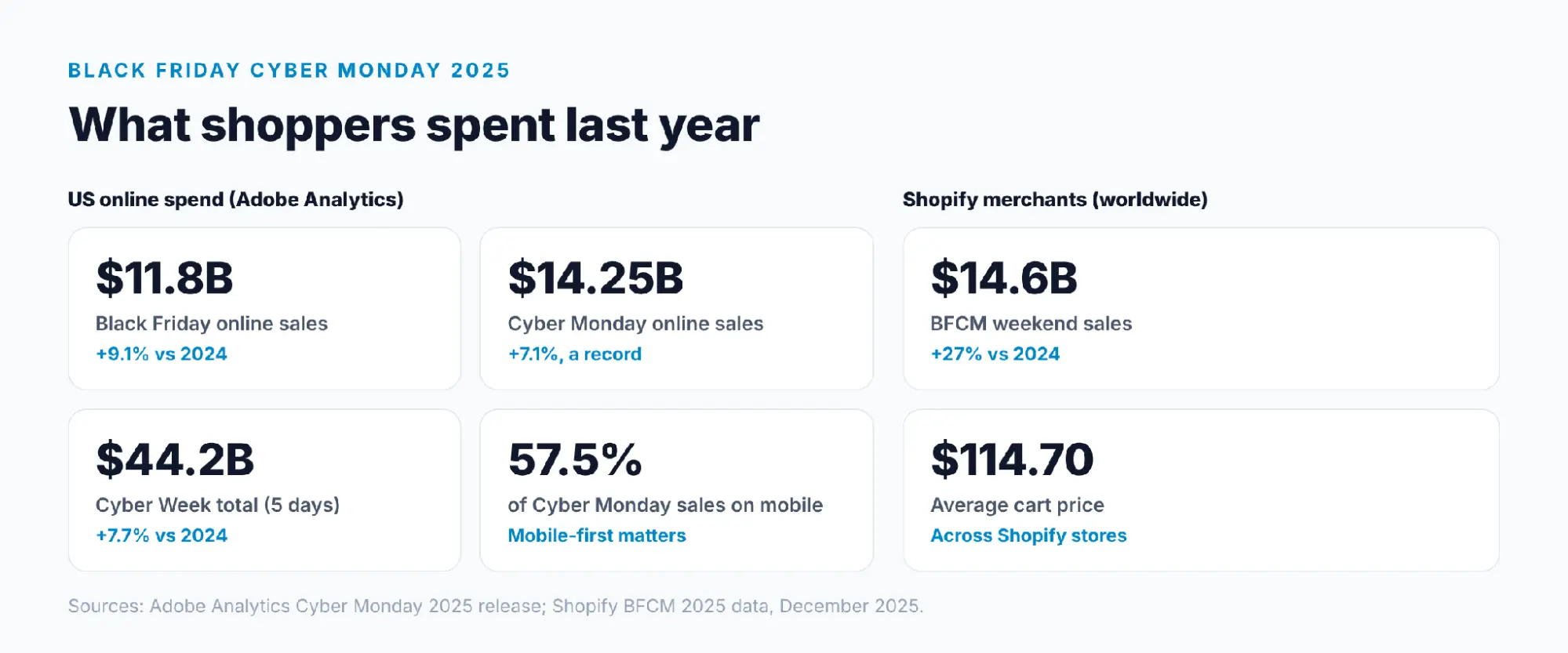
- Black Friday online spend: US shoppers spent $11.8 billion online on Black Friday 2025, up 9.1% from the year before.
- Cyber Monday online spend: Cyber Monday reached a record $14.25 billion, up 7.1%.
- Mobile shopping: Phones accounted for 57.5% of Cyber Monday online sales.
- Buy now, pay later: Shoppers spent $1.03 billion through buy now, pay later on Cyber Monday alone.
- AI shopping assistants: Traffic to retail sites from AI tools grew 670% on Cyber Monday compared with the year before.
The US figures above come from Adobe Analytics. Shopify reported that its merchants made a record $14.6 billion in Black Friday Cyber Monday sales in 2025, up 27%, with an average cart price of $114.70.
Most shoppers will see your sale on a phone, many will want to pay in installments, and a growing number will arrive from AI assistants rather than search results.
Black Friday Timeline: When to Start Preparing
The best Black Friday campaigns are planned months ahead. The timeline below works back from the 2026 dates, so you can see what needs to happen and when.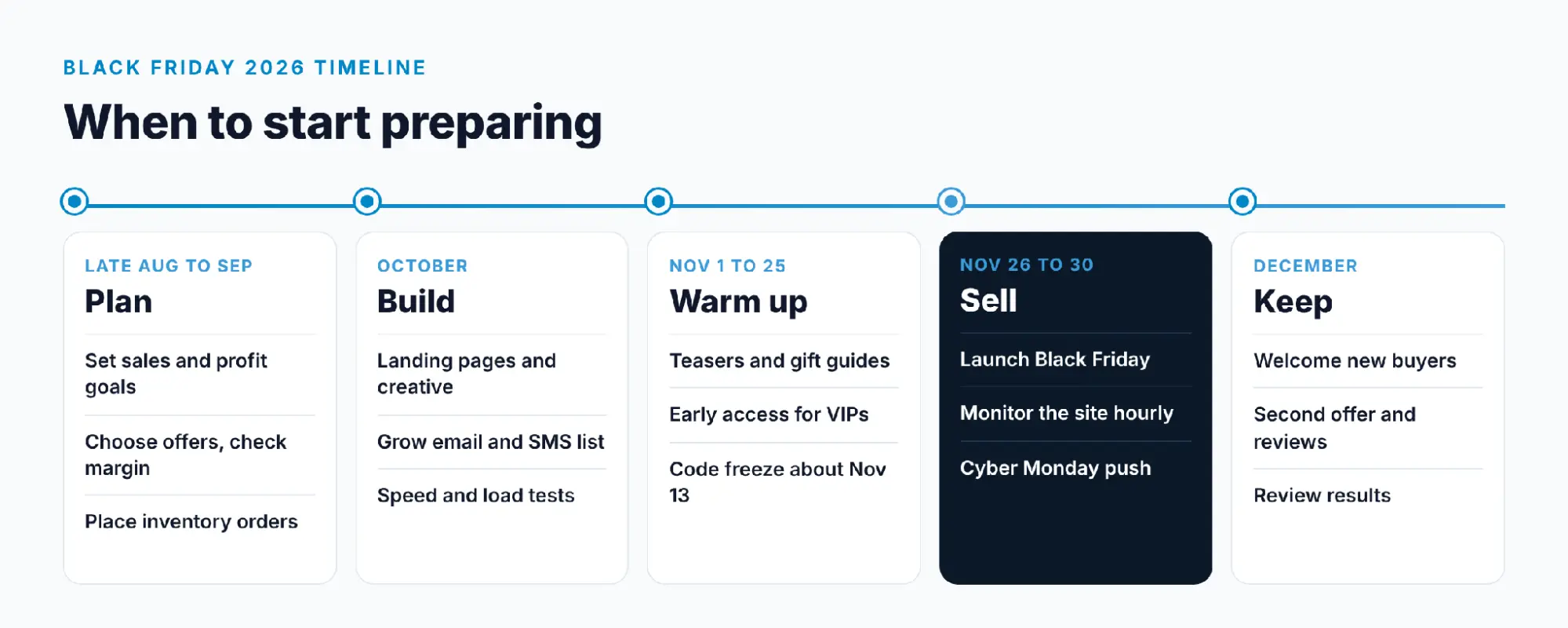
- Late August to September (plan): Set sales and profit goals, choose your offers, run the margin math and place inventory orders with your suppliers.
- October (build): Build landing pages and creative, grow your email and SMS list, run speed and load tests and agree on a code freeze date.
- November 1 to 25 (warm up): Send teasers, open early access for subscribers, publish gift guides and raise ad budgets gradually.
- November 26 to 30 (sell): Launch on Thanksgiving or Black Friday, monitor the site hourly and adjust offers and ads as results come in.
- December (keep): Welcome new buyers, send a second offer, handle returns quickly and review what worked.
If you are reading this in November, the last-minute plan later in this guide covers what to prioritize with two weeks or less to go.
How to Prepare for Black Friday: Get Your Online Store Ready
Your marketing can only perform as well as your store does on the day. It is also where many sales are quietly lost.
1. Test Site Speed and Load Capacity
Shoppers have little patience during a sale, and a slow product page sends them straight to a competitor. Test your key pages on mobile, and fix the biggest problems first, such as oversized images, heavy apps and unused scripts.
Shopify and BigCommerce handle hosting and scaling for you, but themes and apps can still slow pages down.
Self-hosted Adobe Commerce (Magento) stores need more work, because the server has to handle the traffic too. Run a load test that simulates your expected peak, and check caching, your content delivery network and server scaling before the sale.
For Vacuum World and Tank World, we carried out Magento performance and security optimization to strengthen the speed and stability of their shared eCommerce platform. That kind of work belongs in October, not the week of the sale.
2. Freeze Code Changes and Audit Your Apps
Set a code freeze date about two weeks before Black Friday. After that date, only urgent fixes go live, because every new change is a new chance for something to break during your busiest week.
Before the freeze, review every app and script on your store. Remove anything you no longer use, and test how your discount, upsell and review apps behave together when a sale is running.
3. Stress-Test Checkout and Payments
A short, simple checkout matters more than ever when traffic peaks, and our guide to eCommerce checkout best practices covers the basics. Before the sale, place real test orders with every discount type you plan to run, on both desktop and mobile. Check that codes stack the way you intend, that free-shipping rules apply correctly, and that sale prices show up in the cart.
Switch on express payments such as Apple Pay, Google Pay, PayPal and, on Shopify, Shop Pay. Add buy now, pay later where it fits your products. Review your fraud settings too, because order volume and fraud attempts both rise during the sale.
4. Set Up Monitoring and an Incident Plan
Decide in advance who watches the store during Cyber Week and what happens if something goes wrong. Set up uptime and error alerts, keep a list of who to call for each system, and agree on how to roll back a broken change.
For an enterprise B2B client running several storefronts, our team provides ongoing BigCommerce maintenance and monitoring, so problems are spotted and fixed before customers notice them.
5. Check Tracking Before the Traffic Arrives
Confirm that your analytics, ad pixels and conversion tracking all record purchases correctly. Tag every campaign link with UTM parameters so you can see which channels actually drove sales.
Broken tracking during Black Friday means you lose the data you need to plan next year. Fix it in October while traffic is still normal.
Plan Black Friday Offers That Protect Your Margin
Deep discounts are common during Cyber Week. Adobe found discounts peaked on Cyber Monday 2025 at 31% off for electronics, 28% for toys and 25% for apparel. You do not have to match the deepest discount to win, but you do need to know what each offer costs you.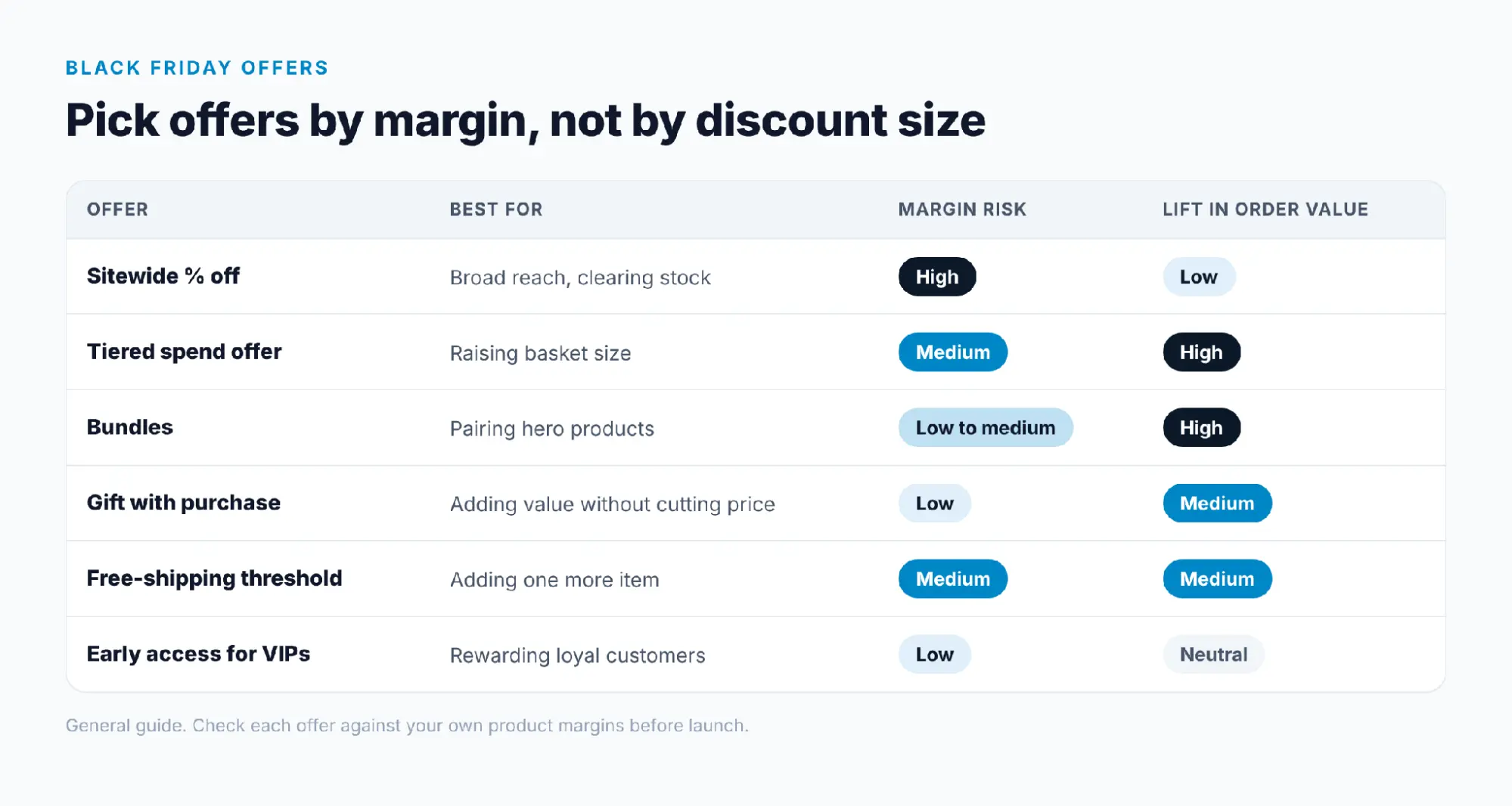
Start with a simple margin check. Take a product that sells for $80 and costs you $32 to make, leaving $48 in gross profit. At 25% off, it sells for $60 and earns $28, so you need to sell about 1.7 times as many units to make the same profit as before.
That math is why it pays to look beyond sitewide percentage discounts. These Black Friday sale ideas tend to protect margin better:
- Tiered spend offers: “Save $20 when you spend $100” rewards bigger baskets instead of discounting every order.
- Bundles: Pair a hero product with an accessory at a modest saving, so shoppers buy more than one item.
- Gift with purchase: A free gift above a set spend can feel like a bigger reward than a price cut, without lowering your prices.
- Free-shipping thresholds: Set the threshold above your usual order value, at a level that still covers shipping, so shoppers add one more item.
- Early access: Give subscribers and loyal customers first access instead of a bigger discount.
You also do not need to discount everything. Lead with a few hero products that bring people in, and keep new arrivals and best sellers at full price or a smaller saving.
Black Friday Marketing Ideas That Drive Sales
Once the store and offers are ready, the campaign decides how many people show up. These Black Friday campaign ideas cover the channels that matter most for online stores.
Grow Your Email and SMS List Before November
Your email and SMS list is usually the cheapest audience you can reach during Cyber Week, because you do not pay per click to reach it. Start growing it in September and October with a sign-up offer or an early-access list.
Collect consent properly for SMS, following rules such as the TCPA in the US and CASL in Canada. A smaller list that agreed to hear from you will perform better than a large one that did not.
Run Early Access for Subscribers and VIPs
Early access rewards your best customers and spreads orders over more days, which takes pressure off your site and your team. Open the sale to subscribers and loyalty members two or three days before Black Friday.
It also gives you early data. If one offer or product takes off, you have time to move it higher on your homepage and in your ads before the main launch.
Plan Your Email and SMS Sequence by Date
Map every send on a calendar before November, so nothing is written in a rush. A typical sequence for online stores looks like this:
| Date (2026) | Message | Goal |
|---|---|---|
| Nov 16 to 20 | Teaser and early-access sign-up | Build interest and grow the list |
| Nov 24 to 25 | Early access for subscribers and VIPs | Reward loyal customers first |
| Nov 27 | Black Friday launch | Drive the main wave of orders |
| Nov 28 to 29 | Weekend reminder with best sellers | Reach shoppers who browsed but did not buy |
| Nov 30 | Cyber Monday offer | Capture Cyber Monday demand |
| Dec 1 | Last chance | Create a clear deadline |
Keep Black Friday email subject lines short, specific and honest. A few examples to adapt:
- Your early access starts now
- 25% off our best sellers, today only
- Free gift with orders over $100
- Last chance: our sale ends tonight
- Still thinking it over? Your cart is waiting
As a Klaviyo partner, we also recommend setting up browse-abandonment and cart-abandonment flows before the sale, so you recover interested shoppers automatically.
Warm Up Your Paid Ads Early
Ad costs usually rise during Cyber Week as more brands compete for the same shoppers. Raise budgets gradually from early November, so your campaigns have time to learn before prices peak.
Clean up your product feed for Google Shopping, with clear titles, sale prices and accurate stock levels. Shopping ads show the price and image right in the search results, which suits deal-hunting shoppers.
For one medical supply store, our team managed Google Shopping campaigns that reached 5X ROAS with Google Shopping ads.
Build One Black Friday Landing Page
Create a single landing page that holds every offer, and point all your emails, ads and social posts to it. This keeps your message consistent and makes results easier to measure.
Add a countdown, clear offer terms, shipping cutoffs and a short FAQ. Publish gift guides in early November too, and link them from the same page.
Design for Mobile First
With more than half of Cyber Monday sales happening on phones, check every page of your sale on a mobile device first. Large tap targets, short forms, and express payment buttons near the top all make it easier to buy on a small screen.
Speed matters even more on mobile, where heavy themes and apps do the most damage. If your Shopify store feels slow on a phone, our Shopify speed optimization service targets exactly these issues.
Prepare Inventory, Shipping and Customer Support
The busiest sales week also brings the most stock questions, delivery worries and support tickets. Planning these early protects your reviews and your repeat sales.
Forecast Inventory From Last Year’s Data
Use last year’s sales by product, plus your planned offers, to forecast demand. Order early, because supplier lead times stretch in the fall, and keep a small buffer of your hero products.
Sync stock levels across every channel you sell on, so you do not oversell. Our guide to eCommerce warehouse management explains how to keep stock and fulfillment running smoothly at peak.
Publish Clear Shipping Cutoffs and Return Terms
Shoppers buying gifts want to know when their order will arrive. Show delivery estimates on product pages and in the cart, and publish your holiday shipping cutoff dates well before December.
Extended holiday returns can also reduce hesitation for gift buyers. State the return window clearly on the landing page and at checkout.
Staff Up Support and Automate Common Questions
Support tickets rise with order volume, and many of them repeat the same few questions about order status, shipping and returns. Answer those in a visible FAQ, and use a chatbot or help center to handle them automatically.
That frees your team for the questions that need a person. Our guide on how to automate customer support for online stores shows how to set this up.
Starting Late? A Two-Week Black Friday Plan
If Black Friday is two weeks away, focus on the changes that protect sales rather than launching anything complex. In order of priority:
- Freeze code changes now: Stop theme, app and code changes, and only fix what is broken. Offers, content pages and emails can still be set up in your store admin.
- Test checkout and payments: Place test orders with every discount you plan to run.
- Choose one or two offers: A tiered spend offer or free gift is quicker to set up and safer for margin than a sitewide sale.
- Build one landing page: Put every offer, shipping cutoff and return term in one place.
- Schedule your emails: Teaser, launch, weekend reminder, Cyber Monday and last chance.
- Check stock on hero products: Make sure your best sellers will not sell out on day one.
- Prepare support: Publish a FAQ and set up auto-replies for order status questions.
- Check tracking: Confirm purchases are recorded in analytics and ad platforms.
Black Friday Checklist for eCommerce Stores
Use this BFCM checklist to track progress across your team. Each task matches a section of this guide.
| Task | When to finish | Area |
|---|---|---|
| Set sales and profit goals | September | Planning |
| Choose offers and check margin | September | Offers |
| Place inventory orders | September | Operations |
| Run speed and load tests | October | Store |
| Audit apps and scripts | October | Store |
| Grow email and SMS list | September to October | Marketing |
| Build landing page and creative | October | Marketing |
| Set code freeze | About two weeks before Black Friday | Store |
| Test checkout, discounts and payments | Before code freeze | Store |
| Clean up Google Shopping feed | Early November | Marketing |
| Publish shipping cutoffs and return terms | Early November | Operations |
| Set up monitoring and on-call plan | One week before | Store |
| Prepare support FAQ and automations | One week before | Support |
| Confirm tracking and UTMs | One week before | Analytics |
What to Do After Cyber Monday
Your Black Friday work does not end on Cyber Monday. The weeks after the sale decide whether the customers you won become repeat buyers or one-time bargain hunters.
- Welcome new buyers: Send first-time customers their own welcome series instead of more discounts.
- Follow up with a second offer: A relevant product or a small reward two to three weeks later can bring them back before the holidays.
- Ask for reviews: Request reviews once orders arrive, while the experience is still fresh.
- Handle returns well: A fast, simple return process keeps a refund from turning into a lost customer.
- Review your results: Compare revenue, conversion rate, average order value, profit per order and new versus returning customers against your goals.
Write down what worked and what did not while it is still fresh. Our list of top eCommerce KPIs is a useful starting point for that review.
Final Thoughts
A strong Black Friday marketing strategy is built long before the sale starts. The stores that do best plan their offers around margin and prepare their site for peak traffic. They also treat Cyber Week as the start of a customer relationship, not the end of a sale.
Start with the timeline, work through the checklist, and keep your offers simple enough to run well. If you are short on time, the two-week plan covers the changes that matter most.
Our team has 14+ years of eCommerce experience and partnerships with Shopify, BigCommerce, Adobe Commerce, Klaviyo and Google. We help online stores get ready for their busiest week of the year.
Want your store ready for Black Friday and Cyber Monday? Contact our team for a pre-sale store review covering speed, checkout and campaigns.
Frequently Asked Questions
Black Friday 2026 is on Friday, November 27, the day after Thanksgiving on November 26. Cyber Monday follows on November 30. Many online stores start their deals earlier in November and run them through Cyber Monday.
Start planning in late August or September. That gives you time to set goals, order inventory, test your site and grow your email list. Your store should be fully tested, with a code freeze in place, about two weeks before Black Friday.
Focus on a few things done well. Offer early access to your email subscribers, and use a tiered spend offer or free gift instead of a deep sitewide discount. Add one clear landing page and a short email and SMS sequence, which cost little to run.
Base your discount on your margin, not on competitors. In 2025, Adobe found peak discounts of about 25% to 31% in categories such as apparel, toys and electronics. Work out how many extra sales you need to make the same profit before choosing a number.
Yes. Online spending keeps setting records. Black Friday 2025 brought $11.8 billion in US online sales, and Shopify merchants worldwide made $14.6 billion across the BFCM weekend. The key is planning offers that are profitable, not just popular.
Test page speed on mobile, run a load test if your store is self-hosted, remove unused apps, and freeze code changes about two weeks before the sale. Then test checkout with every discount you plan to run, and set up monitoring for the sale week.