How to Increase Average Order Value in eCommerce: 15 Proven Tactics

Category
Digital Marketing
Choosing an eCommerce SEO agency is a bigger decision than it looks. The right partner can turn your category and product pages into a steady source of sales that does not stop when the ad budget runs out. The wrong one can spend a year’s budget on reports, or lose rankings you already had during a redesign.
The difficulty is that most SEO agencies sound the same in a sales call. They all promise more traffic, they all talk about content and links, and they all show a chart going up and to the right.
As a store owner, you need answers to simpler questions. How much extra revenue can SEO bring my store? How long before it pays for itself? How will I know if the agency is actually working?
This guide shows you how to choose the right SEO company for an online store, from setting a revenue goal to signing the contract and checking results.
Key Takeaways
- Judge an eCommerce SEO agency on the sales it has grown for stores like yours, not on traffic charts or general SEO promises.
- Start with a revenue goal and a short brief, then build a shortlist from platform partner directories and referrals.
- Ask for a plan that ranks the work by its likely impact on revenue, and find out who will implement each change.
- Work out the expected return using gross profit, not revenue, and judge it over 12 to 24 months, not one quarter.
- Track organic revenue and orders every month, and treat any guaranteed ranking as a red flag.
What an eCommerce SEO Agency Should Do for Your Store
SEO for an online store is different from SEO for a service business. A law firm might have 30 pages to optimize. A mid-sized store can have thousands of product pages, hundreds of categories, and filters that create new pages every time a shopper picks a size or color.
You do not need to know how to do this work yourself. You do need to know what each part of it does for your sales:
| Area of work | What it means for your sales |
|---|---|
| Technical SEO | Google can find, load and show every product you sell, instead of wasting time on duplicate pages. |
| Category and product pages | The pages that take orders rank for the searches your buyers actually type. |
| Site structure | Your best-selling and highest-margin categories get the most visibility. |
| Product data and feeds | Your products appear correctly in Google Shopping’s free listings, with the right price and stock. |
| Content and links from other sites | You reach shoppers earlier in their research, before they have picked a brand. |
| Migrations and redesigns | You keep the organic sales you already have when the site changes. |
What makes a good SEO company for a store is depth in these six areas, explained in terms of sales, not a long list of general services.
Site structure is where many stores quietly lose sales. When categories overlap or important pages sit too deep in the menu, Google struggles to understand which page to rank. Our guide to eCommerce website architecture explains how a clean structure supports every other SEO task.
Agency, Freelancer or In-House: Which Do You Need?
Before comparing agencies, decide whether an agency is the right model for your store. Each option suits a different stage of growth.
| Option | Best for | Strengths | Watch-outs |
|---|---|---|---|
| In-house SEO | Large brands with steady, long-term SEO needs | Deep product knowledge and fast decisions | Salary and benefits cost, and one person rarely covers every skill |
| Freelancer | Smaller stores or a single project, such as an audit | Lower cost and direct contact with the expert | Limited capacity, and work stops if they are unavailable |
| SEO agency | Growing stores that need several skills at once | A full team for a single monthly fee | Quality varies, and senior staff may not work on your account |
Is hiring an SEO company worth it? Usually yes, when organic search already brings in meaningful sales and could bring in more. It is also worth it before a migration, when organic sales have dropped for no clear reason, or when paid ads are getting too expensive to scale.
If your store is small and someone on your team has time to learn, start in-house. You can always bring in an agency later for a technical audit or a specific project.
How to Choose an SEO Company for Your Store: 8 Steps
The steps below take you from a blank page to a signed contract. They work whether you are comparing large agencies, small specialists or freelancers.
1. Start With a Revenue Goal and a Short Brief
Before you speak to any agency, write down what SEO should do for your business in the next 12 months. “More traffic” is not a goal. “Grow organic revenue from $40,000 to $55,000 a month” is.
Your current organic revenue is in Google Analytics 4, under Reports, Acquisition, Traffic acquisition, in the Organic Search row. Then put together a one-page brief with:
- Your monthly organic revenue and its share of total sales
- Your platform, catalog size and best-selling categories
- The categories with the highest profit margins
- Any planned migration, redesign or new market
- Your monthly budget range and how much of your team’s time is available
The brief makes proposals easier to compare, because every agency answers the same questions about the same goal.
2. Build a Shortlist From the Right Places
Start with your platform’s partner directory. Shopify, BigCommerce and Adobe Commerce all run partner directories, and a listing shows that an agency works on that platform regularly.
Add agencies recommended by other store owners in your category, and check independent review sites for detailed client feedback. Aim for a shortlist of three to five agencies, so you can compare properly without spending months on calls.
3. Check Experience With Stores Like Yours
Every platform has its own limits, and they affect sales. On Shopify, for example, the same product can be reached at several web addresses, one for each collection it belongs to. If your theme links to the wrong version, Google spends time on duplicates instead of your products.
Ask each agency what it has done for stores on your platform and of a similar size. A good agency answers in plain language and explains what each fix did for traffic and sales.
Filters are a good test. Ask how the agency decides which filtered pages, such as “black running shoes size 10”, should appear in Google. Our guide to faceted filtering shows why this decision matters so much on large catalogs.
4. Ask for Results in Sales, Not Traffic
Ask for two or three case studies from online stores similar to yours. A useful case study shows the starting point, the work done, the timeframe and the change in organic revenue or orders.
Traffic on its own can mislead. An agency can grow visits by ranking for blog topics that never lead to a sale.
Ask to speak with a current client as well. Ask them one direct question: has the agency’s work paid for itself? Their answer will tell you more than any sales deck.
You can see how we present this kind of work in our technical SEO case study for Prissy Duck, a tall women’s clothing brand on BigCommerce.
5. Ask for a Plan Ranked by Revenue Impact
Before you sign, ask each shortlisted agency for a short audit or a first-90-day plan for your store. Some agencies charge for this, and that is reasonable for a detailed piece of work.
A good plan lists specific problems on your site and ranks them by how much revenue each one could affect. It should start with your best-selling categories, not with minor fixes that look good in a report.
Ask the agency to estimate the revenue opportunity and show the assumptions behind it. Be wary of precise promises, but a clear estimate shows the agency is thinking about your sales.
6. Find Out Who Does the Work and Who Implements It
The person who sells the contract is often not the person who does the work. Ask to meet your account lead and the specialists who will work on your store.
Then ask the question many store owners forget: who will make the changes? SEO advice earns nothing until it goes live on your site. Some agencies have developers who work on your platform, and others hand a list to your team. Either can work, as long as you know which one you are paying for and how much of your team’s time it needs.
7. Compare Proposals With a Scorecard
Once proposals arrive, score each agency against the same criteria. A simple weighted scorecard stops the lowest-priced or most polished proposal from winning by default.
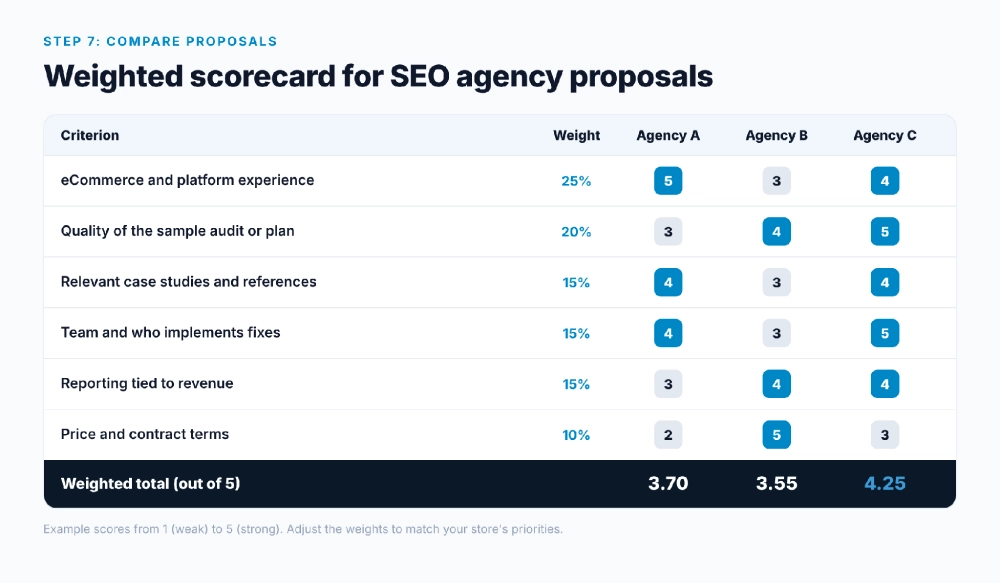
| Criterion | Weight |
|---|---|
| eCommerce and platform experience | 25% |
| Quality of the sample audit or plan | 20% |
| Relevant case studies and references | 15% |
| Team and who implements fixes | 15% |
| Reporting tied to revenue | 15% |
| Price and contract terms | 10% |
Score each agency from 1 to 5 on every criterion, multiply by the weight, and add up the totals. Adjust the weights if, for example, a migration makes platform experience even more important.
Use the reporting criterion to check that results are measured in sales, not only rankings. Our list of top eCommerce KPIs can help you agree on the right measures.
8. Check the Contract Before You Sign
Read the minimum term, the notice period and the list of deliverables carefully. A long contract with no exit clause leaves you stuck if the work does not deliver.
Make sure you own your content, your Google Analytics and Search Console accounts, and any data the agency collects for you. Agree on review points, such as a check at three and six months, and what happens if agreed milestones are missed.
Questions to Ask an SEO Agency Before You Hire
Google’s own guidance on hiring an SEO suggests asking for examples of past work and what results to expect in what timeframe. As a store owner, these are the questions that matter most:
| Question | What a good answer sounds like |
|---|---|
| How will this grow our revenue? | A plan tied to your best-selling categories, with a clear link between the work and sales. |
| What results have you achieved for a store like ours? | Case studies that show organic revenue or orders, not just traffic. |
| How long before we see a return? | An honest timeline with milestones, and no promise of instant results. |
| What will you work on first, and why? | The changes most likely to affect sales, ranked by impact. |
| How will you report results? | Monthly reports that show organic revenue, orders and conversion rate. |
| What is included in the price, and what costs extra? | A clear list of deliverables, hours and any extra fees. |
| How much of my team’s time will you need? | A specific estimate for approvals, content and developer time. |
| How do you protect our sales during a redesign or migration? | A redirect plan and testing before launch. |
| Will our products appear in Google’s AI Overviews and ChatGPT? | No guarantees, but a clear view on what can improve visibility and how to track it. |
If an answer is full of jargon, ask the agency to explain what it means for your sales. A good agency can always do that.
The AI search answer is worth listening to closely. It is a newer area where promises often run ahead of reality. Our guide to AI search for eCommerce explains what realistic AI search work involves, so you can judge an agency’s claims.
Red Flags When Hiring an SEO Agency
Some warning signs are easy to spot once you know them. Walk away, or ask much harder questions, if an agency shows any of these:
- Guaranteed rankings: Google states that no one can guarantee a #1 ranking on Google, and no agency controls its results.
- Shortcuts that risk a penalty: Bought links break Google’s spam policies, and a penalty can cost you organic sales for months.
- Secret methods: A trustworthy agency explains what it does and why.
- Reports with no sales data: Rankings and traffic charts with no link to revenue or orders.
- Agency-owned accounts: Analytics, Search Console and content should always belong to you.
- Long lock-in contracts: A 12-month term with no exit clause protects the agency, not you.
- Guaranteed AI placements: No one can promise your store will appear in AI answers.
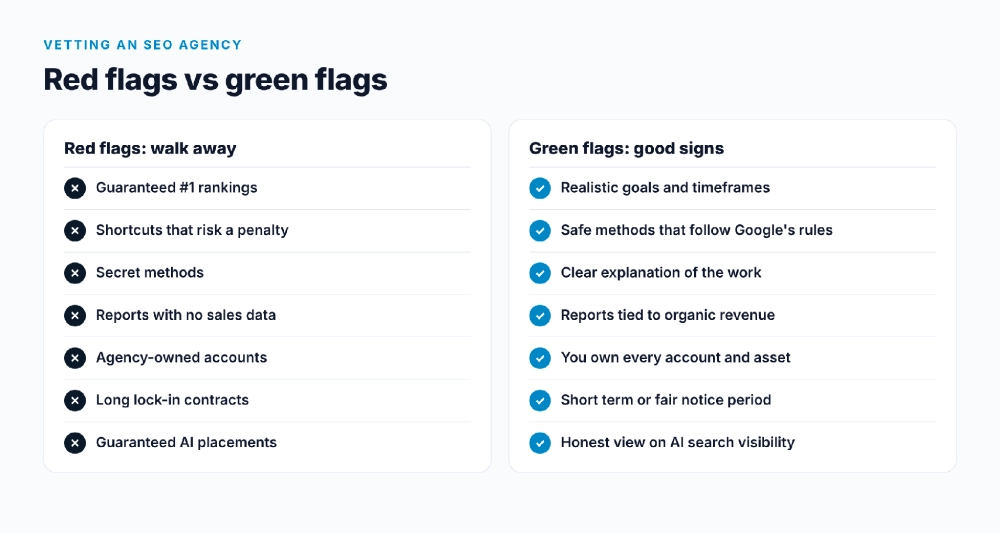
The good signs are the opposite: realistic goals, safe methods, clear explanations, reports tied to sales, full ownership of your accounts and fair contract terms.
How Much Does eCommerce SEO Cost?
SEO pricing varies widely, so survey data is a useful starting point. Ahrefs ran a survey of 439 SEO service providers, last updated in 2024. The average monthly retainer was $2,917, and the most common range was $501 to $1,000 per month.
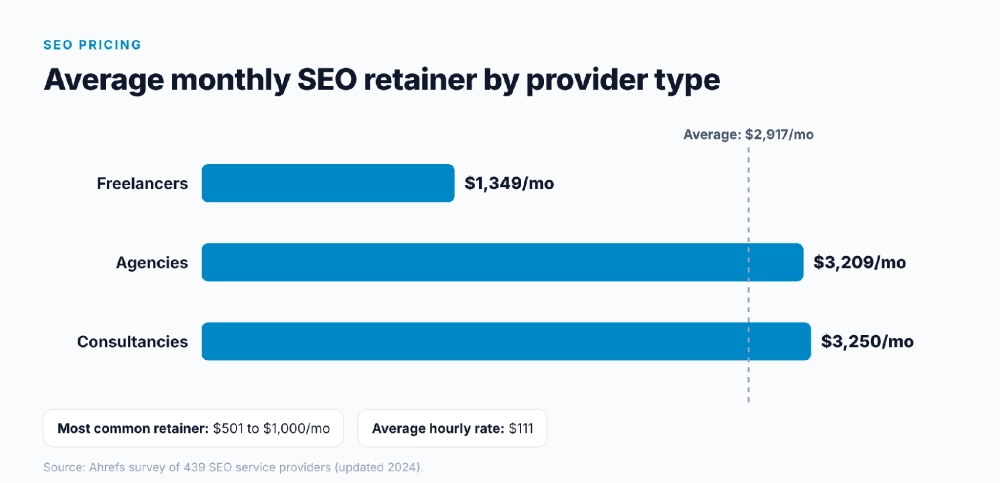
In the same survey, agencies averaged $3,209 a month, consultancies $3,250 and freelancers about $1,349. For eCommerce stores, the price usually depends on:
- Catalog size: More products and categories mean more pages to optimize and more technical risk.
- Technical health: A store with years of technical problems needs more work up front.
- Content needs: Category copy, product descriptions and buying guides all take time to produce.
- Competition: Crowded categories need more content and links from other sites to rank.
- Implementation: Retainers that include developer time cost more but get fixes live faster.
Be cautious with very low prices. If a monthly fee seems too good to be true, ask exactly which tasks and hours it includes. The better question is not what SEO costs, but what it returns.
How to Work Out the ROI of eCommerce SEO
Return on investment (ROI) tells you whether SEO is making you money. For an online store, the simplest version is:
SEO ROI = (extra gross profit from organic sales − total SEO cost) ÷ total SEO cost
Use gross profit, not revenue. A $100 order with a 45% margin earns you $45, and that is the number your SEO spend has to beat.
Here is a simple example. A store earns $40,000 a month from organic search and hires an agency for $3,000 a month, plus about $4,000 of developer time in the first year. Over the year, organic revenue grows steadily to $55,000 a month.
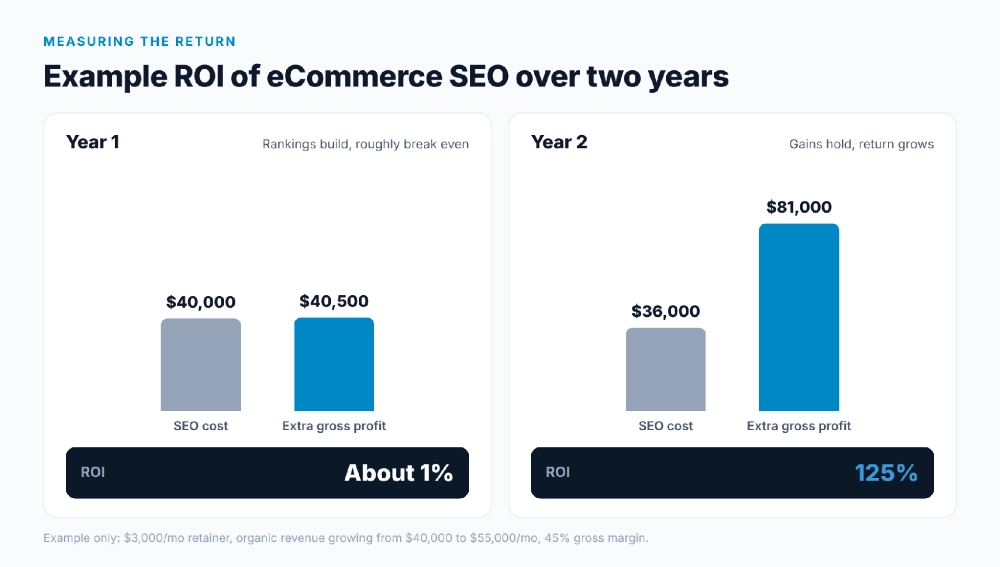
| Example store | Year 1 | Year 2 |
|---|---|---|
| Extra organic revenue | $90,000 | $180,000 |
| Extra gross profit (45% margin) | $40,500 | $81,000 |
| SEO cost (retainer, plus $4,000 developer time in Year 1) | $40,000 | $36,000 |
| ROI | About 1% | 125% |
In this example, SEO roughly breaks even in the first year, while rankings build. In the second year, the gains hold and the same budget earns more than twice its cost in extra gross profit. This is why SEO is usually judged over 12 to 24 months, not one quarter.
These are example figures, not a forecast. To work out your own numbers, keep these points in mind:
- Compare year over year: Seasonal peaks, such as Black Friday, can make month-to-month changes misleading.
- Separate brand searches: Shoppers searching your store name would find you anyway. Growth from non-brand searches shows what the agency added.
- Count every cost: Include developer time, content and tools, not just the retainer.
- Ask the agency to model it: A good agency will build this calculation with your own margins and traffic.
What to Expect From an SEO Agency in the First Six Months
A good agency will be honest that SEO takes time. The first few months usually follow a pattern like this:
- Weeks 1 to 4: Onboarding, account access, a full audit, keyword research and a plan ranked by revenue impact.
- Months 2 to 3: Technical fixes, improvements to key category pages and quick wins on pages that already rank on page two.
- Months 4 to 6: Ongoing content and product page improvements, with early movement in rankings, traffic and orders.
- After six months: Regular reviews of what is driving revenue, and a plan for the next stage of growth.
To get started quickly, have these ready for onboarding: access to your store platform, Google Analytics, Google Search Console, Google Merchant Center and any SEO apps you already use.
How to Tell If Your SEO Agency Is Working
You do not need to read technical reports to know whether SEO is paying off. Check these numbers every month, and compare them with the same month last year:
| What to check | Where to find it | What good looks like |
|---|---|---|
| Organic revenue and orders | Google Analytics 4 | Steady growth year over year |
| Organic conversion rate | Google Analytics 4 | Stable or rising as traffic grows |
| Clicks from non-brand searches | Google Search Console | More clicks for product and category searches |
| Top category pages | Google Search Console | Better positions for your best-selling categories |
| Work completed | The agency’s monthly report | Fixes and pages delivered as planned |
Be concerned if reports keep showing rankings but never sales, if agreed fixes are months late, or if a drop in traffic is never explained.
The early months often focus on work shoppers never see but search engines do. For a jewelry store, our technical SEO work fixed every technical error found in the audit and optimized 1,489 product pages. That is the groundwork later content relies on.
Final Thoughts
Knowing how to choose an SEO company comes down to evidence and fit. The right eCommerce SEO agency understands your platform, can show sales growth for stores like yours, explains its plan in plain language and is clear about who implements each change.
We have spent over 14 years building and optimizing stores on Shopify, BigCommerce and Adobe Commerce. Our eCommerce technical SEO services focus on the product and category pages that bring in revenue, and our developers make the fixes on your platform.
Take your time with the brief, the shortlist and the scorecard. The few weeks you spend choosing will shape the next year of your organic sales, so it pays to compare agencies on the same terms.
If you would like a second opinion on your store’s SEO before you hire anyone, contact our team for an eCommerce SEO review.
Frequently Asked Questions
Many stores see early movement within three to six months, once technical fixes and category page improvements are in place. Larger gains usually build over six to twelve months, depending on competition, catalog size and how quickly changes go live.
There is no standard figure, because it depends on your margins, competition and starting point. Stores with healthy margins and many pages that already rank on page two often see a return sooner. Ask any agency to estimate your return with your own numbers.
Yes, if your store has a large catalog. Filters, duplicate pages, product feeds, platform limits and migrations all need experience that general SEO agencies may not have. Ask to see case studies from stores on your platform.
No. Rankings depend on Google’s algorithms, your competitors and your own site, none of which an agency controls. Realistic goals look different: fixing named problems, improving rankings for priority categories and growing organic revenue over an agreed period.
Yes. Bring an SEO agency in before a migration, not after. It should map every old URL to a new one and test redirects before launch. Our guide to BigCommerce 301 redirects shows the level of detail involved.
Give each person their own login rather than sharing yours, with only the permissions they need. On your store platform, a staff account limited to products, content and themes is usually enough. You can remove it in minutes if the relationship ends.

Related Posts