Adobe Commerce B2B Features: What Magento Gives You Natively, and Where Custom Work Starts

Category
Platform Comparison

Shopify and Printify are two popular eCommerce platforms that provide solutions for businesses looking to set up and manage an online store. These platforms offer various features and tools to help entrepreneurs and small businesses sell products and fulfill orders effectively.
This blog post will dig into a detailed comparison of these two platforms. By the end of this post, you should know which option is the best solution for your eCommerce store.
What is Shopify?
Shopify is a well-known eCommerce platform that caters to businesses of all sizes. It offers a user-friendly interface and robust features to help entrepreneurs build, customize, and manage their online stores. With Shopify, users can easily integrate various payment gateways, manage inventory, track orders, and create a seamless shopping experience for customers.
What is Printify?
Printify is a print-on-demand platform that takes care of product printing and shipping after you make a sale.
Unlike Shopify, it doesn’t provide you with a storefront or a full website. Instead, it connects you with a network of print providers who create custom products like t-shirts, hoodies, mugs, and more on your behalf.
You design your products inside Printify and connect it to your store, whether it’s Shopify, Etsy, or another platform. When a customer places an order, the selected print provider handles everything from printing to packaging and delivery.
This means you don’t need to manage inventory, invest upfront in stock, or deal with logistics, which makes it a low-risk way to start a print-on-demand business.
What makes Printify stand out is its network of print providers.
You’re not limited to a single supplier. For the same product, you can choose between multiple providers based on pricing, location, print quality, and shipping speed. This flexibility gives you more control over your margins and customer experience.
At the same time, it’s important to choose your providers carefully.
The quality and delivery time can vary from one provider to another, so it’s always a good idea to test products by ordering samples before listing them in your store. It helps ensure consistency and avoids potential issues with customer satisfaction later on.
Need Help in Choosing Between Shopify and Printify?
Reach out to us today and get the eCommerce experts’ advice to choose the best platform for your business.
Schedule A Free ConsultationShopify vs Printify: A Detailed Comparison
We’ll compare Shopify vs Printify to see how they stack up against one another in distinct categories in the spirit of healthy competition. Let’s start the fight now since only one will be left in the end!
Product Offerings and Customization Options
Both Shopify and Printify come with interesting features to cater to the needs of their customers. Let’s take a closer look at what each platform has to offer:
Shopify
Shopify is an eCommerce platform allowing stores to set up and manage online stores. In terms of product offerings, Shopify provides a comprehensive selection that includes apparel, accessories, home goods, and more.
- One of the benefits of using Shopify is its extensive library of themes and templates.
- With over 70 professionally designed themes, users can easily customize their online store’s theme, look, and feel to match their brand identity.
- Additionally, Shopify provides a robust set of tools for product customization.
- Users can easily add product variants, assign different pricing options, and offer personalized customer experiences.
Printify
Unlike Shopify, Printify focuses exclusively on print-on-demand products. They have partnered with a vast network of print providers, offering an extensive range of products that can be customized. From t-shirts to caps and hoodies to mugs and phone cases, Printify provides an array of options for businesses looking to create custom merchandise.
- Printify’s key strength lies in its flexibility and variety of product options.
- With multiple print providers, users can select the one that best suits their needs regarding pricing, quality, and shipping options.
- This allows for more excellent choices and customization, enabling businesses to balance budget and product quality.
It also opens the door to private label products, allowing brands to sell customized items under their own label without the need for inventory management.
Printing and Fulfillment Process
When comparing Shopify and Printify, one important facet is the printing and fulfillment process. Both platforms offer solutions for these crucial steps in eCommerce, but there are some differences to be aware of.
Shopify Printing Process
Unlike Printify, Shopify does not provide a direct printing and fulfillment service. Instead, merchants using the Shopify platform can integrate with third-party printing and fulfillment services, such as Printful or Printify — a common approach among those looking to start dropshipping on Shopify without holding inventory.
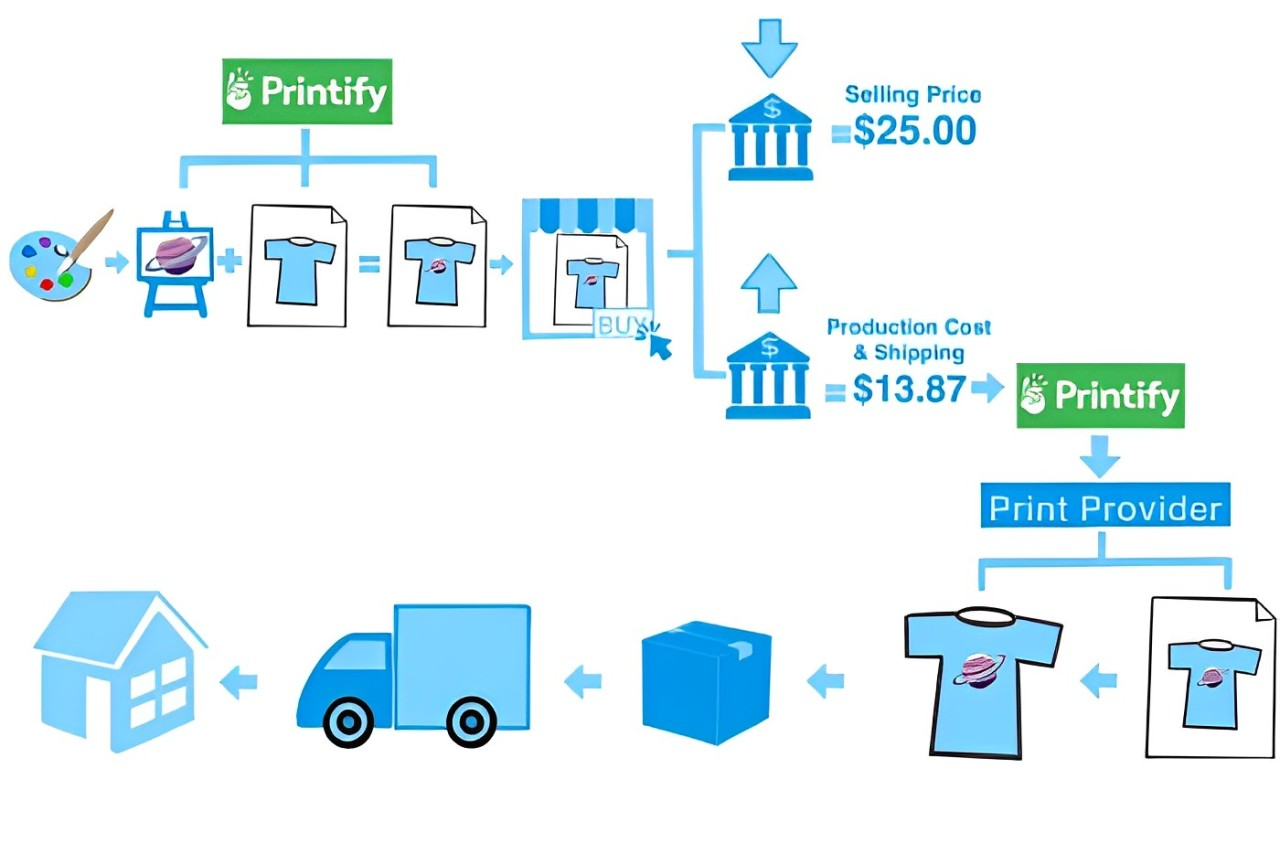
Image Source: ecompath
Shopify offers a variety of integration options, allowing merchants to choose from a range of printing and fulfillment providers. This flexibility enables merchants to find the most suitable printing solution for their business needs and take advantage of different printing partners’ specific features and capabilities.
Many of these integrations are made easier with the help of popular Shopify apps that support automation, product syncing, and order tracking.
Printify Printing Process
Printify is a print-on-demand service connecting merchants with a printing partner network. The process begins when a customer places an order on the merchant’s online store. Printify then automatically sends the order details to the chosen printing partner for production.
Printify offers a plethora of products that can be customized, including apparel, accessories, home decor, and more. Merchants can choose from various printing techniques, such as DTG(Direct-to-Garment) printing, sublimation, and embroidery, depending on the product and printing partner.
Pricing Structure
Businesses must consider the overall eCommerce website costs associated with using a platform like Shopify or Printify. Both platforms offer different pricing models and fee structures that can significantly impact a business’s bottom line.
Shopify
Shopify offers several pricing plans to suit different business sizes. The Basic plan starts at $29 per month when paid annually, while the Grow plan (often listed simply as “Shopify”) starts at $79 per month with annual billing. The Advanced plan starts at $299 per month when paid annually, with more features and lower payment processing fees.
In addition to the monthly fees, Shopify charges payment processing fees on each sale. If you use Shopify Payments, online credit card rates typically start around 2.9% + 30 cents on the Basic plan and go down on higher plans, and Shopify may charge additional fees if you choose a third‑party payment gateway instead of Shopify Payments.
Apart from these core costs, there are a few additional expenses to consider. You may need to purchase a custom domain, which typically costs around $10 to $15 per year. Many store owners also rely on third-party apps to extend functionality, which can range from a few dollars to $50 or more per month, depending on the features. Additionally, premium themes are available if you want a more customized design, usually with a one-time cost between $100 and $400.
Also Read: How Much Does it Cost to Build a Shopify Website?
Printify
Printify, on the other hand, does not charge any monthly subscription fees. It follows a pay-as-you-go model, meaning businesses only pay for the services they use. This can benefit small businesses or those with a low volume of orders, as they do not have to pay a fixed monthly fee.
Instead, Printify charges a flat product fee, including the print-on-demand service and fulfillment costs. This fee varies depending on the product and printing partner chosen. It is important to note that additional fees, such as shipping and handling charges, may be applicable.
For beginners, Printify’s free plan works well as it keeps initial costs low while you test your products and market demand. However, as your order volume increases, upgrading to the Premium plan can become more cost-effective. With higher monthly orders, the discounted product pricing offered under the Premium plan can help improve your overall profit margins.
Integration with Other Platforms
Both Shopify and Printify offer integration with other platforms to enhance your online store’s overall functionality and reach. Here is a comparison of their integration capabilities:
Shopify
- Shopify provides seamless marketplace integration with popular platforms such as Amazon, eBay, Walmart, and Google Shopping, etc..
- It also offers integration with major shipping carriers like UPS, FedEx, and DHL, which streamlines the shipping process and ensures reliable and efficient delivery of orders to customers.
- With Shopify, you can integrate various payment gateways, including PayPal, Stripe, and Shopify Payments, allowing you to offer your customers swift and secure payment options.
Printify
- Printify integrates seamlessly with Shopify, allowing you to create and sell custom-printed products on your Shopify store without any hassle.
- It also offers integration with other eCommerce platforms like WooCommerce, Etsy, and eBay, making it a versatile choice for online sellers looking to expand their presence across different platforms.
- Printify integrates with popular payment gateways like PayPal and Stripe, ensuring safe and secure transactions for your customers. This makes it convenient for you to accept payments from customers worldwide.
Marketing and Sales Tools
Both Shopify and Printify offer a range of marketing and sales tools to help boost your online business. Here’s a comparison of the features they provide:
Shopify
- Integrated social media: Shopify connects your store easily with popular social channels like YouTube, Facebook, Instagram, and TikTok, etc. You can tag products in your posts and run ads to reach a wider audience and sell products directly from those platforms.
- Abandoned cart recovery: This feature sends automated reminders to customers who have added products to their cart but still need to complete the purchase. It helps you recover potentially lost sales by encouraging customers to complete their transactions.
- Discount codes and promotions: Shopify allows you to create and manage discount codes for your products, offering customers incentives to purchase. You can set time-limited promotions and offer free shipping or discounts on specific products or collections. These strategies are especially effective when used as part of a broader effort to increase sales on your Shopify store through targeted marketing and conversion optimization techniques.
- SEO optimization: Shopify provides built-in SEO tools to help improve your store’s visibility in search engine results. You can customize meta tags, URLs, and alt tags for your products, making it easier for interested buyers to find you.
- Email marketing: With Shopify, you can create and send customized email campaigns to engage your customers. You can also automate emails for order confirmation, shipping updates, and abandoned cart recovery.
Printify
- Product personalization: Printify offers a product personalization tool that allows customers to add custom designs, text, or images to their products. This feature can increase customer engagement and boost sales.
- Mockup generator: Printify provides a mockup generator that allows you to create professional-looking product images. You can easily place your designs on different products and showcase them on your online store.
- Product push to marketplaces: Printify integrates with popular marketplaces like Etsy and eBay, allowing you to sync and sell your products on multiple platforms. This expands your reach and widens your customer base.
- Pricing and profit margins: Printify has a dynamic pricing calculator that allows you to set your prices and profit margins for each product. You can adjust prices to maximize profitability while staying competitive in the market.
- Analytics and reporting: Printify provides tools to help you evaluate your store’s performance. You can keep an eye on sales, revenue, and other key metrics to make data-driven decisions to improve your business.
Scalability and Future Growth
Both Shopify and Printify offer scalability and the potential for future business growth.
Shopify
Shopify is known for its scalability and ability to handle businesses of all sizes. Shopify can accommodate you with your business goals whether you’re just starting or have an established company. The platform is designed for colossal traffic and extensive inventories, ensuring your website can handle increased demand as your business grows.
Printify
Printify, on the other hand, is a print-on-demand platform focusing specifically on custom products’ printing and fulfillment. While Printify doesn’t offer the same level of scalability as Shopify, it does provide ample opportunities for growth within its niche market.
Customer Support and Resources
Regarding customer support and resources, Shopify and Printify offer comprehensive options to help their users. Here is a breakdown of their customer support features and resources:
Shopify
- 24/7 Support: Shopify provides round-the-clock customer support through various mediums, including live chat, email, and phone.
- Help Center: Shopify’s Help Center serves as a hub for users to find articles, guides, and tutorials on various topics, from setting up their store to optimizing marketing strategies. The Help Center covers almost all sorts of topics and provides step-by-step instructions for beginners.
- Community Forums: The Shopify Community Forums allows users to connect with other merchants, share experiences, ask questions, and receive help from the community. It’s a great resource for getting other Shopify users’ insights, tips, and advice.
- Shopify Experts: For users who need additional assistance, Shopify Experts are available. These certified professionals can help with web design, development, marketing, and more tasks. Users can hire Shopify experts for specific projects or ongoing support.
Printify
- Knowledge Base: Printify offers an extensive Knowledge Base that includes step-by-step guides, tutorials, FAQ sections, and helpful articles. Users can find product creation, order processing, integration, and more information.
- Email Support: Printify provides customer support via email. Users can submit their queries or concerns and expect a response within a specific time frame.
- Partnerships: Printify has partnered with various print providers and manufacturers to offer users a wide range of products and services.
- Integration Guides: Printify provides integration guides to help users connect their online stores seamlessly to the platform. These guides walk users through integrating Printify with different eCommerce platforms.
Conclusive Thoughts: Which One Should You Get Started With?
After comparing the features, pricing, and performance of Shopify and Printify, it is clear that both platforms have their strengths and weaknesses.
Overall, the choice between Shopify and Printify depends on your business’s specific needs and goals. If you are looking for a comprehensive eCommerce platform with a vast range of features, you should opt for Shopify development. On the other hand, if you are focused solely on selling custom print-on-demand products, Printify offers a more streamlined and cost-effective solution.
If you are about to launch an eCommerce store but want to learn about the process, don’t hesitate to contact us. WebDesk Solution provides top-notch eCommerce development services worldwide. We understand your business needs and offer personalized solutions with feature-rich functionalities.
Frequently Asked Questions
Yes, you can integrate Printify with your Shopify store to create and sell print-on-demand products. You can design products in Printify, publish them to your Shopify store, and when a customer places an order, Printify automatically handles printing and shipping. This allows you to run your store without managing inventory or logistics.
No, Printify does not provide website-building features. It is primarily a print-on-demand platform that integrates with eCommerce platforms like Shopify. You will still need to have a website or an online store set up, such as Shopify, to use Printify effectively.
Shopify does charge transaction fees on their lower-tier plans, but these fees can be waived if you use Shopify Payments as your payment gateway. Printify, on the other hand, does not charge any transaction fees for the products you sell using their platform.