
eCommerce ERP Integration: What Connects, What Breaks, and How to Scope It

Category
eCommerce Tips & Trends

Is your eCommerce store struggling to meet the customer expectations and holding you to grow? Choose Composable Commerce. It is a game-changing approach offering flexibility and agility for developing an eCommerce solution that provides a next-gen shopping experience.
In other words, composable commerce allows businesses to utilize various technologies to build a tailored solution that satisfies the user’s needs, which is not possible in the traditional monolithic architecture. It is similar to assembling different pieces in a LEGO game.
According to a report by eMarketer, around 72% of businesses have already opted for composable commerce to build cohesive eCommerce solutions.
This indicates it’s high time for IT professionals, business owners, and decision-makers to consider composable commerce to enhance their digital experiences and continuously serve ever-changing consumer trends. With composable commerce, you can build an eCommerce store that offers excellent customization and responsiveness.
In this blog, we will walk you through the composable commerce definition, architecture, and key advantages it offers. From improved flexibility in design to delivering next-gen customer experiences, we will explain why businesses continuously adopt composable commerce.
What is Composable Commerce?
Composable commerce is a modern eCommerce approach that enables businesses to identify and integrate the best-of-the-breed components to build a solution that aligns with their business needs and enhances customer experiences. Think of it as a selection of APIs and microservices combined to create an eCommerce ecosystem that helps deliver a unique digital storefront across multiple channels and touchpoints.
Compared to traditional commerce, where businesses are confined to a one-size-fits-all approach with limited functionality, composable commerce allows you to swap and upgrade components as needed. This makes composable commerce significantly more agile than traditional architecture.
To understand it better, let’s look at the essential components of composable commerce:
Modular: Every component of the system operates independently, allowing these components to be deployed, updated, and replaced without disrupting the entire system.
Open: The system supports seamless integration across applications, increasing compatibility and eliminating vendor lock-in.
Flexible: Businesses can craft a unique technology stack to develop an eCommerce experience that aligns well with their specific requirements.
Business-Centric: Merchants have the freedom to respond quickly and cost-effectively to changes in their business needs, enhancing responsiveness and adaptability.
Composable Commerce vs Headless Commerce
Many people often get confused between composable commerce and headless commerce. Even though they have certain similarities, they differ in scope.

Headless commerce enables businesses to separate the front end (presentation layer) from the back end (eCommerce engine layer) to offer more design flexibility. On the contrary, composable commerce allows businesses to choose the most suitable components for both the front end and back end to build a custom tech stack that solves complex business problems at scale.
For a deeper comparison of how traditional and modern systems differ, explore our guide on traditional CMS vs headless CMS.
MACH Architecture: The Foundation of Composable Commerce
MACH architecture is the foundation of composable commerce, offering a modern and future-proof framework for developing advanced eCommerce solutions. This architecture comprises four essential components: Microservices-based, API-first, Cloud-native, and Headless. It provides businesses the flexibility to develop scalable, customizable eCommerce experiences using best-in-class technologies.

Let’s explore these components in detail:
- Microservices-based:
These are loosely coupled, independently deployable services that handle specific functions such as payment processing, cart functionality, or inventory management. This modular approach allows businesses to update, scale, or replace individual components without affecting the entire system, improving operational efficiency and reducing downtime.
- API-First:
The API layer acts as a bridge between various systems and services, ensuring seamless communication between components, regardless of the vendor. By focusing on APIs, businesses can connect new features, update existing ones, or integrate third-party services, enhancing the user experience. This makes the composable commerce architecture versatile and interconnected.
- Cloud-native:
Built for cloud environments, this architecture offers on-demand computing, automatic scalability, high availability, enhanced performance, and reliability through platforms like Google Cloud and AWS.
During peak shopping periods, businesses can allocate more resources to critical components, such as checkout and payment processing, to improve the customer experience. Additionally, the pay-as-you-go model reduces costs by charging based on consumption.
- Headless:
The headless component removes the front-end presentation layer from the backend logic, offering key advantages like flexibility and omnichannel capabilities. Learn more about the benefits of headless commerce in our detailed guide. This separation allows businesses to deliver consistent experiences across multiple touchpoints, such as mobile, IoT devices, and other channels, while maintaining robust backend functionality.
It ensures that changes in one layer don’t affect the other, increasing agility and allowing seamless user interaction with the brand, regardless of the device. Many businesses are now leveraging headless commerce development to enable this flexible architecture and improve digital performance across platforms.
Advantages of Composable Commerce
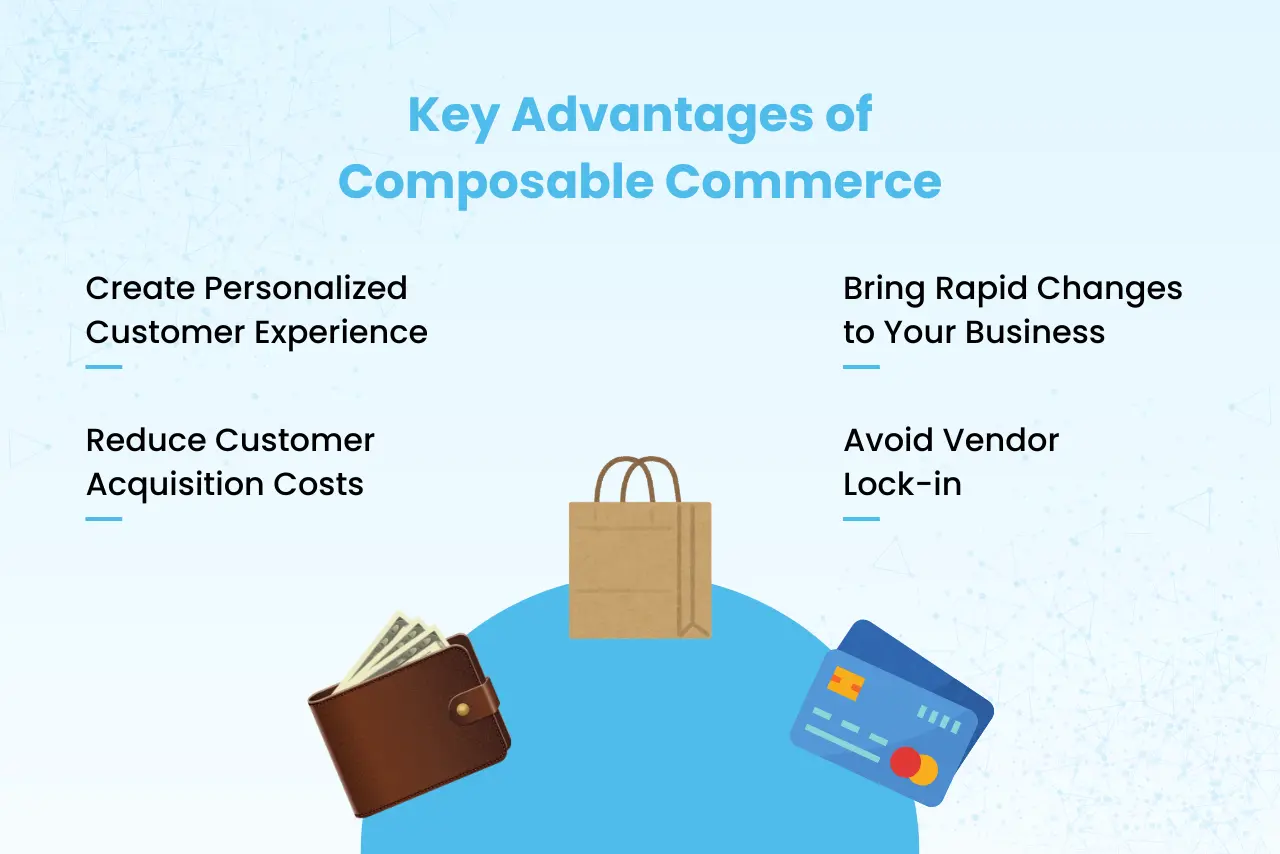
Here are some of the most essential advantages of considering composable commerce.
Flexibility and Agility
Composable commerce empowers businesses to select vendors that can mix and match various components, creating a technology stack tailored to specific requirements. This modular approach offers greater flexibility, allowing businesses to swap out features, integrate new functionalities, or replace components as needed, rather than relying solely on a single vendor for all functionalities.
Scalability and Future-Proofing
Composable commerce enables businesses to scale their eCommerce operations seamlessly. Each component operates independently, allowing organizations to add or remove resources based on demand. This modular architecture supports growth without the limitations of traditional systems, ensuring adaptability to changing customer needs and emerging technological advancements.
Enhanced Customer Experience
With composable commerce, businesses can offer highly personalized shopping experiences that cater to customer preferences across various channels. The integration of specialized tools for analytics, user behavior tracking, and marketing enhances engagement and satisfaction. This focus on customer experience helps build loyalty and encourages repeat business.
Faster Time to Market
Composable commerce accelerates the time to market by allowing businesses to deploy, test, and launch components independently. The modular approach reduces lengthy deployment cycles, enabling businesses to respond quickly to market trends and evolving customer expectations.
Cost Efficiency
The pay-as-you-go model in composable commerce leads to significant cost savings. By selecting only the necessary components and services, businesses avoid hefty licensing fees associated with monolithic platforms. Additionally, the ability to scale resources efficiently minimizes waste, optimizes budget allocation, and improves ROI. This cost efficiency makes composable commerce a strategic choice for scaling operations.
Conclusion
Composable commerce offers businesses the flexibility, scalability, and innovation needed to succeed in today’s competitive landscape. By leveraging MACH architecture, your eCommerce solution can adapt seamlessly to evolving market demands. Now is the time to consider composable commerce to stay ahead, innovate quickly, and deliver exceptional value to your customers.
If you’re looking to develop an eCommerce solution using composable commerce, contact us today. WebDesk Solution is a leading eCommerce development company, delivering top-notch eCommerce solutions to businesses globally. Our deep understanding of your unique needs allows us to create robust, scalable, and reliable eCommerce solutions that align with your business goals.

Related Posts